
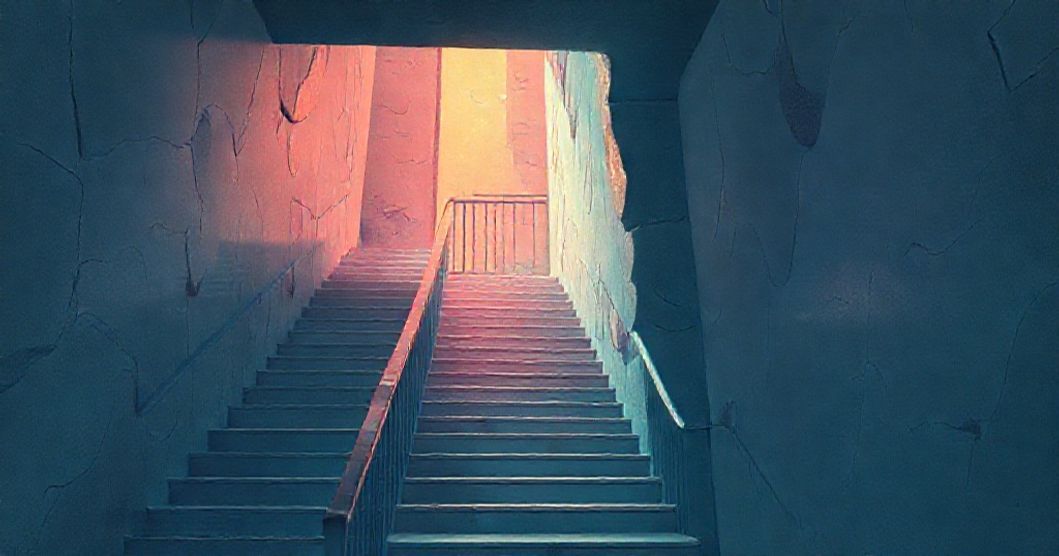
Part 1: Dream Presentation
The uncanny sensation of stepping into a moment that shouldn’t feel familiar jolted me from my ordinary awareness yesterday—a vivid Deja Vu that unfolded like a flickering film reel. For just a heartbeat, I stood in a space I recognized instantly, yet it couldn’t have been more than a few seconds before the clarity returned. The scene? A small staircase, its wooden steps worn smooth from countless footsteps, and in my hands, a slice of pizza still warm from the oven, its cheese stretching slightly as I brought it to my mouth. The air carried the faint scent of garlic and tomato sauce, mingling with the cool draft from an open window above the staircase. This wasn’t just any moment—it was a memory I’d carried with me for over a year, a fragment of a dream that had materialized in waking life, though I couldn’t recall the full context of the dream itself. The details were sharp: the texture of the pizza crust, the way the light filtered through the window panes, the subtle creak of the staircase as I descended. What struck me most was the emotional weight of it all—the quiet dread that settled over me like a shroud, even as my rational mind insisted this was merely my brain’s knack for pattern recognition. Why did it feel so profoundly disturbing to recognize something so ordinary as a dream snippet, yet feel so alien in its familiarity? The question lingered, tangled with the lingering taste of pizza and the echo of that creaky staircase.
Part 2: Clinical Analysis
Symbolic Landscape: The Staircase, Pizza, and the 'Future Snippet'
Want a More Personalized Interpretation?
Get your own AI-powered dream analysis tailored specifically to your dream
🔮Try Dream Analysis FreeIn dream psychology, the staircase emerges as a universal symbol of transition, growth, and psychological ascent or descent. Looking down a staircase often represents reflection on past experiences or anticipation of future paths, while ascending typically signifies ambition or new challenges. In this dream, the act of descending (or standing at the top, looking down) suggests a moment of retrospective awareness—a pause to examine life’s 'steps' and their outcomes. The pizza, a comfort food associated with pleasure and indulgence, introduces themes of nourishment, contentment, or unresolved desires. Its presence in a dream context may reflect the dreamer’s need for emotional sustenance or a longing for simpler pleasures amid life’s complexities.
The 'snippet' of future (Deja Vu) introduces a layer of temporal ambiguity. In dreamwork, such fragments often represent repressed memories or the brain’s natural tendency to connect disparate experiences—a phenomenon known as 'patternicity,' where our minds seek meaning in randomness. The emotional disturbance arises not from the content of the dream itself but from the dissonance between the dream’s apparent 'predictive' nature and the logical explanation of memory overlap.
Psychological Currents: Theories of Memory, Cognition, and the Unconscious
From a cognitive perspective, Deja Vu can be explained by the brain’s dual processing systems: one pathway that processes a memory normally, while another (perhaps the hippocampus or temporal lobe) momentarily misfires, creating the illusion of novelty. This aligns with Freud’s concept of 'screen memories'—subconscious fragments that surface to protect against deeper emotional content. Jung, meanwhile, might frame this as synchronicity: meaningful coincidences where the unconscious communicates through seemingly disconnected events.
Neuroscientific research suggests that dreams consolidate memory by integrating neural patterns, and Deja Vu occurs when these patterns momentarily overlap with waking experiences. The dreamer’s disturbance reflects a deeper existential question: if our minds can 'predict' future experiences (even inaccurately), does this challenge our sense of free will or control over our present moment? This tension between perceived premonition and biological explanation creates the emotional dissonance.
Emotional and Life Context: Uncertainty and the Need for Grounding
The dream likely arises from a period of life transition or uncertainty, where the dreamer feels adrift in patterns they cannot fully control. The pizza, as a comfort symbol, may represent an attempt to hold onto stability amid change, while the staircase embodies the feeling of navigating unknown territory. The 'future snippet' Deja Vu amplifies anxiety about life’s unpredictability, triggering a primal fear of losing control over one’s narrative.
In clinical practice, such experiences often correlate with stress, burnout, or unprocessed emotions. The brain’s tendency to 'fill in gaps' with dream fragments can feel threatening when we lack clarity about our waking goals or identity. The dreamer’s question—'why does it feel so disturbing?'—reveals a deeper need for understanding: not just the mechanics of the mind but the emotional resonance of these experiences.
Therapeutic Insights: Bridging the Dream-Waking Divide
For the dreamer, this experience offers an opportunity to explore the gap between perceived 'prediction' and present-moment awareness. Reflective practices like journaling dream fragments immediately upon waking can help distinguish between true precognition and memory errors. Mindfulness exercises, such as 5-4-3-2-1 grounding (identifying five sights, four sounds, etc.), can anchor the dreamer in the present, reducing anxiety about future 'snippets.'
Therapeutic work might involve exploring life transitions and unprocessed emotions. The staircase could symbolize a path that needs intentional navigation, while the pizza invites reconnection with simple joys. By acknowledging the dream’s message as a call to integrate past experiences with present choices, the dreamer can transform the 'disturbing' Deja Vu into a tool for self-awareness.
FAQ Section
Q: Is this a sign of true precognition or just memory confusion?
A: Most likely, it reflects memory overlap and pattern recognition. The brain’s tendency to connect unrelated experiences creates the illusion of prediction, though rigorous scientific testing would be needed to confirm precognition, which remains controversial.
Q: Why does this feel emotionally disturbing?
A: The disturbance stems from the existential tension between the brain’s predictive capacity and our desire for control. The dream’s 'future' snippet threatens to undermine feelings of agency, triggering primal fears of being swept by unforeseen forces.
Q: How can I differentiate between meaningful dream recall and random memory mixing?
A: Journaling details immediately, noting emotional tone, and reflecting on waking life connections can help. If these 'snippets' persist and cause distress, consider exploring underlying anxieties through therapy.