
Part 1: Dream Presentation
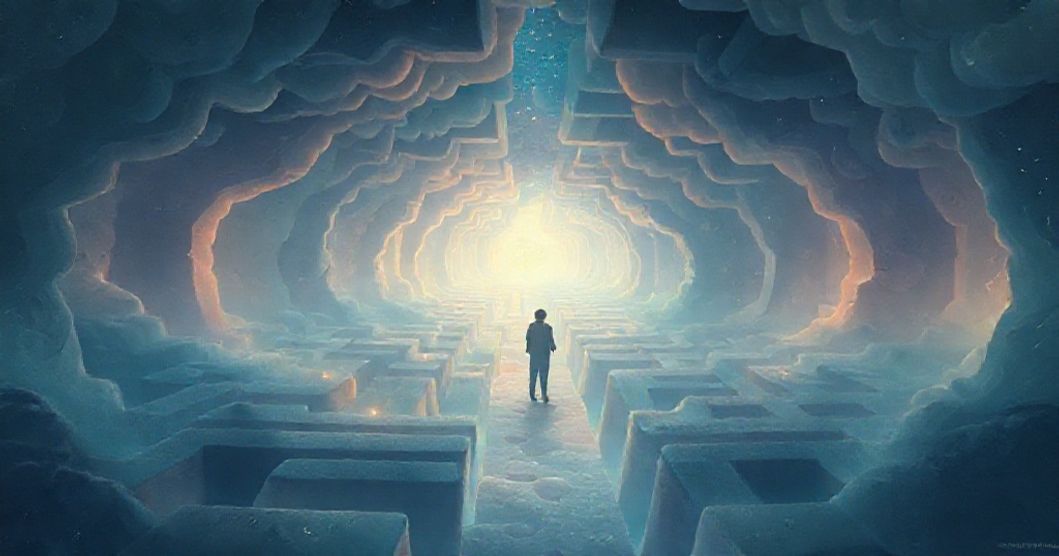
Dreams often blur the boundaries between past, present, and future, and this dream masterfully embodies that fluidity through its exploration of temporal confusion. The dreamer finds themselves in a hallway where walls shift like water, a recurring motif of instability that mirrors the subjective nature of memory itself. The staircase, a symbol of transition and ascent/descent, becomes a literal loop, suggesting the cyclical nature of dream recall and the difficulty of distinguishing between remembered and newly experienced dreams.
The calendar, with its melting numbers and overlapping dates, serves as a powerful visual metaphor for the dreamer’s core confusion: the inability to anchor a dream’s timing in a fixed past or present. The recurring ‘12’ and ‘6’—numbers that lack definitive meaning on their own but carry emotional weight through repetition—represent the dreamer’s struggle to reconcile subjective experience with objective time. When the dreamer touches the calendar and sees a date from ‘months ago,’ yet the room itself feels new, they confront the paradox of memory: we experience dreams as if they belong to a distant past, even when they emerge from the immediate present.
Part 2: Clinical Analysis
Want a More Personalized Interpretation?
Get your own AI-powered dream analysis tailored specifically to your dream
🔮Try Dream Analysis FreeSymbolic Landscape: The Temporal Paradox
The dream’s central symbol—the shifting hallway with its melting walls—represents the malleable nature of memory in dreams. In psychoanalysis, such architectural instability often reflects the dreamer’s unconscious uncertainty about identity and continuity. The staircase, a Jungian symbol of psychological growth and transformation, becomes a literal loop here, suggesting the dreamer is caught in a cycle of questioning rather than resolution. The calendar, with its overlapping dates, embodies the cognitive dissonance between the dreamer’s subjective timeline (where dreams feel timeless) and the objective reality of time. This is not merely a dream about forgetting; it is a dream about remembering—and the anxiety that accompanies the realization that our minds cannot reliably anchor experiences in a fixed past.
Psychological Perspectives: The Architecture of Dream Memory
From a Freudian lens, the dream’s temporal confusion might reflect repressed memories or unresolved conflicts that the unconscious is struggling to process. Freud believed dreams were the ‘royal road to the unconscious,’ and here, the dreamer’s confusion about dream timing could signal an unconscious attempt to revisit past experiences (even if they never truly occurred) without the clarity of waking memory. Jung, meanwhile, would interpret the recurring symbols and temporal loops as manifestations of the collective unconscious—the dreamer’s psyche reaching out to universal patterns of memory and time.
Cognitive neuroscience offers another perspective: dreams occur during rapid eye movement (REM) sleep, and our brains often construct coherent narratives from fragmented neural activity. The dreamer’s confusion arises because the brain’s memory consolidation process blurs the line between recent and ‘distant’ dreams, especially when emotional themes repeat. The brain’s default mode network, active during self-referential thinking, may be amplifying this confusion by creating a narrative of ‘past’ dreams that never existed outside the current moment.
Emotional & Life Context: The Anxiety of Temporal Disruption
The dream’s timing confusion likely reflects waking life stressors related to identity, purpose, or time management. When we feel uncertain about our past experiences, it often signals underlying anxieties about how we’re spending our time or whether we’re on track with life goals. The dreamer’s question—When did I have this dream?—echoes a deeper uncertainty: When did I live this life? or What have I accomplished? These existential questions manifest in the dream as literal temporal confusion, as the mind struggles to map internal experiences onto external time.
Additionally, the dream may emerge during periods of transition or decision-making. When we face choices that feel weighty, our unconscious processes these by creating narratives that question the validity of our past actions and future paths. The dream’s circular staircase and melting dates thus symbolize the anxiety of not knowing where we’ve been, where we are, or where we’re going—a common emotional state in periods of life change.
Therapeutic Insights: Navigating Dream Memory with Awareness
For the dreamer, this dream offers an opportunity to practice temporal awareness in waking life. Keeping a dream journal, noting both the emotional tone and specific details of dreams, can help anchor experiences in time. When confusion arises, asking: What sensory details or emotions felt familiar? can distinguish between true memories and dream fragments. Mindfulness practices, particularly those focusing on present-moment awareness, can help the dreamer separate subjective time (where dreams feel timeless) from objective time (where events are fixed).
Therapeutically, this dream suggests exploring underlying identity issues. Journaling prompts like “What does ‘knowing’ my dream time mean to me?” can reveal deeper anxieties about self-worth or purpose. By recognizing the dream as a reflection of temporal uncertainty, the dreamer can begin to reframe these feelings as opportunities for self-discovery rather than sources of confusion.
FAQ Section
Q: Why do dreams feel like they happened months ago when they’re recent?
A: Dreams activate the same memory pathways as waking experiences, but their emotional intensity can make them feel ‘older’ than they are. Our brains often contextualize dreams with earlier memories, creating a false sense of temporal distance.
Q: Is confusion about dream timing a sign of mental health issues?
A: Occasional confusion is normal, but persistent disorientation may indicate sleep disorders or anxiety. If it interferes with daily life, consider consulting a sleep specialist or therapist.
Q: How can I tell if a ‘part 2’ of a dream is real or my mind’s creation?
A: Ask yourself: What details changed? If the ‘new’ elements feel emotionally consistent but lack concrete details, it may be a continuation of the same dream. Keep a dream journal to track recurring symbols over time.