
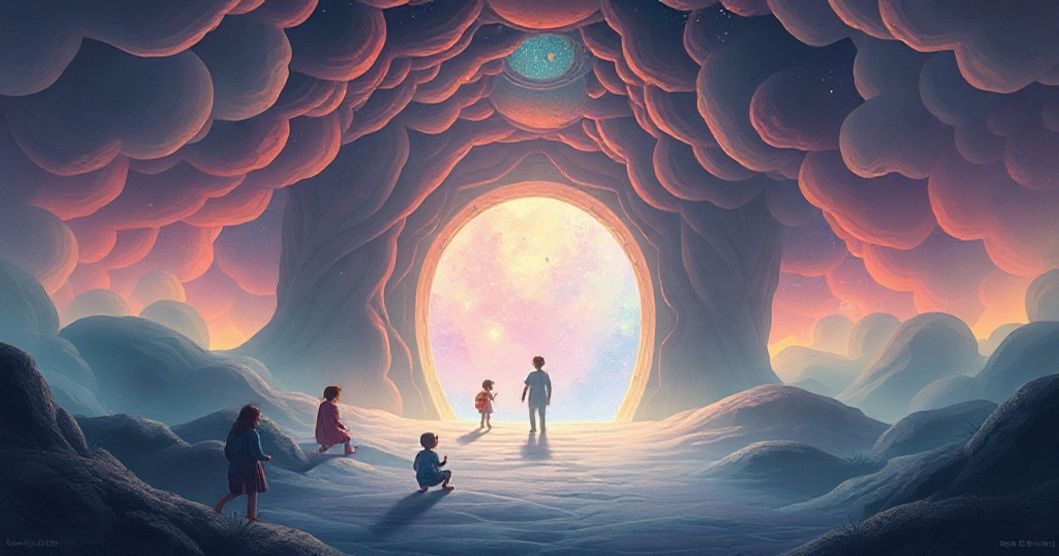
Part 1: Dream Presentation
Dreams often serve as psychological blueprints, revealing hidden connections between our conscious and unconscious lives. In this particular dream, the mind constructs a vividly organized realm—a hub reminiscent of Disney’s iconic central plaza—where distinct, themed areas radiate outward from a central point. The dreamer describes this space as “The Arcade,” a dreamscape that feels both familiar and deeply personal, with pathways leading to swimming pools, theme parks, schools, and arcades, all anchored by a grand cinema. This central hub, where the dreamer has conversed with a figure named “Gemini,” embodies a powerful metaphor for the integration of fragmented aspects of self, while the contrast between “The Arcade” and the “mechanical realm” of waking life suggests a yearning to reconcile playfulness with responsibility.
The dream unfolds as a carefully ordered landscape: a central cinema serves as the threshold, with each adjacent door opening to a distinct domain. To the left, a shimmering swimming pool evokes fluidity and emotional depth; straight ahead, a theme park represents adventure and ambition; to the right, a schoolyard speaks to learning and growth; and beyond, an arcade embodies creativity and nostalgia. The dreamer’s use of “Gemini” as a conversational figure hints at a dialogue between conscious thought and deeper intuition, while the “mechanical realm” of waking life contrasts sharply with the dream’s organic, unstructured energy.
Part 2: Clinical Analysis
Want a More Personalized Interpretation?
Get your own AI-powered dream analysis tailored specifically to your dream
🔮Try Dream Analysis FreeSymbolic Landscape: The Hub as Self-Organization
The “hub” structure in dreams typically represents the ego’s attempt to organize disparate aspects of experience into a coherent whole. Here, the dreamer’s hub—modeled after Disney’s Magic Kingdom—reflects a cultural archetype of “order within chaos,” a place where boundaries between experiences are both maintained and transcended. The central cinema, with its doors leading to diverse domains, symbolizes the ego’s role as a portal between conscious awareness and the unconscious. In psychoanalytic terms, this central space could be interpreted as the dreamer’s “collective self,” where different life experiences converge.
The themed areas themselves are rich with symbolic meaning: the swimming pool, with its “unnatural clarity,” suggests emotional depth and fluidity; the theme park, with “impossible loops,” embodies the dreamer’s willingness to take risks and embrace the unexpected; the schoolyard, with its “chalk drawings of forgotten dreams,” hints at repressed aspirations or unfulfilled childhood potential; and the arcade, with its “vintage pinball machines,” represents nostalgia and playful creativity. Each space is not merely a location but a metaphor for a different aspect of the dreamer’s psyche, organized around a central, unifying force—the cinema.
Psychological Undercurrents: Jungian and Freudian Perspectives
From a Jungian perspective, “The Arcade” functions as a mandala—a symbolic center representing the self’s attempt at wholeness. The mandala structure (central hub with radiating paths) is a classic Jungian symbol of psychological integration, suggesting the dreamer is actively seeking to reconcile fragmented parts of their personality. The “Gemini” figure, conversing about correlations between inner child and adult life, aligns with Jung’s concept of the shadow and animus/animus archetypes—parts of the psyche that often manifest in dreams as guiding figures.
Freud might interpret the dream as a manifestation of repressed desires and unconscious conflicts. The “mechanical realm” as the “upper level” of reality contrasts with the dream’s “second story” subconscious, suggesting the dreamer feels the real world lacks the spontaneity and playfulness of their inner life. The cinema, as a portal to different worlds, could represent the dreamer’s need to escape or explore alternative identities—a common Freudian theme of wish fulfillment.
Neuroscientifically, this dream reflects the brain’s default mode network, which activates during rest and is responsible for self-referential thought, memory, and imagination. The detailed, organized nature of the dream suggests the brain is working to integrate recent experiences and emotions into a coherent narrative—a process known as “dream consolidation.”
Emotional and Life Context: Bridging Inner and Outer Realities
The dream’s contrast between “The Arcade” and “The mechanical realm” likely reflects the dreamer’s relationship with structure and spontaneity in waking life. The “mechanical realm” implies a world governed by logic, routine, and responsibility, while “The Arcade” offers a space of creativity, play, and emotional freedom. This dichotomy may signal a period of transition or tension between adult responsibilities and the desire to reconnect with childhood curiosity.
The “Gemini” conversation suggests the dreamer is processing dual aspects of self: the disciplined, “mechanical” adult and the playful, creative inner child. The schoolyard, with its “forgotten dreams,” hints at unfulfilled potential or educational experiences that left an emotional residue. The theme park, with its “impossible loops,” might reflect the dreamer’s need to take risks in a controlled environment, perhaps in career or relationships.
Therapeutic Insights: From Dream to Self-Awareness
This dream offers valuable clues for self-reflection. The first step is to map waking life domains to the dream’s themed areas: Is the swimming pool a metaphor for emotional expression? The schoolyard, for learning or growth? By identifying which real-world areas correspond to each dream space, the dreamer can begin to understand which aspects of their life feel “integrated” and which feel neglected.
A practical exercise is to journal about each themed area, noting emotions, memories, and current life situations associated with them. For example, if the theme park evokes excitement, explore if this relates to career aspirations or social connections. The central cinema, as a portal, suggests the dreamer should revisit these domains with curiosity rather than judgment, allowing the unconscious to guide exploration.
Long-term integration involves creating “dream-like” spaces in waking life—moments of play, creativity, or unstructured time that honor the “Arcade” aspect of self. This could mean scheduling regular “adventure time” or engaging in creative hobbies that feel childlike yet purposeful. The “Gemini” figure, as an inner voice, encourages the dreamer to listen to both the “mechanical” and “arcade” parts of themselves, recognizing that neither is inherently good or bad—only different expressions of the self.
FAQ Section
Q: What does the central cinema symbolize in dream analysis?
A: The cinema represents the dreamer’s ego as a portal between conscious awareness and the unconscious, with auditoriums as gateways to different aspects of self. It suggests a need to process experiences through narrative and perspective.
Q: Why contrast “The Arcade” with “The mechanical realm”?
A: This dichotomy reflects the dreamer’s relationship with structure vs. spontaneity, likely signaling a desire to integrate playful creativity with adult responsibility in waking life.
Q: How can the dreamer use this insight practically?
A: Map waking life domains to dream areas, journal about emotions tied to each, and create intentional “arcade-like” spaces in daily life to honor both structure and playfulness.