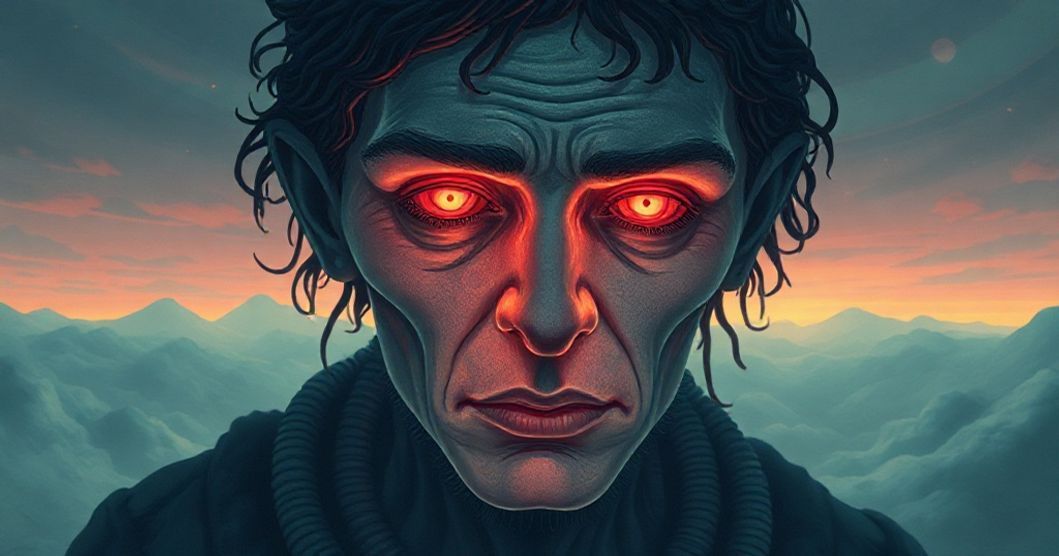
Part 1: Dream Presentation\n\nDreams serve as the subconscious’s canvas, painting portraits of our deepest desires, fears, and unresolved tensions through symbolic imagery. Five or six years ago, I encountered a most extraordinary figure in one such dream—whom I later came to call Thingamajig, though that name felt more like a placeholder for the enigma he embodied. His form was distinctly otherworldly: instead of a conventional head, he bore a foot, its sole marked by the rugged lines of a well-worn boot; his chest displayed a single, luminous eye that seemed to observe the world with a quiet, unblinking curiosity; beneath his shoulder blade, a mouth curved in perpetual motion, speaking without words. His hands, long and sinewy, ended in hooked fingers that moved with a predatory grace, as if designed for both creation and capture.\n\nStrangely, his presence carried dual sensory signatures: a rich aroma of smoked cheese, earthy and comforting, mingling with the sharp tang of machine oil, evoking the scent of a well-loved workshop. He lived in a cluttered garage, walls lined with half-finished projects, tools, and the detritus of forgotten dreams—yet within this chaos, he brewed coffee with meticulous care, the steam curling upward in lazy spirals as he stirred. Beyond his mechanical talents, Thingamajig was an artist: he crafted custom bicycles from discarded parts, each frame a testament to his ingenuity, while in the evenings, he’d sit beneath a battered guitar, strumming melodies that seemed to pour from some hidden well of emotion. His voice, when he spoke, was a rich high baritone, slightly rough at the edges, as if years of smoking and singing had left their mark—a sound both commanding and tender.\n\nWe spent the dream’s duration simply being together: no grand adventures, just quiet moments of shared presence, the kind that lingers long after waking. When we parted, it was as friends—no romantic tension, only a sense of mutual understanding. The dream’s visual manifestation, as depicted in the accompanying image, was crafted through digital tools, yet the essence of Thingamajig remains indelible: a paradoxical figure of both comfort and mystery, blending the practical and the poetic in a way that defied easy categorization.\n\n## Part 2: Clinical Analysis\n\n### Symbolic Landscape: The Multifaceted Form of Thingamajig\n\nThe dream’s most striking element is Thingamajig’s surreal anatomy, each feature laden with symbolic weight. The foot serving as a head invites exploration of the “grounding” vs. “head” functions: feet traditionally represent stability, practicality, and connection to the physical world, while heads signify thought, intellect, and identity. Here, the foot-head may suggest a prioritization of instinctual knowing over abstract thinking—a shift toward trusting bodily wisdom over cerebral analysis.\n\nThe single eye on his chest further complicates this duality: eyes represent vision, insight, and self-awareness. Placing it in the chest (the seat of emotion and intuition) suggests that perception arises from the heart rather than the mind, signaling a dreamer attuned to emotional intelligence over rational judgment. The mouth on his back, meanwhile, hints at communication rooted in the past or hidden motivations—speaking from behind, as if sharing truths not yet fully acknowledged in waking life.\n\nThe hooked fingers, though unusual, carry their own symbolism: their predatory curve suggests both creation (crafting something new) and capture (securing inspiration or opportunities). This duality mirrors the tension between action and receptivity, a common theme in dreams where the unconscious seeks balance between initiative and surrender.\n\n### Psychological Currents: Jungian and Freudian Perspectives\n\nFrom a Jungian lens, Thingamajig embodies the shadow archetype—a collection of repressed or unintegrated aspects of self that demand recognition. The surreal physicality reflects the shadow’s chaotic, multifaceted nature: we cannot contain it within neat categories, yet it offers vital insights into parts of ourselves we may resist. Jung’s concept of the “animus” (the masculine aspect of the feminine psyche) might also apply here, as Thingamajig’s dual talents (mechanical and artistic) could represent the animus’s potential for both practicality and creativity.\n\nFreudian theory, by contrast, might interpret the dream as a form of wish fulfillment or unconscious conflict. The conflicting sensory details (smoked cheese and machine oil) could reflect competing desires: the comforting, earthy “cheese” evokes nurturance and tradition, while “machine oil” signals innovation and progress. This tension between preservation and transformation is classic Freudian territory, where dreams resolve internal dissonance through symbolic representation.\n\nCognitive neuroscience adds another layer: dreams construct narratives by weaving together disparate neural patterns, often repurposing waking experiences into surreal scenarios. Thingamajig’s garage, for example, might stem from the dreamer’s memories of a workshop or creative space, while his dual talents reflect the brain’s natural tendency to merge seemingly unrelated skills into cohesive identity.\n\n### Emotional & Life Context: The Unconscious’s Call for Integration\n\nThe dream’s timing (five or six years ago) suggests it may have emerged during a period of significant life transition, perhaps a time when the dreamer was navigating competing life demands. Thingamajig’s garagedomesticity—the space between order and chaos—mirrors the dreamer’s internal landscape: a creative repository where old tools and new ideas coexist. His ability to brew coffee (nurturance) and build bicycles (creation) reflects a need to balance self-care with purposeful action.\n\nThe dual sensory experiences (smoked cheese and machine oil) are particularly telling: the “cheese” evokes nostalgia for comfort, while “machine oil” signals practicality. This contrast may reflect the dreamer’s struggle to reconcile comfort with productivity, or perhaps a longing for a partner who can hold both the warmth of home and the excitement of adventure.\n\nThe dream’s conclusion—parting as friends—suggests a resolution to potential tension or a recognition of the relationship’s true nature: Thingamajig is not a romantic ideal but a symbol of healthy connection, where authenticity trumps perfection. This aligns with the dreamer’s need to embrace imperfection in relationships, finding value in the “unusual” rather than the conventional.\n\n### Therapeutic Insights: Embracing the Shadow Self\n\nFor the dreamer, Thingamajig offers a powerful invitation to integrate conflicting aspects of self. The surreal form reminds us that wholeness does not require uniformity; instead, it thrives on the interplay of seemingly contradictory traits. Practical steps might include:\n\n1. Shadow Integration Exercise: Journaling about “unlovable” or “unacknowledged” parts of yourself, asking how they might contribute to your growth.\n2. Creative Expression: Engaging in both practical and artistic pursuits, mirroring Thingamajig’s dual talents, to bridge the gap between head and heart.\n3. Sensory Awareness: Experimenting with smells and textures that evoke comfort and creativity, creating a physical reminder of the dream’s healing potential.\n\nThe dream’s message is clear: the “unusual” aspects of ourselves—those we might dismiss as “too much” or “too strange”—are the very ones that make us uniquely human and capable of profound connection. By embracing this paradox, the dreamer can cultivate a more authentic, integrated sense of self.\n\n### FAQ Section\n\nQ: What does the foot-headed figure symbolize in this dream?\nA: The foot as a head likely represents prioritizing physical, instinctual wisdom over intellectual analysis—a reminder to trust your body’s guidance alongside your mind.\n\nQ: Why include conflicting sensory details (smoked cheese and machine oil)?\nA: These dual scents symbolize competing life needs: comfort vs. progress, nostalgia vs. innovation, or the tension between “being” and “doing.”\n\nQ: How does the friendship ending reflect on the dream’s purpose?\nA: The resolution to part as friends suggests the dream acknowledges relationships that bring joy without requiring perfection—a healthy boundary that fosters authenticity over idealization.