
Part 1: Dream Presentation
Dreams often serve as mirrors to our unconscious selves, reflecting truths we may struggle to name while awake. In this particular dream, the dreamer embarks on a journey through familiar yet unknown territory, encountering a powerful symbolic figure who challenges assumptions about identity and purpose. The narrative unfolds as follows:
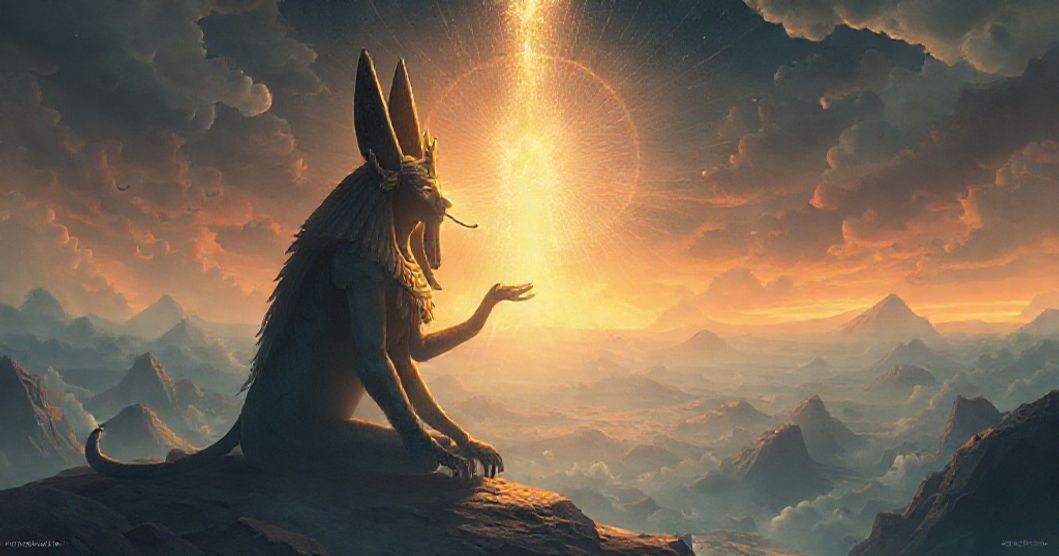
I found myself among friends in a dimly lit gathering, though their faces blurred at the edges like distant memories. Without conscious intent, I rose from the group and walked away, drawn by an invisible current toward a corridor I’d never noticed before. The air shifted as I crossed a threshold—suddenly, I stood in a chamber carved from ancient stone, its walls smooth and cool beneath my fingertips. A single stone table dominated the center, its surface pitted with faint etchings I couldn’t make out. Directly ahead, the wall blazed with an enormous tableau: a figure I recognized from vague childhood myths, though I’d never seen him in life—Anubis, the jackal-headed god, rendered in deep ochres and blacks, his eyes seeming to follow my every step. As I entered, a shimmering barrier of light rippled across my skin, not painful but transformative, peeling away the social facades I’d worn so long I’d forgotten them. In that moment, I felt myself expanding, my form shifting into something both familiar and new. I became Anubis—not the stern, masculine figure of myth, but a feminine iteration: eight feet tall, jet-black skin glistening like polished obsidian, my head crowned with a jackal’s muzzle that retained the soft curves of my own features. This felt not like a costume, but my true form, revealed at last. The painting on the wall flickered, then cracked open like a living thing, and the Anubis I’d seen before stepped free, his golden eyes locking onto mine. No words passed between us, yet our connection was electric—a silent understanding of ancient truths. In that charged stillness, we moved to the stone table, and what followed was a ritual of union: not in the vulgar sense, but a profound merging of my transformed self with the divine presence, as if completing a cycle I’d unknowingly begun. When I woke, my heart raced, the memory of that connection lingering like a physical sensation. I’d never sought out Egyptian mythology, yet Anubis’s image haunted me, and I feared the meaning might be tied to his role in embalming and death. Was this a vision of my own approaching end? Or something far more personal, something I’d been avoiding in my waking life?
Part 2: Clinical Analysis
Want a More Personalized Interpretation?
Get your own AI-powered dream analysis tailored specifically to your dream
🔮Try Dream Analysis FreeSymbolic Landscape: The Language of the Unconscious
The stone chamber serves as a powerful symbol of the unconscious mind—a space both ancient and foreign, where archetypal forces reside. Stone, as a building material, represents permanence and foundational structures, suggesting the dreamer’s need to examine core beliefs. The single stone table functions as a threshold object, a place where the mundane and sacred intersect. Anubis, the Egyptian god of embalming and the afterlife, appears as a psychopomp—a guide between worlds—yet in this dream, he takes a feminine form, subverting traditional gendered interpretations of divine figures. The transformation of the dreamer into a female Anubis is particularly significant: it embodies the Jungian concept of the anima (the feminine aspect of the male psyche) or animus (the masculine aspect of the female psyche), suggesting the dreamer is integrating traditionally masculine qualities (justice, structure, authority) with her feminine identity. The jet-black skin and jackal-headed form symbolize primal power and intuition—the jackal’s keen senses represent the ability to discern truth beneath appearances.
The “magical barrier” that strips away outer masks reflects the dreamer’s psychological defenses dissolving during sleep, revealing authentic selfhood. In dreamwork, such barriers often represent social conditioning, fear of judgment, or repressed aspects of identity. The act of “consummating the stone table” is not literal but symbolic of wholeness and integration: the dreamer’s union with the divine figure represents the completion of a self-discovery process. The absence of words underscores the ineffable nature of this realization—truths that cannot be fully articulated in waking life but can be experienced in dreams.
Psychological Undercurrents: Archetypes and the Shadow Self
From a Jungian perspective, Anubis embodies the shadow—the repressed aspects of personality that demand integration. By merging with Anubis, the dreamer is confronting and integrating these shadow elements. The dreamer’s fear of death ties to Anubis’s association with embalming, but this should not be interpreted as a literal premonition. Instead, it reflects the dreamer’s unconscious processing of mortality—a natural part of adult development. The stone chamber, with its ancient feel, represents the dreamer’s connection to ancestral wisdom and collective unconscious.
Freudian analysis might view the “consummation” as a manifestation of repressed desires, particularly regarding self-acceptance. The dreamer’s gendered transformation suggests a desire to reclaim power traditionally denied to women—a common theme in dreams of gender-bending or divine role reversal. The lack of external triggers (no exposure to Egyptian mythology) indicates the dream is an internal dialogue, not influenced by external media.
Neuroscientifically, this dream reflects the brain’s default mode network, which activates during rest and processes emotional material. The dream’s narrative coherence suggests the brain is attempting to make sense of fragmented experiences or identity conflicts through mythic imagery.
Emotional and Life Context: Confronting Identity and Fear
The dreamer’s concern about death likely stems from waking-life stressors related to mortality, transition, or life purpose. The absence of friends in the stone chamber suggests a period of isolation or introspection, where the dreamer is questioning social roles and seeking authenticity. The sudden appearance of Anubis, a figure associated with judgment and transition, mirrors the dreamer’s need to confront life changes—perhaps career shifts, relationship endings, or personal growth. The fact that the dreamer is a woman adds layers of gender-specific challenges: societal expectations of femininity versus personal authenticity.
The “magical barrier” stripping away masks implies the dreamer has been hiding parts of herself in waking life—perhaps suppressing ambition, creativity, or authority. Anubis’s role as a guide aligns with the dreamer’s search for direction, suggesting she’s at a crossroads where she must trust her intuition.
Therapeutic Insights: Embracing the Divine Self
This dream invites the dreamer to recognize that self-discovery is a sacred process, not a linear one. The “consummation” with Anubis represents the integration of one’s authentic self into daily life—a practice of living in alignment with unconscious truths. To deepen this insight, the dreamer might benefit from journaling about moments of feeling “unmasked” in waking life and how they were resolved.
Reflection questions could include: When do I feel most like my true self? What masculine qualities might I be integrating? These questions encourage the dreamer to explore how they balance assertiveness with vulnerability, structure with intuition.
The dream suggests the dreamer has been avoiding a deeper connection to her authentic power. To integrate this insight, she might practice rituals that honor her shadow self—such as creative expression without judgment, or standing up for herself in ways she previously hesitated.
FAQ Section: Navigating Dream Meanings
Q: Why did I feel like my “outer mask” was stripped away?
A: The barrier symbolizes psychological defenses falling during sleep, revealing authentic selfhood. This often occurs when the unconscious identifies a need for self-integration.
Q: What does the female Anubis represent?
A: It integrates traditionally masculine (Anubis) and feminine (dreamer’s gender) aspects, suggesting wholeness through dualistic integration.
Q: Is the “consummation” literal or symbolic?
A: Symbolic of merging with one’s true self, completing a cycle of self-discovery rather than a physical act. It represents psychological union with authentic identity.
The dream ultimately urges the dreamer to embrace her power, both in waking life and in the unconscious, recognizing that self-discovery is a sacred journey with no destination other than the present moment of integration.