
Part 1: Dream Presentation
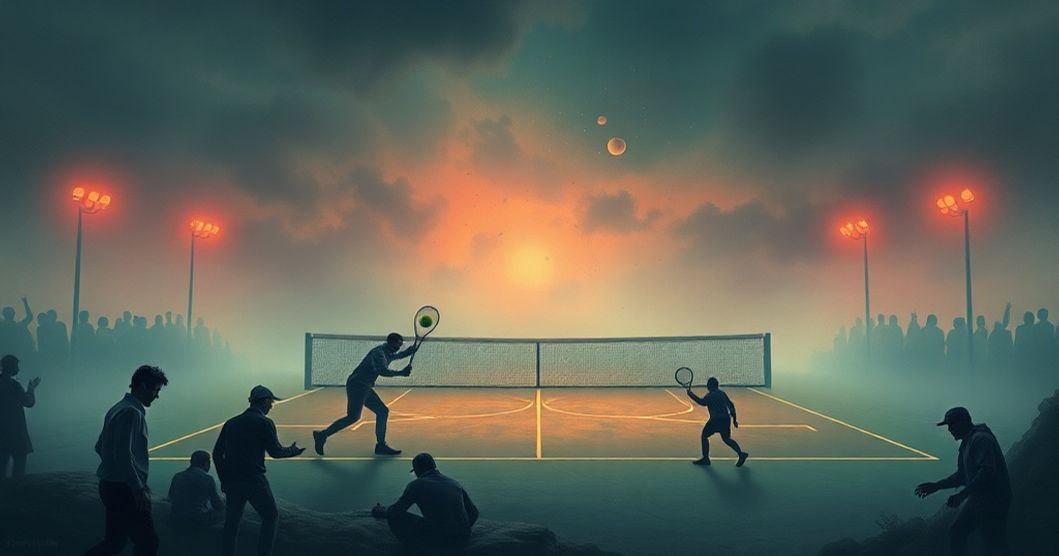
Dreams often serve as psychological mirrors, reflecting our subconscious preoccupations through surreal scenarios that blend the mundane and the macabre. In this particular dream, the dreamer navigates a disorienting landscape where athletic competition collides with ecological mystery, creating a vivid tableau of vulnerability and collective unease. Last night’s dream unfolded like a surreal psychological drama set on a disorienting stage. I found myself in the middle of a crucial tennis match, though the venue defied all logic—a flat, expansive expanse that I recognized as a beach yet was unmistakably composed of packed, sun-baked dirt. There were no boundaries, no net, just endless open space under a pale, featureless sky. My opponent, a shadowy figure whose face I couldn’t discern, served with relentless precision, and I struggled to meet the challenge. Every time I missed a serve, I’d sprint across the uneven dirt, shoes sinking slightly with each step, chasing after stray balls that seemed to vanish into the haze. The air felt thick with tension, as if the very ground itself watched my failures unfold. As I ran deeper into the court, the terrain shifted: what had been hard-packed dirt gave way to tall, swaying grass, waist-high and tinged with the browns of late summer. Pushing through the vegetation, I stumbled upon a clearing where the grass lay flattened in a perfect circle, as though some invisible force had pressed down on it. Around this eerie clearing, dozens of deer lay scattered—dozens more than I’d ever seen in one place—all motionless, their eyes closed, as if they’d succumbed to a silent, shared fate. A chill ran through me; their deaths looked peaceful yet profoundly unsettling, as if they’d simply fallen asleep and never woken. Without thinking, I turned to flee, and suddenly the ground swarmed with insects—black, crawling creatures, swarming over the dead deer and closing in on me. I could feel their tiny legs tickling my skin, hear their high-pitched buzzing in my ears. A wave of recognition washed over me: this was a plague, a contagious threat that had claimed the deer and now sought me out. Desperately, I remembered there were stairs nearby, a narrow path off this cursed beach. I started climbing, but the air grew heavy with drowsiness, my eyelids drooping despite my frantic efforts to stay awake. The world blurred, and I felt myself succumbing to sleep, the last thing I knew was the overwhelming urge to rest as the insects closed in. Then I woke, gasping for breath in my own bed.
Part 2: Clinical Analysis
Symbolic Landscape: Decoding the Dream’s Imagery
Want a More Personalized Interpretation?
Get your own AI-powered dream analysis tailored specifically to your dream
🔮Try Dream Analysis FreeThe dream’s surreal elements carry layers of symbolic meaning that reveal the dreamer’s inner psychological landscape. The tennis match, set on a beach-dirt hybrid, embodies the tension between competition and disorientation—like a life where performance expectations feel both inescapable and illogical. The act of chasing balls after missed serves symbolizes the relentless pursuit of 'corrective action' in the face of failure, while the open, boundaryless court reflects a lack of structure or safety in the dreamer’s waking life. The matted circle of grass is particularly significant: its perfect geometry suggests a boundary or threshold crossed, a space where natural order has been disrupted. In dream symbolism, circles often represent wholeness, but here the flattened grass implies a loss of that wholeness, perhaps reflecting feelings of fragmentation or stagnation.
The dead deer, dozens lying in sleep, introduce deeper ecological and emotional subtexts. Deer in mythology and symbolism often represent intuition, grace, and connection to nature—qualities the dreamer may be struggling to access. Their collective death in sleep suggests a loss of this intuitive wisdom or a surrender to unseen forces, possibly mirroring anxieties about environmental collapse, personal stagnation, or a sense of collective decline. The insects, described as 'swarming' and 'attacking,' function as carriers of contamination—both literal in the dream and metaphorical for repressed fears or overwhelming stressors that feel inescapable.
Psychological Perspectives: Theoretical Framing
From a Jungian lens, this dream reflects the shadow self—parts of the psyche we avoid or project outward. The deer, as symbols of the wise self (stag archetype), dying collectively could represent the shadow’s attempt to integrate suppressed aspects of identity. The tennis match, with its competitive pressure, mirrors the shadow’s demand for mastery over uncontrollable elements. The insects, as shadow projections, embody repressed anxieties about contamination or 'infection'—fears of spreading or being spread by something harmful.
Freud’s perspective might interpret the tennis match as a sublimation of sexual or aggressive urges, with the 'plague' representing guilt or fear of contamination (Oedipal conflicts or unresolved anger). The chase for balls could symbolize the dreamer’s attempt to reclaim lost 'power' or 'control' over aspects of life they feel slipping away. From a cognitive neuroscience view, the dream’s disjointed elements (sports, death, insects) reflect the brain’s random activation during REM sleep, but the emotional tone (anxiety, fear) connects to amygdala processing of unresolved emotional conflicts.
Emotional & Life Context: Unpacking the Subtext
The dream likely emerges from the dreamer’s current emotional state, where performance pressure or competitive stress is intersecting with deeper ecological or collective anxieties. The 'plague' could symbolize a real-world concern about environmental degradation, public health threats, or societal instability, while the deer’s death reflects a loss of connection to natural systems. The 'drowsiness' and falling asleep on the stairs suggest a pattern of avoidance—both literal in the dream and metaphorical for the dreamer’s tendency to 'numb out' rather than confront overwhelming challenges. This might stem from burnout, where the effort to maintain performance (tennis) exhausts them, leading to a subconscious desire to surrender control (falling asleep) rather than continue the struggle.
The transition from athletic competition to plague could also represent the dreamer’s perception of life as a series of 'matches' where failure isn’t just personal but contagious—like a virus spreading from one aspect of life to another. The open, exposed court without boundaries mirrors a life where personal boundaries are eroded, making the dreamer feel vulnerable to external threats.
Therapeutic Insights: Actionable Reflections
This dream offers valuable clues for personal growth. First, the dreamer should explore areas of performance pressure in waking life—are they chasing 'balls' out of obligation rather than passion? Journaling about recent competitive situations could reveal if these pressures stem from external expectations or internalized self-criticism. The matted circle and dead deer invite reflection on 'threshold moments' where natural intuition has been suppressed; creating space for quiet reflection (even brief mindfulness practices) might help reconnect with this wisdom.
The insects as plague suggest that small, persistent stressors (like the buzzing of unaddressed worries) can feel overwhelming if ignored. The dreamer should identify these 'invisible threats' and address them proactively rather than allowing them to spread. The stairs, a symbol of progress, represent the dreamer’s need to 'climb' toward resolution rather than surrender to drowsiness. Short-term actions might include setting clear boundaries in high-pressure situations, while long-term strategies could involve reconnecting with nature or creative outlets that foster intuitive, non-competitive expression.
FAQ Section
Q: Why did the dream shift abruptly from a tennis match to a plague scenario?
A: Dreams often merge unrelated themes to highlight emotional connections. The transition from competition to plague shows how failure or loss of control can feel like an invasive, overwhelming threat to safety—turning performance anxiety into existential fear.
Q: What does the 'beach-dirt court' symbolize?
A: This hybrid space represents a life where stability (beach) and instability (dirt) collide—expectations that feel both familiar and alien, creating a disorienting pressure to perform without clear direction.
Q: Why did the dream end with falling asleep on the stairs?
A: Falling asleep reflects a subconscious strategy to avoid confronting threats (the insects, the plague). It mirrors real-life patterns of 'numbing out' rather than addressing problems, suggesting the dreamer might need to pause and process anxiety rather than push through it.