
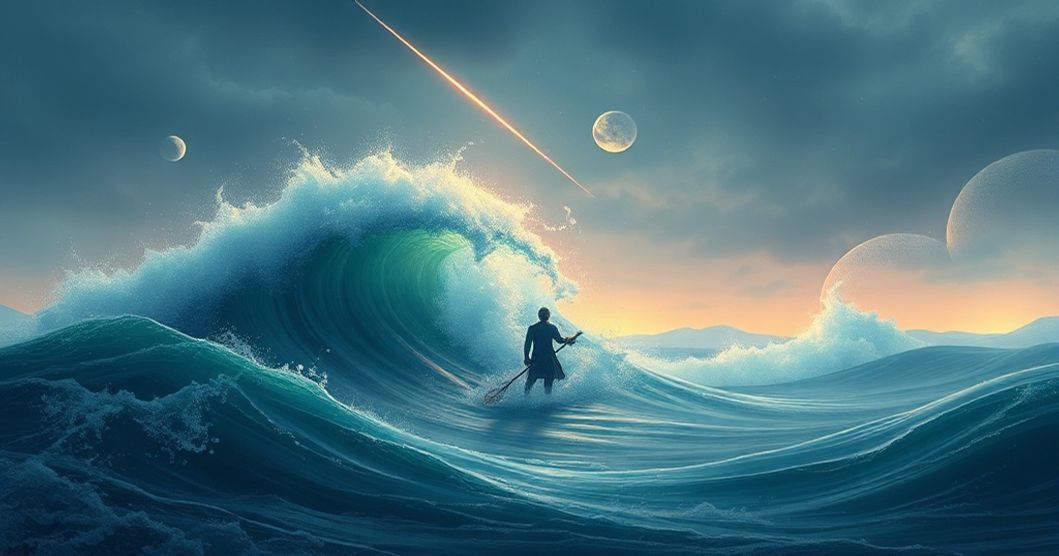
Part 1: Dream Presentation
Dreams have a way of transporting us to realms where reality bends and primal fears surface with bone-deep clarity. This dream, vivid and terrifying in its authenticity, unfolded like a nightmare made manifest—a tsunami approaching a Hawaiian shoreline with my family at my side, and a world of destruction unfolding before my eyes. I woke from the most visceral dream I’ve ever experienced, its echoes still clinging to my consciousness like saltwater on skin. I found myself in a tropical paradise—Hawaii, by the feel of the air and the scent of salt in the breeze—though the beauty of the landscape was overshadowed by an impending dread. The signs of a tsunami arrived not with warning sirens but in subtle, unsettling ways: the ocean’s unnatural calm, the distant rumble that grew louder with each passing moment. My husband and daughter were beside me, our small family sharing a rented home perched on a hilltop that overlooked two bays. The property, a shared apartment-style residence, offered sweeping views of both waterways—the left bay, closer to our balcony, seemed destined to be the first to face the wave, though the right bay was the last to feel its wrath. As the first signs of disaster unfolded, I watched in horror as families below scrambled to safety, their screams mixing with the roar of the approaching wall of water. A young boy clutched his brother’s hand, only to lose him in a moment of chaos; I saw paddleboarders thrown against rocky outcroppings, their boards splintering against the cliffs. Aftershocks rippled through the shoreline, snatching those who dared return for belongings or loved ones. The water lapped at our sliding glass door, inches from my outstretched fingers as a man was swept away, his desperate grasp just beyond my reach. I couldn’t save him, and I couldn’t save anyone else, either. In a final, surreal act, I recorded the moment the tsunami struck, filming a goodbye video to my family, knowing it might be our last communication. The dream’s realism was overwhelming—every sensation, from the weight of fear to the cold dread of the water, felt achingly authentic.
Part 2: Clinical Analysis
Symbolic Landscape: The Tsunami as Unconscious Force
Want a More Personalized Interpretation?
Get your own AI-powered dream analysis tailored specifically to your dream
🔮Try Dream Analysis FreeThe tsunami itself emerges as a powerful symbol of overwhelming, uncontrollable life forces—anxiety, existential threats, or responsibilities that feel impossible to outrun. In dream imagery, natural disasters often represent repressed emotions or unresolved trauma seeking expression. The tropical Hawaiian setting contrasts sharply with the impending destruction, creating a metaphor for beauty and vulnerability coexisting in life. The hilltop home, positioned to overlook the bays, symbolizes the dreamer’s attempt to maintain safety and control amid chaos—a common psychological defense mechanism. The two distinct bays, with the left bay facing the wave first, may represent different areas of life (or timeframes) where vulnerability presents itself, while the right bay’s delayed impact suggests a temporary reprieve or different pattern of threat.
The family’s presence—husband and daughter—anchors the dream in themes of protection and connection. The dreamer’s inability to save others, including the man swept away and the boy who loses his brother, reflects core feelings of powerlessness, guilt, or self-doubt. These failed rescue attempts often mirror waking experiences where the dreamer feels inadequate to protect loved ones or manage life’s crises. The act of recording a goodbye video introduces another layer: it suggests an acceptance of finality, a desperate attempt to preserve connection even as all control slips away.
Psychological Perspectives: Layers of Understanding
From a Freudian perspective, the tsunami could represent repressed anxieties about loss and mortality, with the family symbolizing the dreamer’s ego and superego in conflict. The dream’s hyper-realism might reflect the dreamer’s unconscious processing of recent stressors or trauma, using the metaphor of a natural disaster to externalize internal turmoil. For Jungian psychology, the tsunami embodies the collective unconscious archetype of destruction and rebirth—the primal fear of annihilation balanced by the possibility of renewal.
Cognitive theory offers another lens: the brain’s REM sleep activity simulates threat scenarios to process emotional memories and survival instincts. The dream’s intensity may stem from the dreamer’s waking state processing real-world stress, with the tsunami representing a metaphor for overwhelming responsibilities or relationship challenges. Neuroscientifically, the amygdala’s heightened activity during REM sleep explains the dream’s emotional charge, while the hippocampus integrates these experiences into memory storage.
Comparing these frameworks reveals that the dream operates on multiple levels: as a repressed fear (Freud), a collective archetype (Jung), and a stress-processing mechanism (cognitive neuroscience). Each perspective illuminates different facets of the dreamer’s emotional landscape without contradicting one another.
Emotional & Life Context: Waking World Connections
The dream’s intensity suggests the dreamer is navigating significant life stressors or emotional turbulence. The recurring theme of loss and powerlessness may reflect underlying anxieties about personal control, safety, or relationships. The tsunami’s approach mirrors situations where the dreamer feels overwhelmed by external pressures—work demands, family responsibilities, or existential uncertainty.
The dreamer mentions