
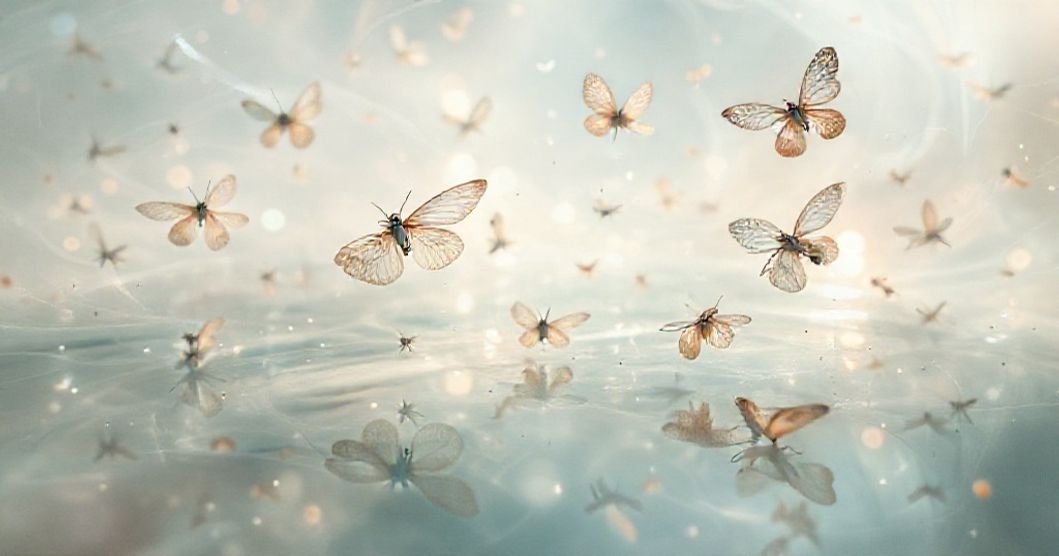
Core Symbols: Moths, Mirrors, and the Language of Transformation
Moths in dreams are ancient messengers of metamorphosis, their delicate wings beating against the threshold between light and shadow. Unlike butterflies, which symbolize complete rebirth, moths often represent the process of change—the slow, intentional unfolding of identity rather than sudden transformation. When these winged creatures appear alongside mirrors, they create a powerful symbolic dialogue: the mirror reflects, the moths guide. Sigils, in esoteric traditions, are symbols charged with personal or spiritual significance, and in dreams, they become your subconscious’s way of marking key truths.
A moth’s attraction to light isn’t mere curiosity—it’s a primal pull toward understanding. In dreams, this light can represent your deepest desires, the parts of yourself you’re drawn to explore, or even the allure of the unknown. The mirror amplifies this: seeing moths on its surface isn’t just a reflection of your image; it’s a reflection of your patterns. If the moths are clustered near the mirror’s edge, they might signal boundaries you’re testing; if they’re fluttering across its surface, they’re urging you to move beyond static self-perception. Together, moths and mirrors create a visual poem of self-discovery.
Psychology Lens: From Jungian Shadows to REM Sleep
Want a More Personalized Interpretation?
Get your own AI-powered dream analysis tailored specifically to your dream
🔮Try Dream Analysis FreeJungian psychology frames the mirror as a portal to the shadow self—the aspects of yourself you’ve disowned or suppressed. Moths, with their nocturnal nature, align with the unconscious: they’re drawn to the dark, to the parts of you that remain unlit. When moths dance across a dream mirror, they’re not just showing you your shadow; they’re showing you how to interact with it. Freud, meanwhile, might interpret the mirror as a projection of repressed desires, while Jung sees it as a bridge between the conscious and collective unconscious.
Neuroscience adds another layer: during REM sleep, the brain processes emotional memories, and self-referential imagery (like mirrors) activates the default mode network—the same region linked to self-awareness and identity formation. Moths, with their erratic flight patterns, could represent the emotional turbulence of integrating new insights. Think of it this way: your brain, in REM, is creating a ‘dream lab’ where you test new narratives about yourself—moths are the test subjects, the mirror the control panel.
Culturally, moths hold diverse meanings: in Native American traditions, they’re messengers between worlds, carrying ancestral wisdom; in alchemical lore, they’re the ‘prima materia’—the raw, unrefined substance awaiting transformation. The mirror, too, has ancient roots: in Greek mythology, Narcissus’s reflection became a warning against vanity, yet in modern dreamwork, it’s a tool for self-understanding. Together, these symbols bridge the gap between ancient wisdom and contemporary psychology.
Life Triggers: When the Subconscious Calls for Reflection
Dreams of moths on mirrors rarely appear randomly; they often surface during periods of transition. If you’ve recently started a new job, ended a relationship, or even changed your daily routine, your subconscious might be using moths to help you process these shifts. The mirror becomes a metaphor for your changing identity—are you seeing yourself clearly, or are you avoiding parts of the new you?
Modern life amplifies this dynamic. In a world of digital reflections (social media, selfies), the dream mirror can feel like a counterpoint: it’s not about curated images but raw, unfiltered self-perception. Moths, drawn to light, might also symbolize your digital habits—are you ‘chasing’ the glow of validation, or are you drawn to the quiet, transformative light of personal growth? The tension between the two—moths (attraction) and mirrors (reflection)—is a mirror of your real-life choices: are you acting on your desires, or are you stuck in self-doubt?
Another trigger: unresolved emotions. If you’ve been avoiding a conversation, a creative project, or even a part of your past, the dream might materialize as moths on a mirror, urging you to ‘see’ what you’ve been avoiding. The mirror, in this case, is less about judgment and more about clarity: you can’t change what you don’t see.
What To Do Next: From Dream to Daily Life
Start with short-term reflection: Grab a notebook and write down the dream’s details. What color were the moths? Were they landing gently or fluttering frantically? How did the mirror look—clear, foggy, or cracked? These details are clues to your subconscious’s priorities. Notice if any moths had distinct patterns or if they moved in a specific direction—this could mirror your current life’s flow.
Medium-term experimentation: Moths thrive in darkness, so try a small, intentional exploration of a ‘shadow’ area. If the dream felt unsettling, pick one thing you’ve been curious about but hesitant to try—a new hobby, a conversation, or even a walk at night. Moths symbolize curiosity, so let this dream be your nudge to step into the unknown.
Long-term integration: Once you’ve explored these new areas, check in with the mirror again—metaphorically. How do you feel about the changes you’ve made? Are you embracing the light, or still retreating from it? The goal isn’t to ‘fix’ the dream but to let it guide you toward authenticity. Over time, these small shifts will turn into larger transformations, much like a caterpillar’s slow, steady journey to becoming a moth.
FAQ
Q: What does it mean if the moths are landing on the mirror? A: Landing moths suggest active self-reflection—your subconscious is prompting you to engage with a specific aspect of yourself you’ve been observing but not yet integrating. It’s not just about seeing; it’s about touching.
Q: What if the mirror shows a different version of me? A: A distorted or unfamiliar reflection hints at the shadow self—parts of you you’ve denied or forgotten. This isn’t a warning but an invitation to ask: What do I need to accept to grow?
Q: Why do the moths feel both beautiful and unsettling? A: Beauty and unease are natural in transformation. The beauty is in the potential for growth; the unease is the fear of letting go of what’s familiar. This duality is your subconscious balancing the old and new.
The moths and mirrors in your dreams aren’t just symbols—they’re your inner wisdom, speaking in a language you’ve been primed to understand all along. By tracing their sigils, you’re not just decoding a dream; you’re decoding your own capacity for transformation.