
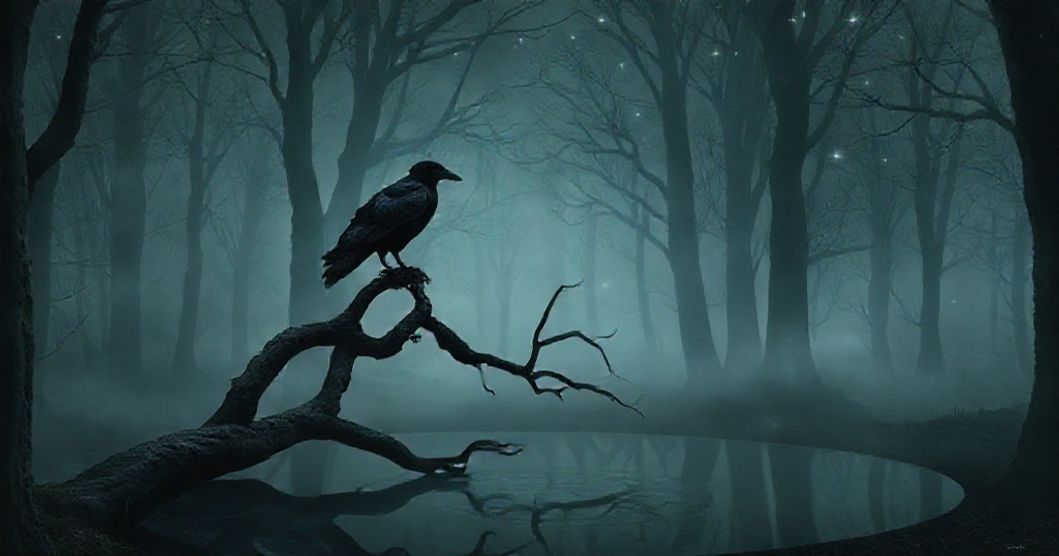
Core Symbols: The Black Bird as Dream Sigil
Black birds in dreams function as spiritual sigils—personalized symbols etched into the fabric of your subconscious. Unlike their lighter avian counterparts, black birds carry the weight of mystery and depth, their plumage a canvas for both portent and promise. In Norse mythology, Odin’s ravens Huginn (thought) and Muninn (memory) were said to circle the world, bringing back wisdom to the Allfather—here, the black bird in dreams might mirror your own thought processes, urging you to listen to the whispers of intuition. Celtic traditions viewed ravens as guardians of the Otherworld, their black feathers bridging the visible and invisible realms; in dreams, this can signify a threshold moment, where the veil between your conscious and unconscious selves thins.
The 'black mirror' element amplifies this symbolism: when a black bird appears alongside reflective surfaces in your dream, it’s less a literal mirror and more a metaphor for self-reflection. You’re not seeing the bird’s shadow, but your own—unseen parts of identity, unresolved emotions, or untapped potential. A single black bird might represent singularity of purpose, while two dead birds (a common variant) often symbolize duality: the balance between light and shadow, or the need to reconcile conflicting life paths. These aren’t just omens; they’re invitations to trace the sigil of your own journey.
Psychology Lens: Jungian Shadows and the Science of Emotional Processing
Want a More Personalized Interpretation?
Get your own AI-powered dream analysis tailored specifically to your dream
🔮Try Dream Analysis FreeFrom a Jungian perspective, black birds embody the shadow archetype—the unconscious aspects of self we avoid or reject. When a raven or crow appears in your dream, it’s the psyche’s way of saying: 'You cannot escape what you’ve buried.' This isn’t inherently negative; the shadow isn’t evil, but incomplete. Jung believed integrating the shadow leads to wholeness, and black birds act as messengers to facilitate this integration. Consider a dream where a black crow caws at you—this could be your shadow demanding attention, not as a warning, but as a teacher.
Neuroscience offers another layer: during REM sleep, the brain’s amygdala (emotion processing center) activates, while the prefrontal cortex (logical reasoning) quiets. This creates the perfect storm for emotional dreams, where black birds might emerge as visual metaphors for unresolved grief or anxiety. If you’ve recently experienced loss, a black bird dream could be your brain processing those emotions, using the bird’s dark plumage to symbolize the weight of grief without literalizing it. Unlike Freud’s view of dreams as wish-fulfillment, modern psychology sees them as emotional regulators—black birds, then, are the mind’s way of sorting through the chaos of feeling.
Life Triggers: When the Subconscious Calls Through Black Feathers
Black bird dreams rarely occur in isolation; they’re triggered by life’s pivotal moments. Grief and loss top the list—especially if you’ve lost two loved ones, the two dead birds in your dream may symbolize the dualities of that loss: sadness and healing, farewell and memory. A major career shift or relationship ending can also spark these dreams, as the uncertainty of change activates the need for transformation.
Spiritual awakening is another trigger: when you begin questioning your beliefs or seeking deeper meaning, the black bird’s mystery becomes a guide. Think of a person in midlife crisis, suddenly seeing black ravens in their dreams—these aren’t omens of doom, but signs that the psyche is craving purpose. Similarly, avoiding self-reflection (the 'black mirror' effect) can manifest as a black bird perched on your shoulder, silent but insistent.
Notice the context: if the bird is flying freely, it may signal liberation; if it’s perched, stagnation. If it’s attacking, you might be confronting an inner critic. The key is to trace the sigil back to your waking life—what’s unresolved there?
What To Do Next: From Dream to Actionable Insight
Start with dream archaeology: write down every detail of your black bird dream—color (pure black? Dark gray?), action (flying, perched, attacking?), number of birds, and your emotions. Ask: 'What was the bird communicating without words?' This reflection helps you decode the sigil’s unique message for your life. For example, a dream of a black raven with a broken wing might signal a need to mend a fractured part of yourself.
Medium-term, try dream incubation: before bed, set an intention to ask the subconscious for clarity. Mentally state: 'If a black bird appears, show me what I need to know.' This practice aligns your conscious mind with the dream’s purpose. You might also explore symbolic rituals—burning black candle wax (representing the bird’s shadow) while meditating on your intentions.
Long-term, embrace the shadow: keep a 'dark journal' to record recurring themes in your dreams and waking life. Notice patterns: Do black birds appear when you’re avoiding a difficult conversation? When you’re ignoring your intuition? Use these insights to integrate the shadow into your daily life. Remember: the black bird’s presence isn’t a sentence—it’s a starting line.
FAQ: Navigating the Dark Feathered Messengers
Q: What does a single black bird in a dream mean spiritually? A: A single black bird often signifies singularity of purpose or a unique message. It may represent intuition calling you to trust your gut, or a threshold moment where the path forward is unclear but necessary.
Q: How do 2 dead birds differ from 1 dead bird in dreams? A: Two dead birds suggest duality—reconciling conflicting emotions, choices, or aspects of self. They may signal a need to balance light and dark, or to honor two separate losses or lessons.
Q: Is seeing black birds always a negative sign? A: No. Black birds can carry positive messages of transformation, spiritual awakening, or hidden wisdom. Their meaning depends on context: fear suggests avoidance; curiosity suggests growth.