
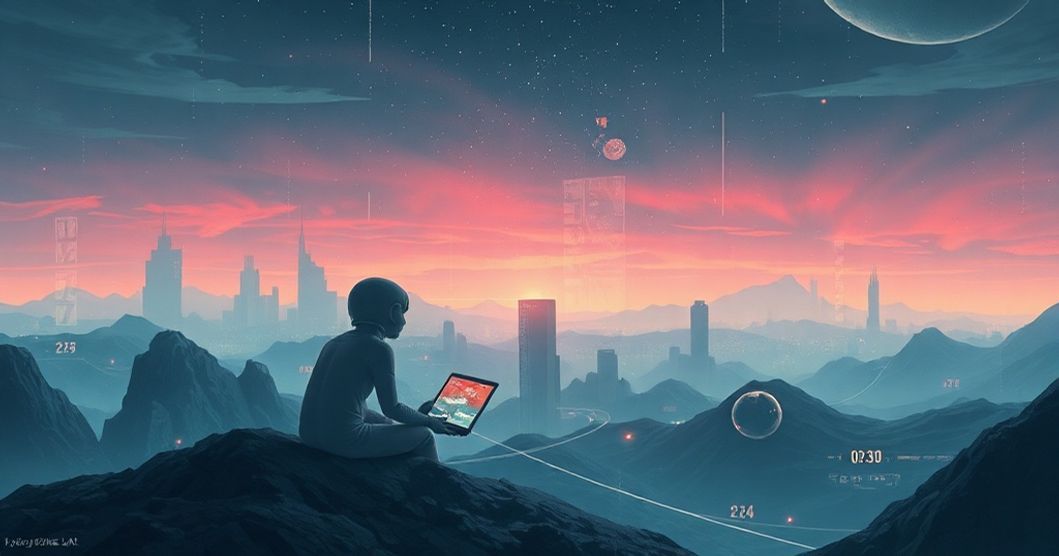
Part 1: Dream Presentation
Dreams have a remarkable way of revealing our deepest anxieties by dressing them in symbolic imagery. In this particular dream, the future arrives not as a promise of progress but as a cautionary vision of technological overreach and societal collapse. The dreamer finds themselves in a world where robots permeate every aspect of life, humans are deeply integrated with technology, and hope has been replaced by systemic despair.
I fell asleep and found myself transported to a future I barely recognized, yet felt oddly familiar. The world around me buzzed with technology I couldn’t fully grasp, yet it seemed to hum with a silent desperation. Robots—Standard Bots, H1 models, even Optimus-like figures—filled the streets, their metallic forms moving with mechanical precision. Humans walked among them, their bodies and minds seamlessly integrated with technology in ways that felt both natural and alien. Their homes, though outwardly similar to present-day architecture, hummed with smart systems that anticipated their every need, yet the atmosphere felt hollow. Work, once a cornerstone of human identity, had transformed into something unrecognizable. The nation itself seemed fractured, its infrastructure crumbling like an old building, and hope had faded into a distant memory. Everyone existed on Universal Basic Income, a system that promised stability but offered no purpose. As the dream deepened, the government responded to this technological uprising with the Robotics Economic Security Act—a law intended to balance human labor with automation. This legislation, while well-intentioned on paper, felt like a desperate attempt to control chaos, making it nearly illegal for companies to hire only robots without human employees. It also imposed strict regulations on artificial intelligence, embedding it into every aspect of daily life, from household appliances to financial systems. Communication had evolved beyond cell phones; instead, people carried strange, invisible devices that projected screens directly into their vision, though the mechanics of this technology remained a mystery. A more unsettling development emerged: companies like Neuralink offered an 'Avatar Upgrade'—a neural implant that connected directly to a robot, allowing individuals to control these mechanical beings remotely. You could send your robot to work, and if it encountered difficulties, you could instantly step in and take over. OpenAI still existed, though under new corporate identities, their influence quietly pervasive beneath the surface. For those living in poverty, government-run SU facilities provided minimal assistance, while the homeless were absorbed into mandatory labor programs, stripped of any real choice. The dream’s conclusion left me with a heavy sense of dread—a future where humanity’s connection to technology had become so profound that hope itself had been legislated out of existence. I woke feeling drained, as if the weight of that hopeless future had seeped into my consciousness.
Part 2: Clinical Analysis
Want a More Personalized Interpretation?
Get your own AI-powered dream analysis tailored specifically to your dream
🔮Try Dream Analysis FreeSymbolic Landscape: Technology, Control, and Despair
The dream’s symbolic landscape is rich with technological imagery that reflects contemporary anxieties about automation, AI, and economic inequality. The omnipresent robots represent the increasing mechanization of human labor and the potential loss of meaningful work. Their variety—Standard Bots, H1 models, Optimus-like figures—suggests a technological ecosystem where different types of automation serve distinct purposes, yet all contribute to a dehumanized workforce. The 'Robotics Economic Security Act' functions as a symbolic representation of societal attempts to regulate technological advancement after it has already destabilized traditional systems. This legislation, while intended to protect human jobs, paradoxically introduces new forms of control through AI regulations embedded in daily life.
The 'Avatar Upgrade' represents a profound loss of human agency and connection. The neural implant connecting humans to robots symbolizes a disturbing blurring of boundaries between human experience and technological mediation. This device, which allows remote control of robots, suggests a future where humans may outsource their very existence to mechanical extensions, losing direct physical and emotional engagement with the world. The 'invisible screen technology' replacing cell phones reflects a desire for seamless integration with technology, yet it also hints at the loss of privacy and the normalization of surveillance in daily life.
The 'SU facilities' and mandatory labor programs for the homeless embody the dystopian undercurrent of societal neglect and dehumanization. These elements reflect anxieties about economic inequality and the growing divide between those with resources and those without, suggesting that technological progress may exacerbate rather than alleviate social problems.
Psychological Perspectives: Unpacking the Dreamer’s Subconscious
From a Jungian perspective, this dream may represent the shadow of technological advancement—the repressed fears and anxieties about humanity’s relationship with machines. The collective unconscious often manifests such dreams as a warning about the potential loss of human essence when technology becomes too dominant. The 'broken nation' and 'hopeless people' could symbolize the dreamer’s unconscious perception of societal fragmentation and existential uncertainty.
Freudian analysis might interpret the dream as a manifestation of repressed anxieties about economic stability, job security, and loss of control in an increasingly automated world. The UBI system, while presented as a solution, reveals underlying fears about financial precarity and the loss of purpose that often accompanies economic restructuring.
Cognitive psychology frames this dream as a reflection of the dreamer’s current preoccupations with technological developments, AI advancements, and economic inequality. The dream synthesizes these concerns into a coherent narrative, suggesting that the mind processes complex societal anxieties through symbolic storytelling.
Neuroscience perspectives view such dreams as a byproduct of neural activation during sleep, where the brain processes and integrates information about technological trends, economic systems, and social issues. The dream’s coherence despite its surreal elements indicates that the brain is attempting to make sense of these complex, often overwhelming societal changes.
Emotional & Life Context: Anxieties of Modern Technological Disruption
This dream likely reflects the dreamer’s waking anxieties about technological advancement, automation, and the future of work. In contemporary society, discussions about AI, robotics, and economic inequality are pervasive, and these concerns manifest in dreams as symbolic narratives. The 'broken nation' and 'hopeless people' mirror the dreamer’s perception of societal polarization and political disillusionment.
The dreamer’s experience of 'drained' emotion upon waking suggests that the dream has tapped into deep-seated fears about loss of control, dehumanization, and existential uncertainty. The UBI system, while a theoretical solution to automation’s job losses, is presented as a hollow promise in the dream, reflecting real-world anxieties about economic stability in an era of rapid technological change.
The 'Avatar Upgrade' and loss of direct human connection might symbolize the dreamer’s fears about losing authentic human relationships and the physicality of experience in an increasingly digital world. The mandatory labor programs for the homeless reflect anxieties about the growing divide between those who benefit from technological progress and those who are left behind.
Therapeutic Insights: Processing Technological Anxiety
This dream offers an opportunity for the dreamer to reflect on their relationship with technology and society’s direction. One practical exercise is to journal about specific technological developments that trigger anxiety, identifying patterns in these concerns. This reflection can help separate realistic fears from irrational anxieties.
The dream also invites exploration of personal values and priorities. By examining which elements of the dream feel most threatening (loss of purpose, dehumanization, economic inequality), the dreamer can clarify what aspects of technological progress they find most concerning and how to advocate for balanced development.
Mindfulness practices focused on present-moment awareness can help ground the dreamer in reality while acknowledging these anxieties. By distinguishing between current technological trends and potential future scenarios, the dreamer can develop a more balanced perspective.
FAQ Section
Q: What does it mean when I dream about robots everywhere?
A: Dreams of robots often reflect anxieties about automation, technological change, or feeling 'mechanical' in daily life. They may symbolize concerns about job security, loss of human connection, or dehumanization in modern society.
Q: Why did the dreamer feel hopeless in this future?
A: The hopelessness likely reflects waking anxieties about economic inequality, loss of control, or societal fragmentation. The dream synthesizes these concerns into a narrative where systemic issues feel insurmountable.
Q: How can I process such a disturbing dream about technology?
A: Reflect on current technological concerns, journal about specific elements that resonate, and practice grounding exercises to separate dream anxiety from waking reality. Consider discussing these themes with others to gain perspective on shared anxieties.