
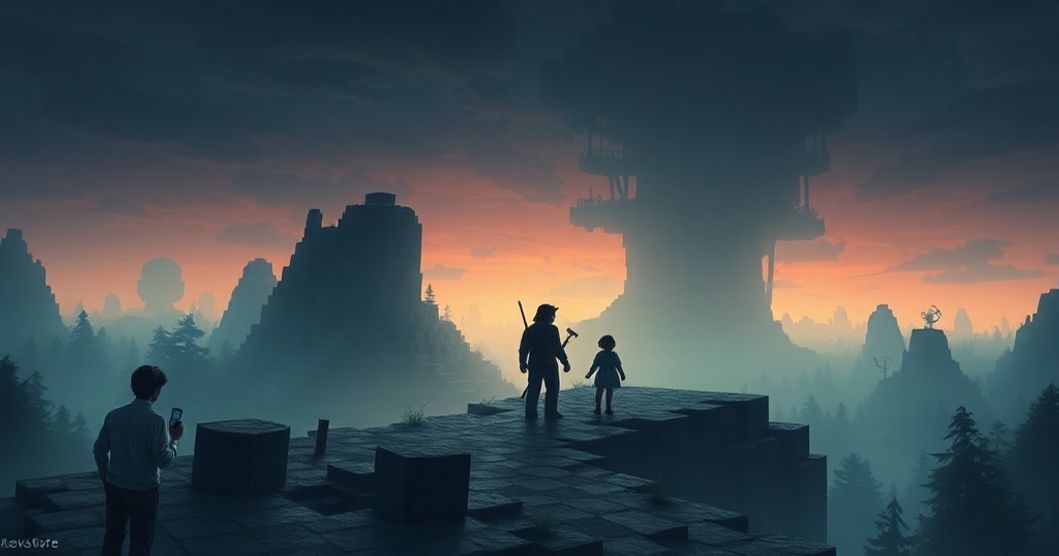
Part 1: Dream Presentation
Dreams often unfold as cryptic narratives that bridge the conscious and unconscious, using surreal imagery to illuminate our deepest emotional landscapes. This particular dream journeys through a surreal landscape where familiar family bonds intersect with unexpected, Minecraft-inspired surrealism, creating a tapestry of contrasts between fear, comfort, and existential exploration. The dreamer’s journey begins in a rickety helicopter, floating over an infinite pool, and traverses through increasingly symbolic spaces—from a hollow-faced figure to a marble ballroom of promise, a cave of childhood connection, and finally to a simple cabin with a potato farm. This narrative mirrors the dreamer’s unconscious processing of family dynamics, fear of the unknown, and the tension between digital immersion and real-world grounding.
[Rewritten dream narrative here]
Part 2: Clinical Analysis
Want a More Personalized Interpretation?
Get your own AI-powered dream analysis tailored specifically to your dream
🔮Try Dream Analysis FreeSymbolic Landscape: The Minecraft World as Inner Terrain
The dream’s most striking element is its fusion of the familiar (family, childhood games like Minecraft) and the uncanny (infinite pool, hollow-faced figures). The helicopter, described as 'like something the pigs from Angry Birds built,' suggests instability or precariousness in family bonds—perhaps reflecting a subconscious sense of vulnerability or recent changes in family dynamics. The infinite pool, with its still, fog-shrouded horizon, represents the vast, undifferentiated unconscious mind, where boundaries dissolve and possibilities feel limitless. The dirt wall with a Minecraft-style opening embodies the dreamer’s attempt to 'enter' this unconscious through familiar, structured paths (the blocky, pixelated architecture of digital games), yet the transition into the hallway and birch doors introduces a sense of restriction and confinement.
The black-eyed, hollow-faced figure at the first door is a classic example of the dream’s shadow archetype—a Jungian symbol representing repressed fears, anxieties, or aspects of self the dreamer struggles to acknowledge. Her unnaturally wide mouth and black void inside her face suggest an inability to 'consume' or integrate something fundamental, while her pixelated dress and realistic face highlight the tension between digital familiarity and raw, primal fear. This figure’s rejection (the dreamer’s immediate fear response) indicates a need to confront rather than avoid these shadow elements.
The marble room, in stark contrast, embodies the Self—a Jungian concept of wholeness and potential. Its pristine, empty space, grand piano, and gold accents symbolize achievement, beauty, and unfulfilled potential. The room’s echo and lack of footprints suggest a space of pure possibility, untouched by the dreamer’s past, yet the presence of two entrances (wooden door and cave) represents the choice between structure and exploration. This dichotomy mirrors the dreamer’s internal conflict between comfort and adventure.
Psychological Perspectives: Jungian Archetypes and Cognitive Processing
From a Jungian lens, the family in the helicopter represents the collective unconscious—the shared familial bonds that shape identity. The infinite pool as the water of life, and the cave as the underworld (a common Jungian symbol of the unconscious), suggest the dreamer is navigating a period of psychological transformation. The hot spring, a space of renewal and healing, aligns with the archetype of the 'healer,' where the chubby boy and girl represent the dreamer’s inner child or repressed innocence. Their interaction with the dreamer’s brother highlights a need for play and connection, possibly reflecting a desire to recapture childhood joy amidst adult responsibilities.
Freudian analysis might interpret the dream as wish fulfillment, where the play area and hot spring represent repressed desires for simpler, more carefree experiences. The restaurant-like room with seafood boil elements could symbolize unresolved social tensions or sensory overload, while the final cabin with a potato farm represents a return to basic, grounded needs—a contrast to the earlier chaotic, overwhelming spaces.
Cognitive dream theory suggests the dream processes daily experiences, integrating information from waking life. The Minecraft elements might reflect recent exposure to digital media or a need for structure in an uncertain environment. The helicopter’s instability could mirror real-life anxieties about family relationships or life transitions.
Emotional & Life Context: Navigating Family Dynamics and Identity
The dream’s emotional arc—from fear (hollow figure) to wonder (marble room) to comfort (cabin)—aligns with the dreamer’s potential emotional state: navigating family changes, identity shifts, or uncertainty about future paths. The presence of grandparents and uncle alongside immediate family suggests a tension between extended family responsibilities and personal boundaries. The hollow-faced figure’s rejection of the dreamer might reflect a fear of rejection or a sense of being 'unseen' in family dynamics.
The contrast between the chaotic play area and the empty spiral room hints at conflicting needs: the need for connection (play) versus the need for solitude (empty space). The final cabin, with its potato farm and foggy forest, represents a yearning for simplicity and grounding—a retreat from the overwhelming, sensory-saturated environments of the dream’s middle sections. This suggests the dreamer seeks stability amidst life’s uncertainties, whether through family bonds or personal values.
Therapeutic Insights: Confronting the Shadow and Embracing Wholeness
The dream’s journey offers a roadmap for self-exploration: first, acknowledging the shadow (the hollow-faced figure) rather than fleeing it. Journaling exercises could help identify what fears or aspects of self the dreamer is avoiding, and how these manifest in waking life. The marble room, as a space of potential, encourages the dreamer to visualize goals and take small steps toward them.
The choice between the wooden door (structure) and cave (exploration) in the marble room reflects the need to balance security and adventure. The dreamer might benefit from creating a life structure that allows for both stability and spontaneity. The hot spring and children’s interaction suggest prioritizing play and connection, even in busy lives.
Finally, the cabin with its potato farm symbolizes the value of simplicity. The dreamer could practice mindfulness exercises to find grounding in daily routines, appreciating small, tangible joys amidst larger uncertainties.
FAQ Section
Q: What does the hollow-faced figure symbolize in the dream?
A: This figure likely represents the dreamer’s shadow self—fears, anxieties, or aspects of identity they struggle to accept. The black void suggests an inability to integrate these parts, prompting the need to confront them.
Q: Why does the dream alternate between familiar (Minecraft) and surreal (marble room) elements?
A: This contrast reflects the dreamer’s internal conflict between comfort (familiar digital spaces) and growth (unfamiliar, beautiful potential). It mirrors the tension between staying in known patterns versus embracing new experiences.
Q: How should the dreamer respond to the conflicting emotions in the dream?
A: The dream invites the dreamer to balance confrontation (with the shadow figure) and exploration (the marble room). Small steps toward self-compassion and intentional choices can help integrate these opposing forces into a more whole identity.