
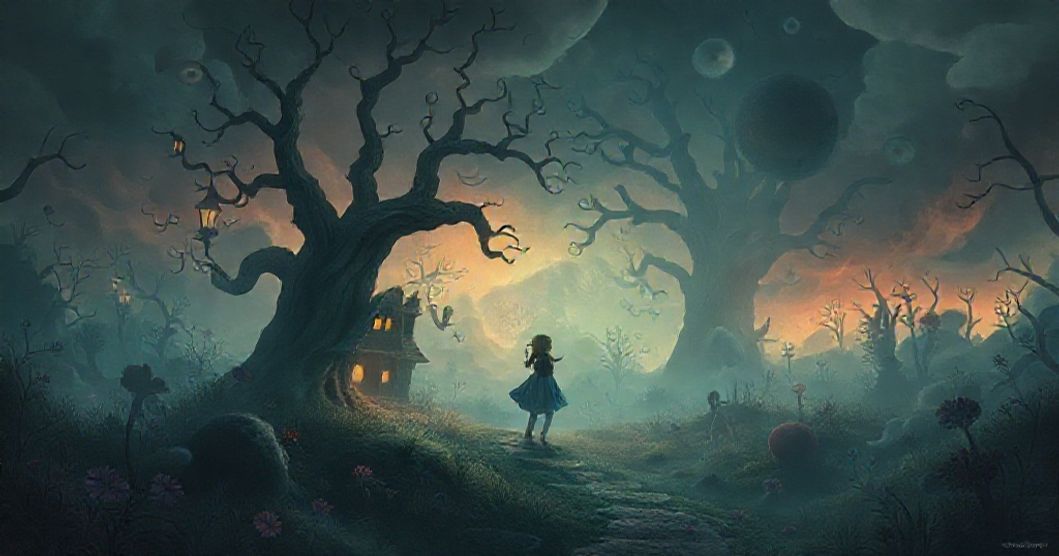
Part 1: Dream Presentation
Dreams often arrive unannounced, carrying symbolic messages from our deeper consciousness. Consider this vivid childhood nightmare, preserved in the dreamer's memory like a faded photograph of fear and wonder:
I awoke in a dream standing in a cornfield where the sky bled a dusty brown, heavy clouds blotting out any trace of sunlight. The air felt thick with heat despite the absence of sun, and the tall cornstalks rustled as if whispering secrets. Before me loomed a massive gate, thirty feet high and constructed of weathered wood, its surface smooth yet forbidding. Atop the gate, the Cheshire Cat grinned down at me, but its eyes were solid black voids, no hint of its usual mischievous glint. As I approached, the metal bars behind me slammed shut with a thunderous clang, trapping me in what felt like an abandoned realm. Beyond the gate, an old wooden shack stood, its paint peeling, and inside, I discovered a rotting rollercoaster structure suspended in mid-air, its tracks creaking like bones. Just then, the Mad Hatter materialized—his face twisted in a manic grin, drool dripping from fangs that glinted white in the dim light, his eyes completely lacking pupils, just blank white orbs. 'You must ride the coaster,' he hissed, 'or your cat will perish.' I climbed into the car, and as we ascended, the structure surprisingly held together. Mid-ride, the Cheshire Cat appeared beside me, cloaked in a black hooded cape that billowed like smoke. With a flick of its paw, it hurled a fireball that struck my clothing, flames licking upward as I plummeted downward. Time seemed to slow as I fell, consciousness slipping away. When I regained awareness, I lay in a stark white room with hospital-bright lights, a single glass window separating me from a solid wall. The wall rose, revealing my cat—my real cat, safe in the dream? No, in the dream, it was a different cat—lying defenseless as metal spikes rained down, crushing it beneath their weight. The floor beneath me transformed into a black-and-red checkerboard pattern, and more spikes began descending slowly, each one a threat. I scrambled to find safety, locating a pile of tangled wires and electrical equipment. Fumbling, I unplugged as many cords as possible, and sparks erupted in a wild display. The spikes halted, but the entire abandoned theme park seemed to crumble around me. Outside, I searched for an exit, a climbable wall, anything to escape. Then a voice boomed over loudspeakers: 'I see you, little one.' The Mad Hatter's voice. I found an 'Employees Only' door and sprinted toward it, but the Cheshire Cat and Mad Hatter appeared above the archway, perched like predators. 'Goodbye,' they whispered in unison, and a sudden pain shot through my chest as they shot me. I died. I woke up, six years old, trembling and gasping, my heart pounding. The relief when I realized my real cat was alive in the real world—my cat, my comfort, my safety—washed over me, but the dream's terror lingered, a scar from a nap I'd never forget.
Part 2: Clinical Analysis
Want a More Personalized Interpretation?
Get your own AI-powered dream analysis tailored specifically to your dream
🔮Try Dream Analysis FreeThe Symbolic Landscape of Childhood Anxiety
This dream is a rich tapestry of symbolic imagery that speaks to the developing psyche of a six-year-old, navigating the transition from concrete reality to abstract fears. The cornfield, with its tall, swaying stalks, represents the boundary between the known and unknown—a common childhood metaphor for the liminal space of growing up. The dusty brown sky, lacking sun, symbolizes emotional uncertainty and the absence of clarity in early childhood understanding of mortality and danger. The massive gate with the Cheshire Cat's blacked-out eyes introduces the theme of hidden knowledge and distorted perception—archetypal figures from Alice in Wonderland, which the dreamer encountered in books or media, now transformed into threatening symbols of unpredictability.
The Mad Hatter, with his drooly fangs and blank white eyes, embodies the chaotic, overwhelming aspects of the child's world—the adult world's irrationality and unpredictability. His demand to ride the rollercoaster or face the cat's death reflects the child's fundamental fear of losing safety and security, particularly regarding loved ones. The rollercoaster itself, suspended in the sky, represents the precariousness of childhood experiences: exciting yet dangerous, with no clear path forward or backward. The fireball and burning clothing symbolize the anxiety of feeling out of control in a world where boundaries and safety can suddenly collapse.
Psychological Perspectives: Jungian and Freudian Frames
From a Jungian perspective, this dream reflects the activation of the shadow archetype—the Cheshire Cat and Mad Hatter as manifestations of the child's fear of the unknown, the 'shadow' self that adults represent. The dream's surreal elements (rollercoaster in the sky, spikes in a hospital room) are classic examples of the collective unconscious manifesting in childhood dreams, drawing on universal themes of mortality and transformation. The cat, a recurring symbol of nurturing and protection, represents the child's most basic need for safety and comfort.
Freudian analysis might interpret the dream as a condensation of repressed fears: the Mad Hatter's menacing appearance could represent the child's anxiety about parental authority or the unpredictable nature of adult interactions, while the cat's death mirrors the child's fear of separation and loss. The hospital room with the glass window suggests the child's emerging awareness of clinical environments and medical procedures, symbols of vulnerability and powerlessness.
Neuroscientifically, this dream may represent the brain's processing of emotional memories during sleep—specifically, the amygdala's activation of fear responses, which are particularly vivid in childhood due to the developing prefrontal cortex's ability to regulate emotions. The dream's narrative coherence despite its surreal elements suggests the brain's attempt to make sense of fragmented emotional experiences.
Emotional and Life Context: Childhood Vulnerability
This dream likely emerged during a period of significant developmental transition for a six-year-old—perhaps facing changes in routine, separation anxiety, or exposure to adult fears. The Alice in Wonderland characters, with their surreal, illogical nature, may have been encountered in books or media, triggering the child's imagination and creating a dreamscape where those characters became threatening. The cat, which the dreamer references as still being alive in reality, suggests the dream's emotional core: the primal fear of losing something precious and the relief that such loss was not real.
The dream's structure—entrapment, escape attempts, and eventual 'death'—reflects the child's emerging sense of agency and powerlessness. The 'employees only' exit and Mad Hatter's final words ('goodbye') suggest the child's awareness of being watched and controlled by external forces, a common anxiety during early school years and the transition to formal social structures.
Therapeutic Insights: Unpacking Childhood Nightmares
For the dreamer, revisiting this nightmare offers an opportunity to understand how unresolved childhood anxieties can manifest as adult fears. The recurring elements—the cat, the Cheshire Cat, the rollercoaster—suggest themes of safety, control, and the unknown that may still resonate in the adult psyche. Reflective exercises might include journaling about current life stressors that trigger similar feelings of vulnerability, or creating a symbolic 'exit' from anxiety-provoking situations.
For parents encountering similar dreams in children, validating the child's feelings without minimizing them is crucial. Children need to understand that dreams are not predictions but expressions of inner emotions. Creating a safe space and reassuring the child of their security can help process these fears. The dream's persistence over time suggests its role in the dreamer's psychological development, teaching resilience and emotional awareness.
FAQ: Navigating Childhood Dream Interpretation
Q: Why do childhood nightmares often involve animals?
A: Animals represent core emotional needs—safety, comfort, and survival. For a child, pets or family animals embody these needs, making their 'death' in dreams a primal fear of losing security.
Q: How can I help my child process a disturbing dream like this?
A: Reassure them it was just a dream, create a calm environment, and ask open-ended questions about what felt scary. Use the dream as a starting point to discuss emotions like fear and safety.
Q: Why do childhood dreams often reference fictional characters?
A: Fictional characters become vessels for complex emotions and fears, especially when children lack vocabulary for abstract feelings. Alice in Wonderland's surreal world mirrors the child's experience of reality as unpredictable and illogical.