
Part 1: Dream Presentation
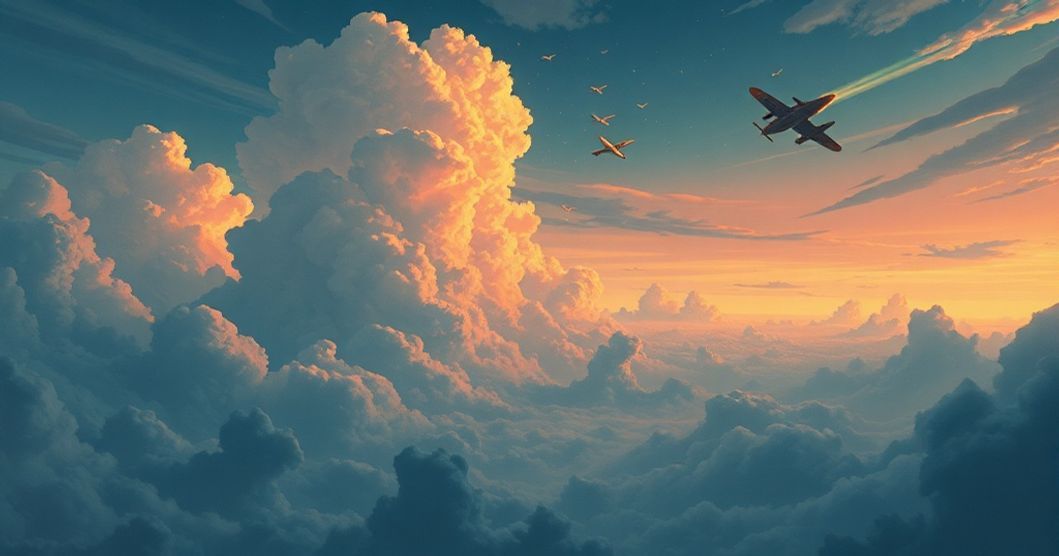
Dreams have a way of revisiting us with eerie precision, and none haunted my consciousness quite like the recurring 'Sky Battle' dream that unfolded twice in rapid succession, etched into my memory with the clarity of a photograph. The first time, I stood atop a massive, sloping hill carpeted in emerald grass, overlooking an endless expanse of untouched prairie stretching to the horizon. Beside me stood a silent companion—a man whose face I never saw, yet whose presence felt both familiar and purposeful. We said nothing, bound by an unspoken understanding that this moment held significance, our gaze fixed on the distant skyline where a faint shimmer hinted at something approaching. A gentle breeze carried the scent of wildflowers, and the sunlight bathed the landscape in golden warmth, creating a paradoxical calm before the storm. Then, without warning, he pointed toward the horizon, and my eyes strained to focus on a tiny cluster of specks in the distance—swarms of what appeared to be gnats, yet growing exponentially as they surged toward us, their movement erratic and chaotic. What began as a distant murmur of activity became a thunderous crescendo of motion as thousands of these airborne forms converged, their shapes resolving into sleek, unfamiliar aircraft. Among them flickered flashes of colored light—red, yellow, green, purple—like fireworks, yet more dangerous, as if these were weapons. I realized too late they were fighter jets, their laser beams slicing through the sky in controlled bursts, engaged in a frenzied dogfight so dense they seemed to merge into a single, swirling mass. Their maneuvers defied physics: instant 90-degree turns, hovered in place, rear nozzles shifting direction with impossible speed. The beauty of the landscape shattered as explosions erupted, fireballs illuminating the sky, and debris rained down—chunks of metal, burning fragments, and shattered aircraft parts cascading toward the hill. The world dissolved into chaos, and I woke with a gasp, only to find myself in a hospital bed, fragments of the dream still vivid. Hours later, in the recovery room, I drifted back into sleep—and the same dream unfolded identically. This time, the hill was gone, replaced by the interior of my crashed car, the windshield spiderwebbed with glass, smoke curling from the wreckage, and the metallic tang of blood in my nostrils. Yet the dream itself remained unchanged: the silent companion, the horizon swarm, the airborne battle, the rain of destruction. Both dreams had occurred during the same 24-hour period following a car crash that left me with a fractured face and a missing eye, yet the dream’s details stayed fixed as a clockwork mechanism, as if the mind had found a symbolic language to process trauma beyond words.
Part 2: Clinical Analysis
Symbolic Landscape: The Sky Battle as Archetypal Conflict
Want a More Personalized Interpretation?
Get your own AI-powered dream analysis tailored specifically to your dream
🔮Try Dream Analysis FreeThe recurring sky battle dream reveals a rich tapestry of symbolic imagery that transcends literal interpretation. The hilltop setting represents a vantage point of observation and safety—a psychological threshold where the dreamer contemplates overwhelming forces. The silent companion embodies the unconscious self or a repressed aspect of identity, present yet unnamed, suggesting an internal dialogue beyond conscious awareness. The horizon swarm of aircraft functions as a collective threat archetype, mirroring how trauma often presents as an inescapable, overwhelming force. The aircraft themselves—with their laser weapons and impossible maneuvers—represent advanced psychological defenses or tools for conflict resolution, their colors (red, yellow, green, purple) signifying emotional states or different approaches to conflict (anger, fear, hope, intuition). The debris and explosions symbolize the shattering of old identities and the collapse of previously held beliefs, while the hill’s vulnerability to destruction reflects the dreamer’s sense of being caught in forces beyond control.
Psychological Undercurrents: Trauma, Repetition, and the Unconscious
From a Jungian perspective, the repeated dream narrative functions as a mandala—a symbolic container for integrating fragmented experiences. The sky battle mirrors the individuation process, where the unconscious confronts the shadow self through symbolic conflict. The two identical dream occurrences suggest a repetition compulsion, a psychological mechanism to process unresolved trauma. Freud might interpret the dream as a wish fulfillment: the control of one’s environment through symbolic mastery of the chaotic battle. Neuropsychologically, this phenomenon aligns with the brain’s default mode network, which processes emotional memories during sleep. The dream’s unchanging structure during two distinct physical states (hilltop vs. car interior) indicates the mind’s attempt to stabilize meaning despite external chaos. The dream’s precision suggests an attempt to create order from trauma, using symbolic language to encode the emotional experience of the crash without direct conscious access.
Emotional and Life Context: Trauma, Transition, and Symbolic Healing
The dream’s timing (December 1999, age 19) coincides with a period of life transition—leaving adolescence, entering adulthood, and the abrupt shift from independence to vulnerability. The car crash, a physical manifestation of this transition, likely triggered the dream’s symbolic warfare. The two dream occurrences during the 24-hour period following the crash suggest the mind’s need to process trauma in stages: initial shock (first dream), then deeper integration (second dream). The dream’s refusal to adapt to changing circumstances (hill vs. car) indicates the mind’s resistance to letting go of the symbolic framework until it’s fully processed. The recurring nature of the dream also reflects the body’s need for emotional closure; the mind cannot move forward until the trauma is symbolically resolved, as seen in the dream’s completion of the battle narrative.
Therapeutic Insights: From Dream to Healing
The sky battle dream offers several therapeutic pathways for integration. First, journaling the dream’s details can help identify patterns in the dreamer’s relationship with conflict. The silent companion might represent a neglected part of self that needs acknowledgment. The dream’s emphasis on impossible maneuvers suggests the need to embrace flexibility in problem-solving, rather than rigid control. Visualization exercises could transform the chaotic battle into a controlled narrative, empowering the dreamer to rewrite the symbolic conflict. Mindfulness practices focused on breath and grounding can help the dreamer differentiate between symbolic anxiety and present-moment safety. The dream’s repetition also suggests the importance of patience in healing, allowing the unconscious to process trauma at its own pace without forcing resolution.
FAQ Section
Q: Why did the dream repeat exactly twice?
A: Dreams repeat to ensure emotional processing is complete; the number two often signifies duality or the need for balance, suggesting the mind required two distinct states (conscious and unconscious) to fully integrate the trauma.
Q: What does the colored light symbolism mean?
A: Colors represent emotional states—red (anger), yellow (fear), green (survival instinct), purple (intuition)—showing how the mind categorizes and processes complex emotions during trauma.
Q: How can I apply this dream to real-life challenges?
A: Use the dream’s imagery as a metaphor for life conflicts: acknowledge the