
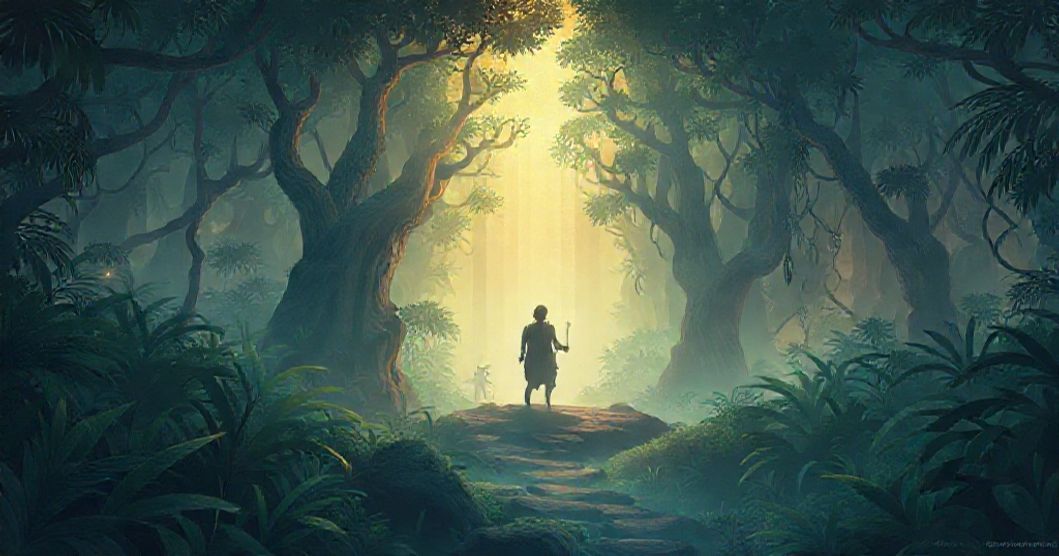
Part 1: Dream Presentation
Dreams often serve as portals to the unconscious, bridging the gap between our waking selves and deeper psychological truths. This vivid dream, set in a moonlit jungle, weaves together themes of initiation, healing, and familial connection through powerful symbolic imagery.
Under a silvery moon, I found myself walking through a dense jungle, the path barely visible beneath tangled vines and shadowed trees. Several figures followed closely behind, their presence both comforting and indistinct in the dim light. The air hummed with an unspoken tension, and then—without warning—a sharp alarm cut through the stillness, jolting me into confusion. A narrow corridor suddenly opened in the vegetation, and from its depths emerged a tribe of natives, their movements urgent and purposeful as they responded to the disturbance. Among the group, a small ferret I’d been carrying froze mid-stride, its body rigid with fear. I called to it, and it darted beneath my legs, seeking shelter.
Before I could react, an imposing man stepped forward—an angry, determined shaman with a weathered face and intense eyes. He advanced rapidly, arms outstretched in a defensive stance, his people fanning out behind him. I raised my hands in a gesture of surrender, but he grabbed my arm forcefully, pressing a burning stick against my skin. His intention was clear: to administer Kambo, a sacred frog poison, as a rite of passage. I wrenched my arm back, my voice rising with equal intensity: “What?!” I met his gaze defiantly, refusing his unasked-for ritual.
Want a More Personalized Interpretation?
Get your own AI-powered dream analysis tailored specifically to your dream
🔮Try Dream Analysis FreeThe shaman, momentarily surprised, explained gravely that this was a necessary purification—a right of passage I couldn’t refuse. Before I could argue further, he pricked my arm with the burning stick, the heat searing my skin, and applied the poison to the wound. Instantly, I felt my consciousness fracturing, slipping into an altered state where reality warped and visions erupted before me. The journey was intense, filled with swirling colors and chaotic imagery I couldn’t fully recall, but my body burned with a feverish heat that threatened to consume me.
In the distance, a woman’s voice cut through the haze—a song, haunting and ancient. In my vision, I saw women seated on smooth rocks, washing clothes beneath cascading waterfalls. As they sang, the cool stream rushed over me, dousing the fever and stilling my racing mind. The visions faded, and I emerged from the altered state to find my younger brother nearby, sweating profusely and struggling through his own trial. “Breathe,” I urged, offering water. The shaman nodded approvingly, his stern expression softening. Then my mother appeared, her eyes tired yet knowing, as if she too had traversed a similar threshold. “I didn’t expect this,” she said. “Neither did I,” I replied, and in that moment, a profound understanding passed between us.
To my left, a young woman knelt, her face hidden beneath a headdress of vibrant colors—red, orange, yellow, green, blue—adorned with swirling patterns that seemed to pulse with energy. “I heard your song,” I told her. “It was me,” she answered. “I saw the vortex of energy around you and sang to guide you.” As we spoke, a boy passed by and accidentally knocked the headdress from her head. I turned away out of respect, letting her retrieve it.
The ceremony concluded, and I searched for my car, only to find no trace of it. I tried several vehicles, none fitting, before settling on a bicycle. I rode through a garage, passing a woman in a red jumpsuit, and emerged into bright sunlight. Outside, two women laughed as they fell from a crumbling tree branch, their joy unburdened by the fall. Then I woke, heart still racing from the intensity of the vision.
Part 2: Clinical Analysis
Symbolic Landscape of the Dream
The dream’s symbolic elements form a rich tapestry of psychological themes. The moonlit jungle serves as a classic symbol of the unconscious mind—dense, unknown, yet alluring. Its narrow path represents the journey of self-discovery, while the sudden alarm and tribal emergence mirror moments of confrontation with one’s deeper self or societal expectations. The ferret embodies intuition and fear: its freezing response reflects a primal instinct to retreat, while seeking shelter beneath the dreamer’s legs suggests reliance on one’s own resources during uncertainty.
The shaman and Kambo poison are central to the dream’s narrative. Kambo, a real Amazonian plant medicine, symbolizes transformative purification—a process of letting go of old patterns to make space for growth. The shaman’s initial aggression (grabbing the arm, applying poison without permission) may represent external pressures to conform to traditional or cultural expectations of “passage.” The dreamer’s resistance (“What?!”) highlights an internal conflict between autonomy and the call to undergo necessary change.
The washing women and their song introduce healing and emotional release. Water, a universal symbol of purification, cools the dreamer’s burning body, representing the soothing effect of emotional catharsis. Their synchronized singing suggests collective healing—an acknowledgment that transformation often occurs within community.
Psychological Layers: Jungian and Freudian Perspectives
From a Jungian framework, the shaman functions as a wise old man archetype—a guide facilitating psychological integration. His confrontation with the dreamer mirrors the individuation process, where the ego (represented by the dreamer’s resistance) clashes with the collective unconscious (the shaman’s authority). The family members (brother, mother) embody the dreamer’s shadow and anima/animus—parts of the self that require recognition and integration. The mother’s line “I now understand you” suggests reconciliation with repressed aspects of the self.
Freud’s lens might interpret the Kambo ritual as a manifestation of repressed desires for control and purification. The shaman’s forceful approach could symbolize the superego’s demands, while the dreamer’s defensive response reflects the ego’s struggle against external pressures. The altered state of consciousness represents the id’s urge to break free from rational constraints, seeking deeper truth.
Neuroscientifically, the dream’s intensity aligns with REM sleep’s role in processing emotional memories. The feverish heat and visions likely correspond to the brain’s attempt to consolidate emotional experiences, while the cooling water and song represent the body’s natural regulatory systems—both physiological and psychological—working to restore balance.
Emotional Context: Waking Life Triggers
This dream likely emerges from the dreamer’s encounter with significant life transitions, such as career shifts, relationship changes, or identity exploration. The right of passage theme suggests a period of self-examination where the dreamer feels pressured to “prove” their worth or undergo transformation. The shaman’s uninvited ritual may reflect real-world situations where others impose their expectations without empathy.
Family dynamics play a crucial role: the brother’s struggle and mother’s wisdom suggest unresolved generational patterns. The dreamer’s role as a guide to her brother hints at a desire to mentor or protect loved ones during their own journeys—a common theme in midlife or post-college transitions.
The headdress and icaro (Amazonian healing song) symbolize ancestral wisdom and spiritual connection. The headdress’s vibrant colors and patterns represent the dreamer’s spiritual identity, while the song’s role in guiding the dreamer reflects a yearning for purpose and belonging.
Therapeutic Insights: Integration and Reflection
The dream invites the dreamer to recognize transformation as a collaborative process, not a solitary one. The shaman’s initial aggression and the dreamer’s resistance highlight the tension between external expectations and internal autonomy—a dynamic to explore in waking life. Journaling specific dream symbols (ferret, washing women, headdress) can reveal recurring themes in daily life.
Practical reflection exercises include: 1. Shadow Work: Exploring the “shaman” figure as a projection of external pressures; journaling about moments when others’ expectations feel forced. 2. Healing Rituals: Creating personal “purification” practices (e.g., journaling, nature walks) that honor autonomy while embracing growth. 3. Family Dialogue: Initiating conversations with family members about shared struggles and support needs, mirroring the dream’s reconciliation between mother and child.
The bicycle’s appearance (a symbol of freedom and adaptability) suggests embracing new paths when old structures (like the missing car) no longer serve. The falling women laughing reflect life’s unpredictability—finding joy in vulnerability rather than fear.
FAQ Section
Q: What does the Kambo poison symbolize in this dream?
A: Kambo represents transformative purification—letting go of old patterns to grow. Its forced administration highlights tension between external expectations and personal autonomy, urging the dreamer to reclaim agency in their healing journey.
Q: Why is the ferret’s reaction significant?
A: The ferret’s fear and sheltering reflect primal intuition. It signals the dreamer’s need to trust their inner wisdom during uncertainty, while the act of protecting it underscores self-compassion in vulnerable moments.
Q: How do the family members represent the dreamer’s internal landscape?
A: The brother (struggling) mirrors the dreamer’s own challenges; the mother (understanding) symbolizes self-acceptance. Together, they represent the integration of past and present, guiding the dreamer toward reconciliation and support.