
Part 1: Dream Presentation
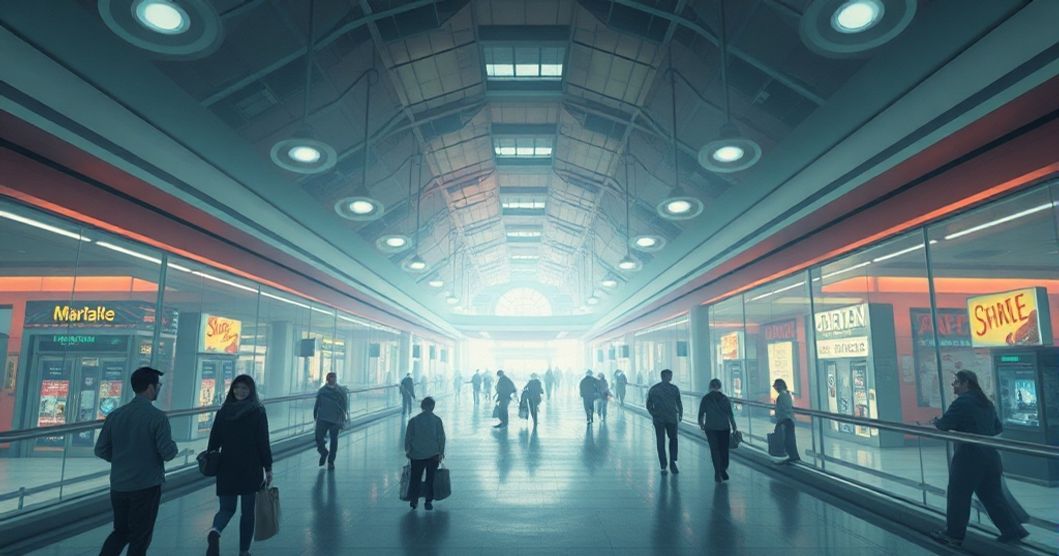
Dreams often serve as mirrors reflecting our inner landscapes, and this particular dream presents a vivid, multifaceted journey through a surreal mall environment that pulses with symbolic meaning. The dreamer begins in New York City, a place traditionally associated with opportunity and reinvention, yet quickly descends into chaos. What starts as a hopeful quest for change transforms into a disorienting descent into a liminal space—the abandoned mall that paradoxically becomes both a refuge and a labyrinth of psychological themes. The dream’s core unfolds through a series of escalating tensions and surreal encounters, creating a narrative that mirrors the dreamer’s internal conflict between desire for transformation and fear of the unknown.
The rewritten dream captures this journey: the dreamer’s initial hope for a fresh start in NYC gives way to homelessness and loss, leading to the discovery of an abandoned mall that suddenly reawakens with activity. This paradoxical stillness within movement mirrors the dreamer’s internal state—stuck yet in motion, lost yet searching. The Uber driver, who appears repeatedly in different states of distress, represents the dreamer’s relationship with change itself: sometimes eager to participate, sometimes paralyzed by uncertainty. The dream’s most striking elements—the 'ADHD Corner,' the 18+ area, the gorilla-costumed figure, and the police confrontation—each serve as psychological signposts pointing to deeper emotional terrain.
Part 2: Clinical Analysis
Want a More Personalized Interpretation?
Get your own AI-powered dream analysis tailored specifically to your dream
🔮Try Dream Analysis FreeSymbolic Landscape: The Mall as Psychological Metaphor
The abandoned mall at the dream’s center is a powerful Jungian archetype of the unconscious mind—an enclosed space where repressed emotions and unresolved conflicts take physical form. Its three stories symbolize the dreamer’s psychological layers: the ground floor (18+ area, ADHD store) represents primitive desires and cognitive dissonance, the middle level (escalators, activity) embodies the dreamer’s current life path, and the upper levels (gorilla chase, police) signify confrontation with deeper fears. The mall’s transformation from abandoned to active mirrors the dreamer’s internal shift from stagnation to forced adaptation.
The 'ADHD Corner'—with its flashing lights and unsettling label—likely represents the dreamer’s struggle with focus and identity in a world that often demands constant productivity. The ADHD diagnosis, in popular culture, has become shorthand for feeling 'unfocused' or 'disordered' in modern life, suggesting the dreamer may feel fragmented or misunderstood in their waking pursuits. The 18+ area, with its naked women, symbolizes temptation and societal pressure to conform to adult expectations, yet the dreamer’s resistance indicates a subconscious boundary between desire and self-preservation.
Psychological Currents: Anxiety and the Uncanny Valley of Change
Freud would likely interpret the dream as a manifestation of repressed anxieties about identity and direction. The Uber driver’s transformation—from able-bodied to handicapped, from vomiting to chasing—represents the dreamer’s fear of losing control over their life trajectory. The gorilla-costumed figure, a classic Jungian shadow archetype, embodies primal fears and the 'wild' aspects of the self that the dreamer struggles to integrate. The figure’s pursuit mirrors the dreamer’s internal conflict between embracing their authentic self and hiding from it.
Cognitive dream theory suggests this dream processes the dreamer’s waking experience of feeling 'stuck' during illness. The '25 days' vs. '1 day' perception reflects the dream’s uncanny time distortion—a hallmark of dreams, where emotional intensity compresses linear time. This distortion mirrors how the dreamer’s internal timeline of healing or transformation feels both accelerated and disjointed.
Emotional & Life Context: Uncertainty as a Catalyst for Change
The dreamer’s focus on loved ones during the climax reveals a deep-seated need for connection amid chaos—a reflection of how stressors often sharpen our awareness of what truly matters. The transition from 'wanting to start over' to homelessness suggests the dreamer is experiencing a crisis of purpose, possibly related to career, relationships, or self-image. The loss of artwork and near-train collision symbolize existential threats to the dreamer’s creative identity and sense of safety.
The dream’s emphasis on 'the same Uber driver' across different states (healthy, sick, crippled) suggests the dreamer’s relationship with change is complex—sometimes embracing it, sometimes fearing its consequences. The 'panic attacks' throughout the dream likely correspond to waking anxiety about balancing responsibilities with personal growth. The dreamer’s resistance to the elevator, despite temptation, reflects a core conflict between following others’ paths and forging their own.
Therapeutic Insights: Navigating the Labyrinth of Self
This dream offers an opportunity for the dreamer to reflect on their relationship with change. The abandoned mall, once a place of loss, becomes a space of discovery—a reminder that transformation often requires entering the unknown. The police confrontation, with its glitter and candy, suggests that even when 'caught' in life’s chaos, there remains a childlike innocence worth preserving.
Practical exercises could include journaling about moments of 'ADHD Corner' anxiety, exploring where focus feels fragmented in daily life. The dreamer might benefit from mindfulness practices to navigate the tension between desire for change and fear of the unknown. The gorilla chase, though terrifying, represents the necessity of facing one’s shadows rather than fleeing them. Reconnecting with loved ones, as the dreamer did, reinforces the importance of emotional anchors during periods of uncertainty.
FAQ Section
Q: What does the abandoned mall represent in this dream?
A: The abandoned mall symbolizes the dreamer’s internal landscape of transformation—once a place of potential (like NYC), now feeling lost yet full of possibility. It mirrors the process of starting over amid uncertainty.
Q: Why did the dreamer feel both temptation and resistance at the 18+ area?
A: This represents the tension between societal expectations and personal boundaries. The dreamer’s resistance suggests a subconscious commitment to self-respect, even when tempted by external pressures.
Q: How should the dreamer interpret the '25 days' vs. '1 day' perception?
A: This time distortion reflects how intense emotional experiences feel both long and short. It suggests the dreamer’s healing process feels disjointed, with progress occurring faster than they anticipated.