
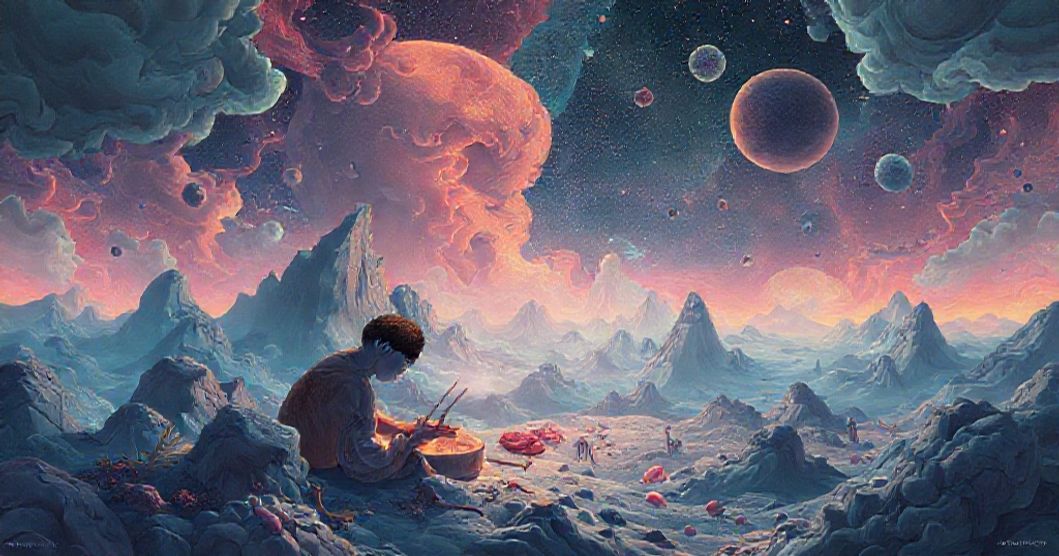
Part 1: Dream Presentation
Dreams often serve as mirrors reflecting our unconscious conflicts, and this particular dream offers a striking encounter with a cosmic figure whose message carries profound implications for both dietary choices and the nature of consciousness. The dream begins with the dreamer preparing for a psychedelic journey, a context that frames the subsequent imagery as potentially prophetic or psychologically significant. In the setting of an old house bedroom, the dreamer finds themselves meditating—a state of introspection that becomes the threshold for the encounter with the cosmic man.
The cosmic man appears between the dreamer and the wall, a liminal space symbolizing the boundary between the conscious and unconscious mind. His gesture of the middle finger is not merely an insult but a primal, direct form of communication, bypassing words to convey rejection or confrontation. The transformation into various shapes—serpent, flame, vortex—suggests fluidity of identity or the shifting nature of reality during altered states, while also evoking the archetypal 'trickster' figure who disrupts comfort with uncomfortable truths. The dreamer’s immediate recognition that the insult stems from meat consumption reveals an unconscious connection between dietary choices and moral unease. The return to human form signals a resolution of sorts, yet the figure retains its stern presence, indicating that this confrontation is not fleeting but demands attention.
The dream’s closing question—'What is the purpose of life?'—and the cosmic man’s answer—'To expand consciousness'—frame the entire narrative as a philosophical inquiry. The dreamer’s confusion about this purpose highlights an existential tension between action and meaning, between personal growth and societal expectations. Together, these elements create a rich tapestry of psychological symbolism and ethical reflection.
Want a More Personalized Interpretation?
Get your own AI-powered dream analysis tailored specifically to your dream
🔮Try Dream Analysis FreePart 2: Clinical Analysis
Symbolic Landscape: The Cosmic Man and Transforming Forms
The cosmic man represents a multifaceted symbolic figure, drawing from several psychological archetypes. In Jungian terms, he embodies the shadow—the repressed aspects of the psyche that demand acknowledgment. His insult, conveyed through the middle finger, is a primal rejection, a refusal to accept the dreamer’s current state of denial. The transformation into serpent, flame, and vortex suggests the shadow’s ability to take many forms, each representing different aspects of the dreamer’s unintegrated self: the serpent as primal instinct, the flame as destructive passion, the vortex as chaotic unconscious energy. The old house itself functions as a repository of memories, perhaps symbolizing the dreamer’s connection to their past self—a self still carrying unexamined ethical choices.
The act of meditation in this space underscores the dreamer’s intentionality, their attempt to quiet the mind and listen to internal messages. The cosmic man’s appearance during this vulnerable, introspective state suggests that the unconscious is responding to the dreamer’s upcoming psychedelic journey—a time when consciousness expansion becomes both literal and metaphorical. The figure’s return to human form after transformation may signify the need to ground spiritual insights in concrete, ethical action.
Psychological Undercurrents: Guilt, Compassion, and Psychedelic Visions
From a Freudian perspective, the dream reflects the superego’s criticism of the id’s desires. The dreamer’s meat consumption triggers a punitive internal voice—represented by the cosmic man—that manifests as a direct confrontation. This aligns with Freud’s theory of dream work as a compromise formation, where repressed guilt is transformed into symbolic imagery. The dream’s timing, just before a psychedelic trip, suggests that the unconscious is preparing the dreamer for the intense self-examination that psychedelics often catalyze.
Jungian psychology offers a complementary view, framing the cosmic man as a collective unconscious archetype—a figure who bridges the personal and transpersonal realms. His message about 'expanding consciousness' aligns with Jung’s concept of individuation, the process of integrating conscious and unconscious parts of the psyche. The dream thus becomes a call to action: not just intellectual expansion but experiential integration of moral awareness.
Neuroscientifically, the dream may represent the brain’s default mode network activating during meditation, creating a space for processing ethical dilemmas. The vivid imagery and emotional intensity suggest heightened neural activity in regions associated with self-referential processing and moral judgment—a natural response to confronting deeply held beliefs.
Emotional Resonance: The Weight of Animal Harm and Interconnectedness
The dreamer’s immediate association of the cosmic man’s appearance with meat consumption reveals a profound emotional conflict. This connection suggests that the dreamer feels morally responsible for animal suffering, even if intellectually they may justify their choices. The dream’s insight—that 'we human deserve every pain we have on earth because of what we’re doing with other creatures'—reflects a karmic or energetic worldview, where harm creates a cycle of suffering that rebounds personally.
The cosmic man’s presence during psychedelics hints at a universal truth: when consciousness expands, the veil between self and others thins, making harm more immediately visceral. This aligns with contemporary psychedelic research suggesting that such experiences often foster interconnectedness, empathy, and ecological awareness. The dream’s warning is thus both personal and collective: our dietary choices are not isolated acts but contribute to a larger energetic system.
Therapeutic Insights: From Dream to Ethical Living
This dream offers several therapeutic pathways for integration. First, it invites the dreamer to examine the gap between their actions and values regarding animal welfare. Journaling exercises could help explore specific ethical conflicts, such as whether meat consumption aligns with their stated values of compassion. Psychedelic preparation practices that include ethical intention-setting may help process these tensions before the actual trip.
Second, the dream’s focus on 'expanding consciousness' suggests a shift from intellectual understanding to experiential growth. This could involve practices like mindfulness meditation, where the dreamer learns to observe thoughts without judgment—a skill that deepens during psychedelic experiences. Additionally, exploring community-based initiatives or plant-based alternatives may translate the dream’s moral insight into tangible action.
Finally, the dream’s question about life’s purpose as 'expanding consciousness' can be reframed as a call to integrate multiple aspects of self: intellectual, emotional, and spiritual. This aligns with humanistic psychology’s emphasis on self-actualization, where consciousness expansion becomes a lifelong journey of self-discovery.
FAQ Section
Q: Why did the cosmic man specifically target meat-eating in the dream?
A: The dreamer’s unconscious likely associates meat consumption with guilt or moral conflict, manifesting as a direct confrontation. This suggests the need to examine whether dietary choices align with their core values of compassion.
Q: What does the cosmic man’s transformation symbolize?
A: The shifting forms represent the fluidity of identity and the unconscious, while also reflecting the dreamer’s fear of confronting uncomfortable truths about their actions and their impact on others.
Q: How can the dreamer practically 'expand consciousness' as suggested?
A: Practices like psychedelic integration, ethical reflection, and mindfulness meditation can help translate the dream’s insight into lived experience, fostering interconnectedness and moral awareness.
Keywords: cosmic man, psychedelic trip, meat-eating, consciousness expansion, animal suffering, shadow archetype, ethical dilemmas, old house, interconnectedness, moral responsibility Entities: cosmic figure, old house, meat-eating practice, consciousness expansion, psychedelic experience