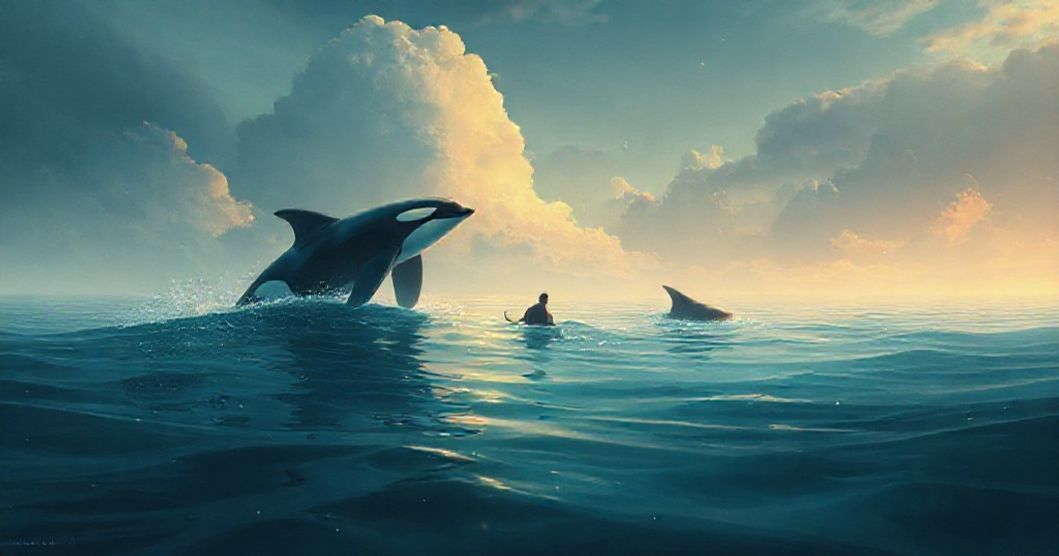
Part 1: Dream Presentation\n\nDreams often serve as mirrors reflecting our inner conflicts and unacknowledged truths, and this particular dream offers a vivid tableau of paradox: the simultaneous terror and fascination of encountering primal forces in a controlled yet unstable environment. The dreamer finds themselves on a boat with an erratic driver, their sister, and an indistinct companion, navigating from a solid, rocky foundation toward open waters. As they depart the imposing rocky mountain attached to the mainland, they enter a channel bordered by drains that funnel toward the ocean—a liminal space between solid ground and the vast unknown. A stranded, wet, and sorrowful dog on one of these drain platforms captures the dreamer’s attention, but the driver’s reckless speed prevents intervention, leaving the dog as a silent witness to unaddressed concern.\n\nIn the middle of the ocean loop, the dreamer’s world shifts dramatically. The water shimmered, and then they appeared: orcas, sleek and powerful, cutting through the waves. One swam alongside me, its massive head brushing my leg in a gentle nibble that sent a jolt of terror through me yet simultaneously drew me in with its primal grace. I tried to understand its meaning in that moment, but the dream offered no clarity. The driver, now completely erratic, accelerated dramatically, and we plunged into the water—surprisingly shallow, not the deep ocean I’d expected. As we descended, multiple orcas surrounded us, their sleek forms matching our descent speed precisely, their eyes meeting ours nose-to-nose as we ascended. This dance repeated three times, a rhythmic dialogue between our small boat and these ancient creatures.\n\nThen, one orca positioned itself alongside me, as if dancing, its sleek body brushing my thigh in a soft, almost affectionate nuzzle that felt both intimate and wild. The paradox of this encounter—the simultaneous terror and awe—defined the dream. I felt both small and powerful, overwhelmed yet strangely connected. When I woke, the emotions lingered: the weight of responsibility for the stranded dog, the thrill of dancing with these majestic creatures, and the unsettling sense that some deeper truth had found its way into my unconscious mind.\n\n## Part 2: Clinical Analysis\n\n### 1. Symbolic Landscape: Decoding the Dream’s Imagery\n\nThe boat serves as a powerful symbol of life’s journey and the sense of control we attempt to maintain. The erratic driver represents external forces or internal impulses that feel out of our control, while the sister and unnamed companion suggest relationships and social connections that shape our experience. The rocky mountain, attached to the mainland, embodies foundational elements of identity or security we rely on, yet from which we must eventually depart.\n\nThe drains and stream leading to the ocean symbolize a passage from structured, surface-level concerns to deeper, more primal aspects of self. The stranded dog, overlooked by the others, is a key symbol of unaddressed emotions or responsibilities. Its silent plea reflects the dreamer’s awareness of something important they’ve neglected—a relationship, a personal need, or a moral obligation. The dog’s sadness and the driver’s refusal to help highlight a conflict between action and inaction, responsibility and avoidance.\n\nOrcas, as the dream’s central figures, represent the dual nature of powerful emotions and instincts. Their massive size and wild nature evoke primal fears—the fear of being overwhelmed by forces beyond our control—while their apparent intelligence and social structure suggest a connection to intuition, wisdom, and emotional depth. The orcas’ dual threatening/affectionate behavior (nibbling legs, dancing alongside) reflects the paradoxical nature of confronting our fears: they can be both terrifying and alluring, destructive and healing.\n\n### 2. Psychological Undercurrents: Theoretical Perspectives\n\nFrom a Jungian perspective, orcas embody the shadow archetype—those parts of ourselves we fear or repress but cannot ignore. The shadow, when integrated, becomes a source of power and wisdom, explaining the orcas’ simultaneous terror and fascination. The dance with the orca represents the dreamer’s attempt to integrate this shadow aspect rather than flee from it.\n\nFreud might interpret the orcas as manifestations of repressed sexual or aggressive impulses. The orca’s nibbling and dancing could symbolize unresolved childhood conflicts or adult relationship issues, particularly regarding boundaries and intimacy. The driver’s erratic behavior might reflect the dreamer’s unconscious anxiety about losing control in relationships or life decisions.\n\nCognitively, dreams function as problem-solving mechanisms. The repeated diving with orcas, matching their speed, suggests the dreamer is processing a waking challenge by visualizing a dialogue with their fears. The three repetitions indicate this is a recurring theme needing attention.\n\nNeuroscientifically, the dream reflects the brain’s REM sleep activity, where emotional memories are consolidated. The orcas’ presence during REM sleep might indicate the brain’s attempt to process emotional intensity and integrate conflicting feelings into a coherent narrative.\n\n### 3. Emotional & Life Context: Connecting to Waking Experience\n\nThe dream likely reflects the dreamer’s current emotional state of ambivalence—simultaneously drawn to and repelled by a significant life change or relationship. The stranded dog suggests a sense of responsibility they feel for someone or something in their waking life, perhaps a family member, project, or personal goal they’ve neglected. The driver’s refusal to help the dog mirrors a pattern of avoiding difficult conversations or responsibilities.\n\nThe orcas’ dual nature mirrors the dreamer’s internal conflict: they feel both attracted to and afraid of deep emotional engagement. The shallow water during dives might represent a situation where they’re overestimating their ability to handle emotional depth, while the orcas’ matching speed suggests they’re learning to meet these challenges rather than flee.\n\nThe sister’s presence hints at unresolved relationship dynamics, possibly a need for closer connection or a desire to resolve past tensions. The unnamed companion might represent a third force in their life—perhaps a new opportunity, a friend, or a part of themselves they’re struggling to acknowledge.\n\n### 4. Therapeutic Insights: Applying the Dream’s Message\n\nThe dream urges the dreamer to acknowledge overlooked aspects of self and relationships. Journaling about the stranded dog could reveal what responsibilities or emotions they’ve neglected. Reflecting on the orcas’ dual nature—both terrifying and affectionate—might help them embrace life’s paradoxes rather than dichotomizing experiences as either good or bad.\n\nPracticing mindfulness during moments of conflict could help integrate the shadow aspects represented by the orcas. Instead of fleeing from difficult emotions, the dream suggests engaging with them directly, as the orcas’ dance with the dreamer indicates a harmonious relationship with these forces.\n\nThe dreamer should ask themselves: What responsibilities have I neglected? How can I balance action with care? What fears am I avoiding that could become sources of strength? These questions guide the integration of the dream’s lessons into daily life.\n\n### 5. FAQ Section\n\nQ: Why does the dreamer feel both frightened and enthralled by the orcas?\nA: This duality reflects the human experience of confronting powerful emotions—they can be terrifying (fear of loss of control) yet alluring (attraction to the unknown). The orcas represent the tension between safety and growth, urging the dreamer to embrace both.\n\nQ: What does the driver’s erratic behavior symbolize?\nA: The driver embodies internal or external forces that feel out of control—anxiety, uncertainty, or relationship dynamics. Their refusal to help the dog highlights a pattern of avoiding responsibility, suggesting the dreamer needs to address these patterns.\n\nQ: How can the dream help with daily life?\nA: The dream encourages acknowledging overlooked emotions and responsibilities. By practicing mindfulness during conflicts, the dreamer can transform fear into strength, integrating the orcas’ primal wisdom into their decision-making.\n\nKeywords: orcas, boat, rocky mountain, drains, stranded dog, underwater diving, shadow integration, emotional duality, responsibility, self-awareness, \nEntities: boat driver, sister, stranded dog, orcas, rocky mountain, ocean channel