
Part 1: Dream Presentation
Dreams often serve as portals to our unconscious landscapes, where reality bends and symbols speak in their own language. In this particular dream, the dreamer journeys through a desert at midnight, encounters a distant city, and ultimately confronts a cosmic perspective that redefines their understanding of time, space, and place. The narrative unfolds in distinct scenes, each layered with symbolic weight: the barren desert at midnight, the glowing city in the distance, the floating view of Earth from space, and the pivotal day-night boundary in Jerusalem.
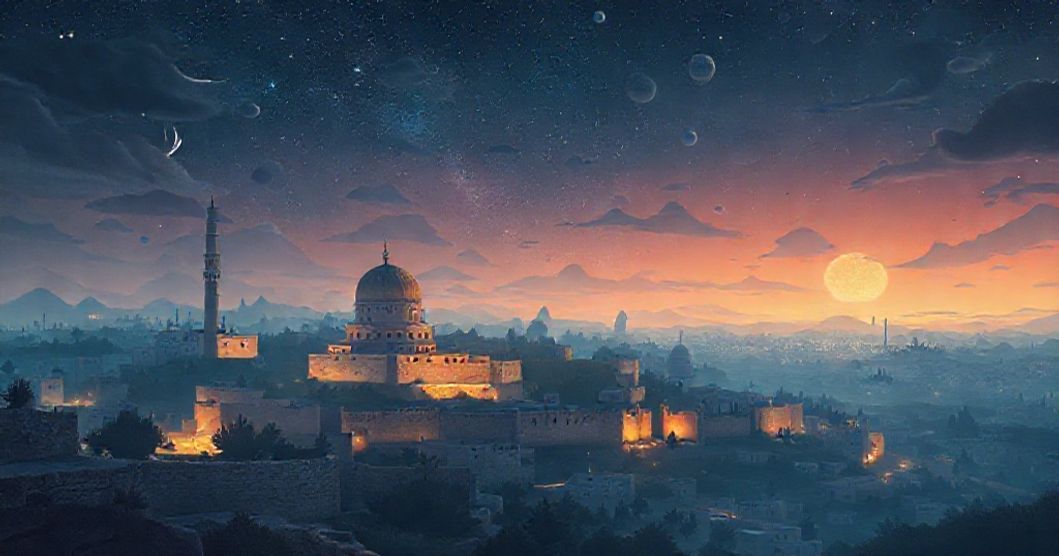
The dream begins in a vast, barren desert at midnight—a time when the world usually surrenders to darkness, yet here the night carries an otherworldly blue hue, as if filtered through a celestial lens. Above, the sky is startlingly clear, sprinkled with stars that blaze with an intensity I’ve never witnessed in waking life. In the distance, a small city glimmers, its lights a warm, golden yellow that cuts through the cool blue night like a beacon. I stand alone at first, though I soon become aware of a group of figures nearby—they wear tattered white robes, simple and unadorned, their faces indistinct in the dim light. I don’t recognize them, yet there’s a strange familiarity, as if we share a silent bond forged in this liminal space.
The dream shifts abruptly, and my perspective transforms. Instead of standing on the desert, I find myself floating in space, looking down at Earth suspended against the backdrop of a star-filled universe. The planet is half-veiled in night, its surface a deep blue-black, while one hemisphere glows with the soft radiance of sunlight, painting a vivid band of day across its curvature. The contrast is stark: the illuminated side and the shadowed side meet in a razor-thin line that seems to stretch infinitely. I realize I’m positioned precisely along this boundary, where night and day collide.
Want a More Personalized Interpretation?
Get your own AI-powered dream analysis tailored specifically to your dream
🔮Try Dream Analysis FreeReturning to the desert, I find myself still at that same boundary, though now the small city is closer, its white-brick houses and clustered tents coming into clearer view. The villagers from before stand beside me, and one of them says, ‘This is Jerusalem.’ The realization washes over me: the city I’ve been drawn to, the lights I’ve seen, the ancient architecture, all point to this sacred place. The desert, once barren and empty, now feels charged with meaning, as if it’s been waiting to reveal this truth. Despite the dream’s puzzling nature—the sudden shifts in perspective, the celestial view of Earth—I feel a strange sense of peace, almost exhilaration, as if I’ve stumbled upon something both ancient and profoundly personal.
I wake with the lingering impression of that blue midnight, the golden lights of Jerusalem, and the boundary line where day and night meet—a boundary that feels both physical and metaphysical, separating yet connecting two realms of experience.
Part 2: Clinical Analysis
Symbolic Landscape: Decoding the Dream’s Visual Language
The desert at midnight serves as a powerful liminal symbol—the dreamer’s unconscious mind, a space of potential and uncertainty where the usual rules of time and place dissolve. The blue hue of the night sky suggests a cool, introspective state, while the golden lights of the distant city represent spiritual longing or the illumination of knowledge. In dreamwork, the desert often signifies a journey of self-discovery, a place where one confronts their inner truths without the distractions of everyday life.
The floating view of Earth from space is a striking example of ego dissolution—a common Jungian theme where the dreamer transcends their individual perspective to see the larger whole. This cosmic perspective mirrors the dreamer’s agnostic yet curious relationship with spirituality: they’re not fully committed to religious dogma but are drawn to exploring its symbolic and psychological dimensions. The half-illuminated Earth reflects the tension between known and unknown, light and dark, which often characterizes dreams of spiritual exploration.
The day-night boundary is a key symbolic element, representing the threshold between conscious and unconscious awareness. In this dream, the boundary is literalized as a physical line the dreamer stands on, embodying the process of integration between opposing states of being. The villagers in white robes add another layer of meaning: white often symbolizes purity or transcendence, while their tattered appearance suggests a spiritual journey marked by struggle or simplicity. Their presence alongside the dreamer implies a collective experience of this boundary, suggesting the dreamer is not alone in their spiritual questioning.
Psychological Perspectives: Jungian, Freudian, and Modern Interpretations
From a Jungian perspective, Jerusalem emerges as a mandala—a central symbol representing wholeness and meaning. Jung viewed mandalas as manifestations of the self, the unconscious striving for integration. For the dreamer, Jerusalem, as a site of historical and spiritual significance, likely embodies the self’s search for meaning and connection. The desert journey could represent the individuation process, where the dreamer confronts their shadow aspects and integrates them into a more complete sense of self.
Freud might interpret the dream through the lens of repressed desires or unresolved conflicts, particularly given the dreamer’s exposure to religious narratives. The dream’s focus on Jerusalem could reflect unconscious curiosity about religious symbolism, even in the face of agnosticism—a tension between rationality and spiritual yearning. The sudden perspective shift from desert to cosmic view might symbolize the dreamer’s attempt to escape the limitations of everyday thinking, seeking a higher understanding.
Cognitive neuroscience offers another framework: dreams as a byproduct of neural activation during sleep, processing emotional memories and integrating information. The dreamer’s recent study of Gnosticism and Biblical stories likely primed their unconscious to synthesize these themes, resulting in a narrative that merges spiritual concepts with psychological imagery. The day-night boundary could represent the brain’s attempt to organize information into coherent patterns, creating a metaphorical map of how we process light and dark, known and unknown.
Emotional & Life Context: The Unconscious as a Guide
The dreamer’s agnosticism combined with familiarity with religious texts suggests an ongoing dialogue between reason and spirituality. The dream’s pleasant tone despite its puzzling elements indicates that the unconscious is finding value in this exploration, even if the dreamer hasn’t fully processed its implications. The desert, often associated with hardship, becomes a place of revelation here—a paradox that hints at the dreamer’s resilience in facing uncertainty.
The connection to Gnosticism adds another layer: Gnostic thought emphasizes inner illumination and the distinction between material and spiritual realms. The floating Earth from space could symbolize this dualistic perspective, where the dreamer momentarily transcends the material world to see the spiritual dimension. The day-night line, then, represents the threshold between these two realms—a space where the dreamer stands in both, processing their spiritual curiosity.
The dream’s timing and context matter as well: in the waking world, the dreamer may be navigating a period of transition, questioning established beliefs, or seeking deeper meaning. The Jerusalem reference, combined with the cosmic view, suggests a search for meaning that transcends individual experience, touching on universal themes of connection and purpose.
Therapeutic Insights: Integration and Self-Reflection
The dream invites the dreamer to explore their relationship with boundaries—both physical and metaphorical. The day-night line in Jerusalem is a call to embrace duality rather than reject it: light and dark, known and unknown, rational and spiritual. By standing at this boundary, the dreamer is being asked to integrate these opposing forces rather than choose one over the other.
Practical reflection exercises could include journaling about moments of boundary crossing in waking life—times when they’ve felt on the threshold of new understanding. This practice helps identify patterns of openness to new experiences. Mindfulness meditation on the day-night boundary could help the dreamer develop a similar awareness, noticing how they navigate between different states of mind.
For long-term integration, the dreamer might explore their spiritual interests more deeply, whether through studying Gnosticism, engaging with religious texts analytically, or simply reflecting on their dreams as a source of insight. The key is to honor both the rational and the intuitive aspects of their nature, allowing the unconscious to guide without dictating.
FAQ Section
Q: What does the floating Earth symbolize in this dream?
A: The floating Earth represents ego dissolution and the expansion of perspective, suggesting the dreamer’s unconscious is integrating a larger worldview that transcends individual concerns. It may reflect a desire to see life from a more global, less self-centered lens.
Q: Why is Jerusalem the specific location mentioned?
A: Jerusalem is a universal symbol of spiritual significance, history, and duality. For the dreamer, its mention likely reflects their intellectual curiosity about sacred sites and the tension between religious symbolism and agnostic thinking.
Q: How does the dream’s pleasant feeling affect its interpretation?
A: The pleasant tone suggests the unconscious is finding value in the exploration, even if the dreamer hasn’t resolved its meaning yet. It indicates a positive relationship with the self’s spiritual and psychological growth process, signaling that the dream is a helpful tool for integration rather than a source of anxiety.