
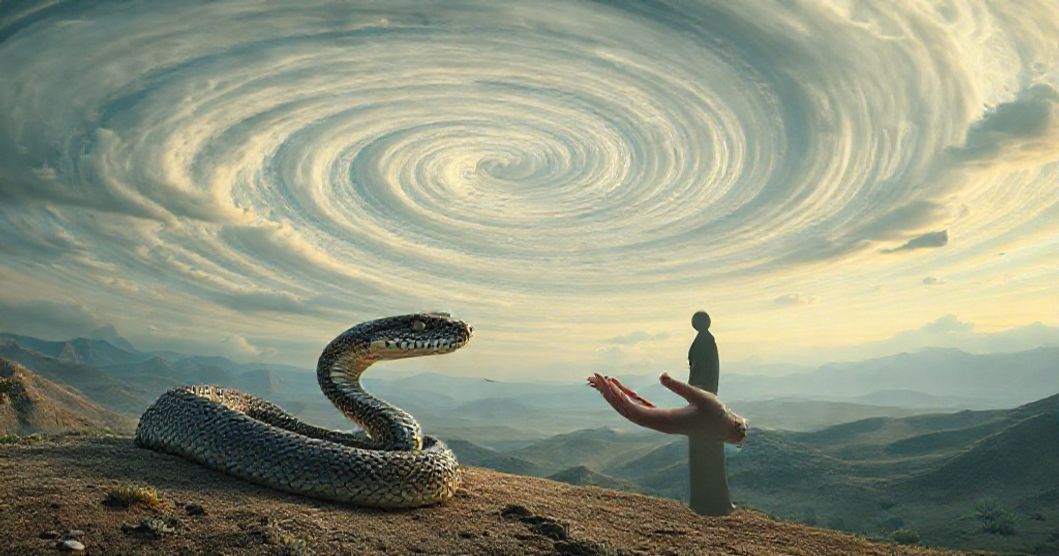
Core Symbols: Rattlesnakes, Whispers, and Skybound Tension
The rattlesnake in your dream is no ordinary serpent—it carries dual symbolism rooted in both primal fear and profound transformation. In Jungian psychology, snakes often represent the shadow self, that which we repress yet cannot ignore, while their rattles signify a warning system: a call to pay attention to unacknowledged truths. Here, the snake isn’t just a threat; it’s a dialogue partner. The act of 'sharing whispers' transforms this dynamic from predator-prey to teacher-student, suggesting your subconscious is attempting to bridge a gap between what you fear to say and what you desperately need to communicate.
The 'rattlesnake skies' add another layer of symbolic depth. Unlike a clear blue sky (representing clarity) or storm clouds (anger), a sky patterned with rattlesnakes merges the celestial realm of intuition with the earthbound primality of the snake. This hybrid setting mirrors the tension between your higher self (sky) and your instinctual, survival-driven self (snake). In Indigenous dreamwork traditions, such skies might signify a 'threshold moment'—a time when the veil between conscious and subconscious thins, making previously hidden messages more accessible.
Psychology Lens: Communication, Shadow, and REM Processing
Want a More Personalized Interpretation?
Get your own AI-powered dream analysis tailored specifically to your dream
🔮Try Dream Analysis FreeNeuroscience offers a complementary perspective: during REM sleep, the brain’s emotional processing centers (like the amygdala) remain active, while the prefrontal cortex—the region governing logic and self-censorship—shuts down. This creates the perfect environment for dreams like yours: raw, unfiltered emotion paired with symbolic imagery. The 'whispering' likely reflects repressed emotions or unspoken truths that your emotional brain is urging you to process.
Jung’s concept of 'active imagination' illuminates this further. When we dream of animals, especially those with primal associations, they often represent parts of ourselves we’ve disowned. The rattlesnake here isn’t the shadow to be feared but the shadow to be integrated—a teacher demanding dialogue, not destruction. In active imagination, engaging with this symbol through journaling or art can reveal hidden aspects of your personality that crave acknowledgment.
Compare this to Freud’s view, which might frame the snake as a phallic symbol or repressed sexual energy. While Freud’s work provides a foundation, modern dream analysis emphasizes context: the 'sharing' element shifts the narrative from individual conflict to relational dynamics, suggesting your subconscious is processing how you communicate with others—especially those who feel threatening yet necessary.
Life Triggers: Unspoken Truths and Boundary Testing
What real-life scenarios might trigger such a dream? Consider recent shifts in your life: a new relationship, career transition, or friendship where you’ve hesitated to speak your mind. The 'rattlesnake' could represent a person or situation that feels simultaneously dangerous and vital—a boundary you’re testing or a vulnerability you’re ready to embrace.
If you’ve recently experienced a loss, betrayal, or unmet expectation, the dream might be urging you to voice your feelings before they fester. The 'whispering' could symbolize a conversation you’ve avoided—with a friend, partner, or even yourself. In social psychology terms, this dream reflects the tension between the need for belonging (the desire to connect) and the fear of rejection (the 'rattlesnake' as a potential threat).
Another trigger: technological or digital overload. In an era of curated online personas, the 'whispering' might represent the urge to strip away filters and communicate authentically, even when it feels risky. The 'rattlesnake sky' could mirror the overwhelming, unpredictable nature of modern communication—where every message carries potential danger (misinterpretation, judgment) yet offers connection.
What To Do Next: From Dream to Action
Short-term reflection: Spend 10 minutes journaling about recent conversations where you felt the urge to speak but held back. Note the emotions tied to these moments—was it fear, excitement, or something else? The snake’s presence may highlight a specific relationship or situation needing your voice.
Medium-term experimentation: Identify one unspoken truth you’ve been avoiding and share it with a trusted confidant. Start small—perhaps a gentle conversation about a minor frustration or a larger vulnerability. Notice how the 'rattlesnake' tension shifts as you embrace this communication.
Long-term integration: Develop a daily practice of 'active listening' to your intuition. When faced with uncertainty, ask: 'What is my subconscious trying to whisper?' This could involve meditation, nature walks, or creative expression—channels that help you process the snake’s dual message of danger and wisdom.
FAQ
Q: Is dreaming of a rattlesnake always about danger? A: No—rattlesnakes symbolize transformation too. If the snake is calm and you’re whispering, it may signal needed change or unspoken wisdom, not just threat.
Q: What does 'sharing whispers' mean in this context? A: It represents subconscious communication—repressed emotions, unspoken truths, or messages you need to hear about yourself or others.
Q: Why would the sky be 'rattlesnake' patterned? A: The sky symbolizes intuition; a 'rattlesnake sky' suggests your inner wisdom is alerting you to something primal yet important, blending danger and guidance.