
Part 1: Dream Presentation
Dreams often serve as psychological mirrors, reflecting our deepest uncertainties in surreal landscapes. This particular night vision, however, transcended typical nightmares to reveal a haunting journey through a crumbling tower and an encounter with a creature that defied understanding. The dream begins in familiar territory—festive parties filled with people the dreamer knows, alcohol flowing, and the comforting rhythm of social celebration. Yet beneath this surface of comfort, an undercurrent of unease simmers, signaling the dream’s true purpose: to explore boundaries between safety and collapse.
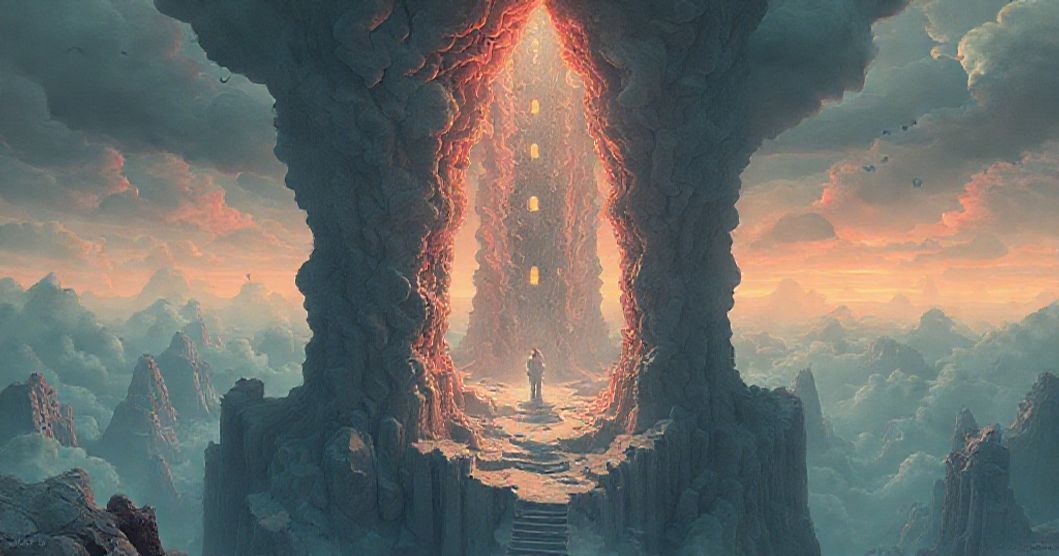
The dreamer finds themselves trapped in a tower of gray concrete, its cold, unyielding walls a stark contrast to the warmth of the party. Red drapes hang like funeral shrouds, framing a table draped in crimson silk—laden with food that the dreamer initially consumes, only for the table to shatter through the floor, revealing a lower chamber. Here, the table shifts to blue, and the dreamer knocks the food to the ground, triggering another collapse. This pattern repeats—each time, the table falls, revealing a new level—until the tower’s structure itself begins to crumble. Stairs materialize underfoot, or the dreamer leaps across gaping holes, with distant voices (family, perhaps) calling from below. The further descent, the more unstable everything feels: rooms without tables, crumbling concrete, and an ever-increasing sense of dread.
Finally, an exit looms, but as the dreamer nears it, their vision narrows at the edges, a sickening twist in their gut. They know the dream is turning. Something they cannot see yet is about to reveal itself. The tower’s walls dissolve, and the dream shifts into a surreal, retro video game aesthetic—like a scene from an old JRPG. There, on the screen, is a creature named “Grand”: a mass of pulsating flesh, purple veins snaking across its surface, pustules dotting its form. It resembles a nightmarish cyst, yet what truly unsettles is a single, yellowed, bloodied tooth protruding from its side, as if ready to fall out. The dreamer reaches out and pulls it. The world warps, and they find themselves inside the creature—now in a cutscene perspective, watching themselves from afar. The room is a prison of fleshy walls, with a hulking figure at its center: a black mane cascades from its back, tapering into a humanoid form that splits open like a hinge, revealing black pseudopods that seize the other person standing nearby. A cacophony erupts—high-pitched, digital static—and the dreamer lunges for the pseudopods, but they are too fast. The creature advances, and the dreamer wakes, sweating, tears streaming, sitting upright in their bed as if fleeing from an invisible horror.
Want a More Personalized Interpretation?
Get your own AI-powered dream analysis tailored specifically to your dream
🔮Try Dream Analysis FreePart 2: Clinical Analysis
Symbolic Landscape: The Tower as Life’s Structure
The tower in this dream functions as a powerful symbol of life’s foundational structures—whether social, emotional, or psychological. Its gray concrete walls represent rigidity and stability, while the repeated descent through levels mirrors how we navigate layers of experience. The red and blue rooms symbolize contrasting emotional states: red’s intensity and celebration give way to blue’s cold detachment, suggesting a shift from excitement to anxiety. Each time the table falls, it reveals a new level, symbolizing how our attempts to “consume” or “control” experiences (the food on the table) lead to unexpected revelations. The dreamer’s actions—eating, then knocking food down—reflect two approaches to life’s challenges: consuming (absorbing experiences) versus rejecting (resisting them), both leading to collapse.
The tooth, a key element, embodies themes of exposure and vulnerability. Its yellowed, bloody appearance suggests decay or something long-hidden, while the act of pulling it represents a desire to confront or extract something deeply embedded. In dream symbolism, teeth often relate to self-expression and control; pulling a tooth can signify the loss of control over communication or identity. Here, the tooth’s connection to the grotesque flesh creature hints at how we might inadvertently expose ourselves to our own inner “monsters” when we try to understand them too closely.
Psychological Currents: Jungian and Freudian Perspectives
From a Jungian lens, the creature “Grand” embodies the shadow self—the repressed, unconscious aspects of the dreamer’s psyche that resist integration. Jung viewed the shadow as essential for wholeness, and Grand’s grotesque form represents these unacknowledged parts. The JRPG aesthetic adds another layer: games often serve as safe spaces for confronting fears, suggesting the dreamer’s mind used familiar media to process deeper anxieties. The creature’s name, “Grand,” may imply a sense of grandiosity or overwhelming scale, reflecting how some fears feel inescapably large.
Freud would likely interpret the tower as a phallic symbol, its verticality representing sexual tension or ambition, while the repeated table falls could signify unresolved conflicts around control. The family voices below suggest a desire for connection or resolution, yet the dreamer’s inability to escape the tower hints at resistance to these needs. The creature’s pseudopods and the bisected human form may represent repressed sexual fears or the anxiety of losing control in intimate relationships.
Neuroscientifically, the dream’s structure reflects the brain’s default mode network, which processes emotions and memories during sleep. The rapid shifts between party, tower, and creature mirror the brain’s random association patterns, while the “JRPG cutscene” might reflect the dreamer’s immersion in digital media, blending waking experiences with unconscious processing.
Emotional and Life Context: Navigating Uncertainty
The dream’s opening—festive parties with known people—suggests social comfort zones that suddenly shift into instability. The dreamer mentions “consumption of alcohol,” which could represent numbing or avoiding discomfort, only for the tower to emerge as a metaphor for unprocessed emotions. The repeated table falls might mirror cycles of trying to “fix” problems that only worsen when we force solutions without understanding.
The family voices below imply a desire for support, yet the dreamer’s isolation in the tower suggests a disconnect between needing connection and fearing vulnerability. The creature’s grotesque form may represent the dreamer’s anxiety about aging, mortality, or loss of control—universal fears that feel particularly intense in the context of the tower’s collapsing structure.
Therapeutic Insights: Confronting the Unknowable
This dream invites the dreamer to recognize that some aspects of life resist understanding, much like the creature “Grand.” The key insight is that the dreamer’s impulse to “understand” Grand (by pulling the tooth) leads to deeper entanglement, not resolution. Instead, the dream suggests a different approach: sometimes, we must accept uncertainty rather than forcing answers.
Practical reflection exercises include journaling to identify recurring patterns (like the tower’s repetition) and shadow work to explore what “Grand” might represent in waking life. The dreamer could ask: What parts of myself feel “unseeable” or overwhelming? Mindfulness practices that embrace uncertainty rather than resist it might help process these feelings. Additionally, the dream’s structure (repeating levels, collapsing environments) suggests a need to rebuild foundations with more flexibility, acknowledging that life’s “tables” will fall, but we can adapt by creating new paths (like the stairs the dreamer constructs).
FAQ Section
Q: What does the tower symbolize in this dream?
A: The tower represents life’s foundational structures—social, emotional, or psychological—that feel rigid or unstable. Its repeated levels suggest navigating layers of experience, while its collapse reflects how attempts to control or consume experiences lead to unexpected challenges.
Q: Why did the creature’s tooth have such significance?
A: The tooth symbolizes exposure and vulnerability. Pulling it represents confronting something deeply embedded in the unconscious, even if it feels grotesque or uncontrollable. The tooth’s yellowed, bloody appearance hints at decay or unprocessed emotions.
Q: How should I interpret the “Grand” creature’s name and form?
A: “Grand” suggests overwhelming scale or grandiosity, while its fleshy, pulsating form embodies the shadow self—the unacknowledged, repressed parts of your psyche. The name hints at how some fears feel inescapably large, yet the dreamer’s inability to fully see it reflects the resistance to confronting these parts directly.