
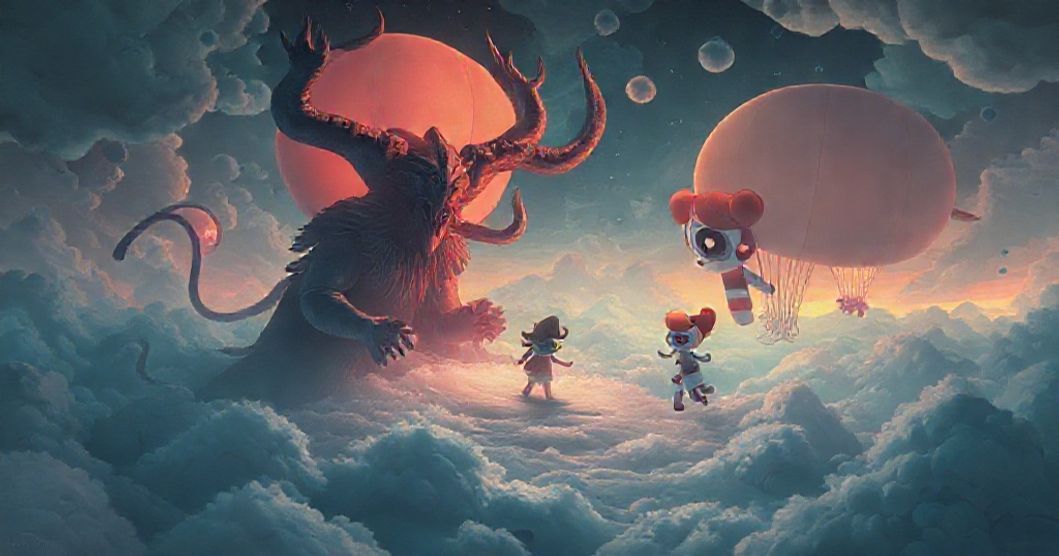
Part 1: Dream Presentation
Dreams often serve as portals to the unconscious, where the most unexpected and paradoxical scenarios unfold. This particular dream offers a surreal journey through symbolic transformation, blending religious imagery with childhood nostalgia and absurd humor. The narrative begins with a figure embodying the archetype of Satan—traditionally associated with evil, temptation, and the shadow self—entering the dreamer’s bedroom. Rather than triggering fear, this encounter becomes a proposition, followed by a bizarre metamorphosis: the demonic figure melts into HIM, the purple, mischievous villain from The Powerpuff Girls, before finally dissolving into a wacky waving inflatable arm man. The dreamer’s laughter throughout, despite these traditionally threatening and unsettling elements, suggests a profound shift in how the unconscious processes fear and desire.
The rewritten dream captures this surreal journey: I awoke mid-sleep to a presence that wasn’t quite darkness or light—a figure I recognized instantly, though not from any waking reality. Satan, as myth and nightmare might paint him, entered my bedroom with a deliberate slither, his form both shadow and smoke. Yet there was no dread, only a strange, anticipatory energy as he spoke: 'We’re going to do it.' His voice, a low, rumbling purr, carried no threat, only a bizarre proposition. He crawled atop me, and in that moment, something shifted. His features blurred, then rearranged—suddenly, it was HIM, the villain from The Powerpuff Girls, with his distinctive purple hue and mischievous grin. The transition felt seamless, almost comical, as if the weight of hellish imagery had dissolved into childhood nostalgia. We were no longer in a realm of sin and judgment; we were in a dream where demonic seduction melted into cartoonish villainy. When our 'encounter' concluded, he transformed again—this time, into a wacky waving inflatable arm man, his plastic form flailing uselessly, colors gaudy and absurd. He sizzled like a burnt candle, the sound of his deflation echoing, and then he was gone, leaving only the faint scent of sulfur mixed with latex. Throughout it all, I felt no fear. Instead, I laughed—a soft, startled chuckle that bubbled up as the absurdity of the metamorphosis overwhelmed me. It was not a nightmare but a surreal, playful journey through the unexpected.
Part 2: Clinical Analysis
Want a More Personalized Interpretation?
Get your own AI-powered dream analysis tailored specifically to your dream
🔮Try Dream Analysis FreeSymbolic Landscape: Demonic Forms and Childhood Contrasts
The dream’s power lies in its deliberate subversion of symbolic expectations. Satan, the ultimate 'dark other,' serves as a starting point for exploring the shadow self—the aspects of ourselves we typically repress or fear. In Jungian psychology, the shadow represents the unconscious mind’s rejected elements, and encountering it in dreams often signifies a need to integrate these parts. However, this dream takes integration to a playful extreme: rather than confronting a terrifying shadow, the dreamer encounters it and immediately shifts into a more childlike, familiar symbol. HIM, the villain from The Powerpuff Girls, introduces a layer of nostalgia and innocence, suggesting the dreamer’s unconscious is not only integrating darkness but also finding humor in its juxtaposition with childhood imagery. The inflatable arm man, with its gaudy, absurd presence, completes this symbolic triptych—representing the absurdity of our deepest fears when stripped of their seriousness. These transformations mirror the dreamer’s relationship with fear itself: instead of being paralyzed by it, they laugh at its absurdity.
Psychological Currents: Playful Shadow Integration and Dream Function
From a Freudian perspective, dreams often serve as a 'royal road to the unconscious,' allowing repressed desires and fears to surface symbolically. Here, the sexual proposition from Satan could represent repressed sexual energy or a desire for power and control, while the subsequent transformations suggest the dreamer’s unconscious is reinterpreting these urges through the lens of humor and play. Cognitive dream theory posits that dreams help process emotional information and integrate memories, and this dream’s structure—beginning with threat, moving to absurdity, ending with dissolution—mirrors the brain’s natural tendency to 'disarm' threatening stimuli through humor and narrative resolution. The lack of fear indicates the dreamer’s psychological defenses are healthy enough to process these symbols without panic, instead finding comfort in the dream’s ability to transform darkness into comedy. This suggests the dreamer may be in a period of psychological flexibility, able to face their inner conflicts with playfulness rather than anxiety.
Emotional & Life Context: Nostalgia, Control, and Unconscious Humor
To interpret this dream, we must consider the waking life context that might trigger such surreal imagery. The presence of The Powerpuff Girls character HIM suggests a longing for simpler times or a need to reconnect with childhood creativity and play. The 'satanic' encounter followed by this nostalgic shift could indicate the dreamer is navigating adult responsibilities while yearning for more playful, carefree aspects of life. The inflatable arm man, with its mindless, flailing movement, might symbolize feeling 'out of control' in waking life—a common theme when facing adult pressures. The dream’s humor, then, becomes a form of emotional regulation: by turning a potentially threatening scenario into comedy, the dreamer is processing stress or uncertainty through laughter. The lack of fear suggests the dreamer has a strong sense of self, able to face even their deepest anxieties without being overwhelmed by them, instead finding amusement in the absurdity of the unconscious’s storytelling.
Therapeutic Insights: Embracing the Absurd and Integrating Shadow Elements
This dream offers several therapeutic takeaways. First, it suggests the value of humor as a tool for emotional processing—finding comedy in our fears can reduce their power over us. Second, the seamless transformation from Satan to HIM to inflatable man illustrates the fluidity of the unconscious mind: our inner conflicts are rarely static but can shift in unexpected, healing ways. For the dreamer, this might mean embracing their 'shadow' aspects without judgment, recognizing that integrating darkness with light (and humor) leads to psychological wholeness. Practical exercises could include journaling about moments when they’ve felt both powerful and playful, or creating symbolic art that merges elements of darkness and light in unexpected combinations. The dream’s conclusion, where the 'threat' dissolves into absurdity, teaches the importance of letting go of rigid interpretations and allowing the unconscious to guide us toward integration through unexpected paths.
FAQ Section
Q: Why did the dreamer not feel scared despite the 'Satan' encounter?
A: The dreamer’s lack of fear suggests psychological resilience and a mature relationship with their unconscious. By transforming Satan into a cartoon villain and then an inflatable man, the dream recontextualizes fear as absurd, reducing its power.
Q: What does the transformation from Satan to HIM to inflatable arm man symbolize?
A: This sequence represents the integration of shadow elements (Satan) with nostalgic innocence (HIM) and absurdity (inflatable arm man), showing the unconscious’s ability to reprocess fear into humor and play.
Q: How can this dream help with waking life challenges?
A: The dream encourages finding humor in stress, embracing the fluidity of self, and integrating 'dark' aspects of life with lightness. It suggests that facing fears with playfulness can lead to greater resilience and creativity.