
Part 1: Dream Presentation
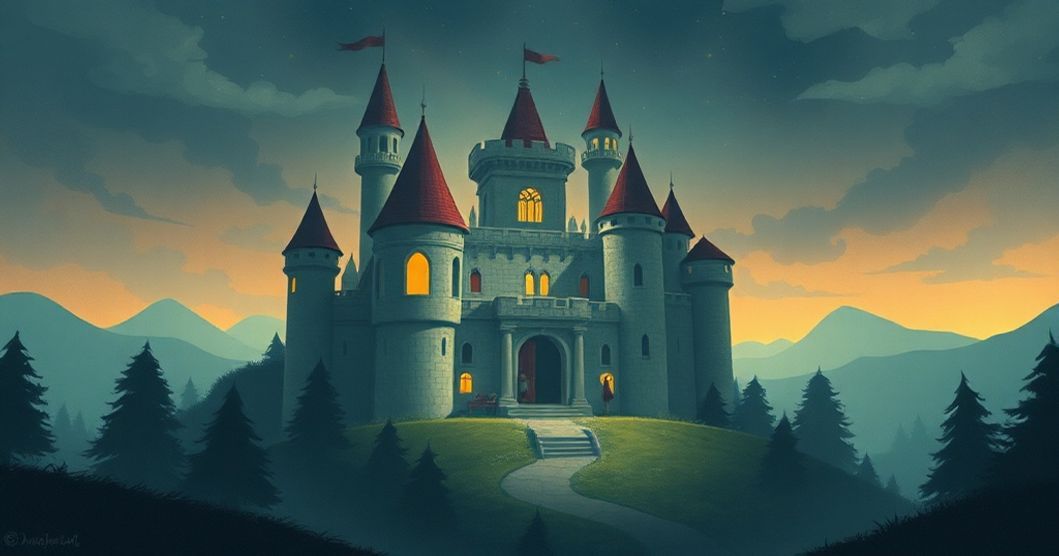
Dreams have a remarkable way of preserving the emotional textures of our earliest years, even as we grow into adults. This particular dream, recurring throughout childhood and into adulthood, offers a vivid portrait of vulnerability and resilience. The dream begins with a third-person perspective of a majestic yet isolating structure—a mansion or castle perched atop a mountain plateau, surrounded by water. This opening scene immediately establishes a sense of both grandeur and separation, evoking the feeling of being both protected and alone, much like the experience of childhood itself. As evening transitions to night, the dream shifts to a more intimate setting: a house that is a precise 1:1 recreation of the dreamer’s home. This duplication suggests a longing for the safety of familiar spaces, where the boundaries between reality and memory blur.
Within this domestic space, the dream introduces its central conflict: shadowy, formless humanoids that lurk in the darkness. These creatures are not merely 'monsters' but blank, featureless figures that seem to embody fear itself—without distinct shape, they represent the amorphous anxieties that feel most threatening precisely because they lack definition. The critical safety element is the 'lights' of the house, which create a protective barrier. This visual metaphor for illumination as safety is universal, suggesting that awareness and consciousness are our primary defenses against the unknown.
The dream’s narrative includes maternal figures (mother), an unknown girl, and grandmother’s house, creating a cast of protective archetypes. The grandmother’s house and toy bin symbolize childhood comfort and nostalgia, while the cousins represent social support. When the dream resets, it reveals a compulsion to confront these fears repeatedly—a psychological pattern where the mind revisits unresolved issues until they are integrated. The increasing difficulty of each iteration suggests that the dreamer’s unconscious is intensifying the challenge to build resilience.
Want a More Personalized Interpretation?
Get your own AI-powered dream analysis tailored specifically to your dream
🔮Try Dream Analysis FreePart 2: Clinical Analysis
Symbolic Landscape: The Language of Shadow and Light
The recurring mansion atop a mountain plateau functions as a powerful symbol of isolation and protection. In dream psychology, high places often represent elevated awareness or spiritual reach, while enclosed spaces like castles signify the self as a fortress—both vulnerable and defensive. The water surrounding the island reinforces this isolation, creating a barrier between the dreamer and the outside world, yet also suggesting emotional depth.
The shadow humanoids are classic manifestations of the 'shadow' archetype described by Carl Jung, representing repressed fears, anxieties, and aspects of the self we disown. Their 'blank' nature indicates these are not specific phobias but primal, undifferentiated fears—perhaps the fear of the unknown, abandonment, or loss of control. The fact that they appear 'before' the 'mold entity' cultural reference suggests this is not a modern fear but an ancient, universal one.
The 'lights' as safety mechanism reflect the dreamer’s need for control and awareness. In waking life, light often symbolizes clarity and consciousness, while darkness represents the unconscious. The dream’s structure—safety in light, danger in darkness—mirrors the psychological principle that understanding our fears (illuminating them) reduces their power.
Psychological Undercurrents: From Jung to Freudian Lenses
From a Jungian perspective, this dream is a prime example of the 'shadow integration' process. The repetition indicates an archetypal conflict between the conscious self (represented by the house and family) and the shadow (the monsters). The 'resetting' pattern suggests the dreamer’s unconscious is attempting to master this shadow through repeated exposure.
Freudian theory would view this as a manifestation of childhood conflicts, particularly the Oedipal or separation anxiety phases. The mother and grandmother figures represent the id’s need for nurturing, while the shadow monsters embody forbidden desires or repressed aggression. The 'resetting' could symbolize the dreamer’s attempt to resolve these conflicts, with each iteration representing a new approach to facing them.
Cognitive psychology frames dreams as problem-solving mechanisms. The dream’s structure—confronting the monster, resetting, improving—resembles the process of trial and error in waking life. The brain may be rehearsing strategies for managing anxiety, using the dream as a practice ground for real-life challenges.
Emotional and Life Context: Unpacking the Subtext
The dream’s persistence suggests it addresses an ongoing emotional need. The transition from childhood to adulthood often brings renewed vulnerability, triggering these primal fears. The unknown girl could represent a lost aspect of self or an unmet need for connection—perhaps the dreamer feels alone despite social connections, or yearns for a protective presence they never fully recognized.
The 'resetting' pattern may reflect modern life stressors: feeling overwhelmed by responsibilities, losing a sense of control, or confronting uncertainty. The dream’s escalating difficulty mirrors how anxiety intensifies when we avoid confronting our fears, leading to a cycle of avoidance and re-traumatization.
Therapeutic Insights: From Dream to Daily Life
The first step in integrating this dream’s wisdom is recognizing the pattern: the repetition is not punishment but a healing process. The dreamer can use this as an opportunity to practice mindfulness, particularly in moments of anxiety. When feeling threatened, they can 'illuminate' their fears by naming them, much like turning on the lights in the dream.
Journaling exercises could help unpack the unknown girl’s significance—perhaps she represents a forgotten aspect of self, a part needing attention. Exploring childhood memories with curiosity, not judgment, can help identify what this dream is trying to protect.
Shadow work practices, such as visualization exercises where the dreamer confronts their own 'shadow' monsters, can transform fear into understanding. This might involve writing a letter to the shadow figure, acknowledging its presence without fear, and asking it to reveal its message.
FAQ Section
Q: What does the unknown girl symbolize in this recurring dream?
A: The girl likely represents an unintegrated aspect of the self—perhaps a part of the dreamer’s personality they’ve overlooked or disowned, or a need for connection they haven’t fully addressed.
Q: Why does the dream reset when the dreamer loses control?
A: The resetting reflects the unconscious’s compulsion to practice mastery. It’s a way to build resilience by repeatedly exposing the dreamer to challenges until they feel empowered to overcome them.
Q: How can the dreamer use this recurring nightmare for growth?
A: By recognizing the pattern as a healing tool, the dreamer can practice 'light' in waking life—illuminating fears through awareness, seeking support when feeling overwhelmed, and integrating shadow aspects through self-compassion.