
Part 1: Dream Presentation
Childhood dreams often remain buried beneath the weight of adult responsibilities, yet sometimes surface unexpectedly during moments of introspection or altered states of consciousness. In this case, the dreamer—a 20-year-old on a spiritual journey—recalls vivid childhood dreamscapes (6-7 years old) that transport her to unfamiliar places, experiences she remembers most clearly when under the influence of cannabis. These dreams feature luminous landscapes, floating islands, and crystalline structures, evoking a sense of wonder mixed with cautious curiosity. The dream narrative unfolds as follows:
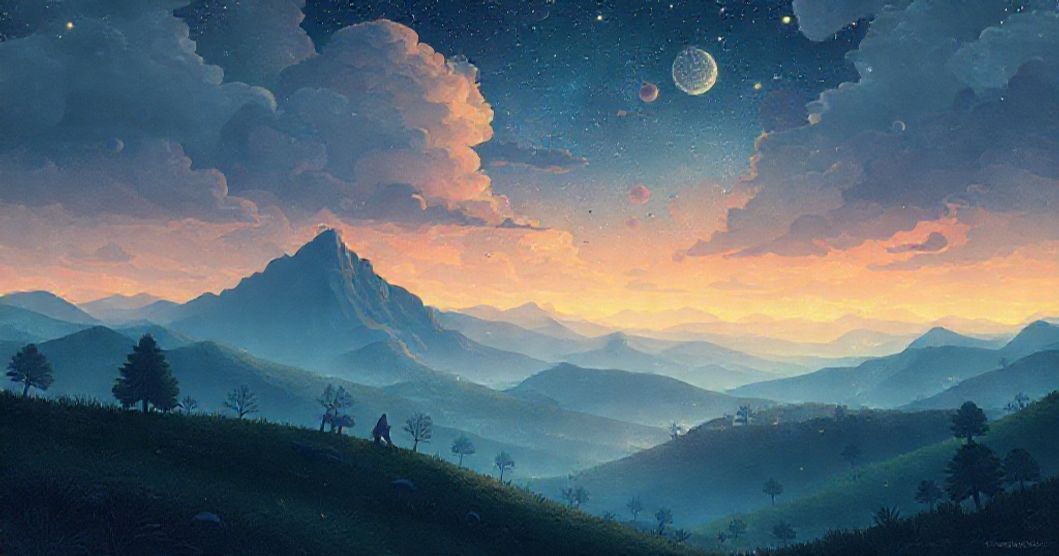
I am six years old again, standing at the edge of a place I’ve never seen in waking life—a landscape where clouds float like islands and trees grow with leaves that shimmer like polished amethyst. The air hums with a sound I can’t quite name, but it feels like the memory of a lullaby I’ve always known. To my left, a river of liquid light flows between golden hills, and I notice tiny figures with faces like melting wax moving along its banks, their voices soft as wind chimes. My bare feet sink into grass that tastes sweet when I press my toes into it, and I feel a strange, comforting warmth in my chest despite the dream’s surreal quality. I want to run toward the floating clouds, but a voice inside me whispers caution, and I pause, uncertain. Then, the scene shifts: I’m in a towering hall with walls made of translucent shells that glow from within, and I hear music that seems to come from everywhere at once. I reach out to touch a shell, and it ripples like water, revealing a face I don’t recognize but somehow know. The dream dissolves then, and I wake with a sense of profound longing, the memory lingering like a half-remembered secret. I’ve learned to recognize these dreams now—fragments of childhood that surface when I’m high, carrying the weight of places I’ve never physically visited but feel deeply connected to.
Part 2: Clinical Analysis
Want a More Personalized Interpretation?
Get your own AI-powered dream analysis tailored specifically to your dream
🔮Try Dream Analysis FreeSymbolic Landscape: Unfamiliar Places and Childhood Wonder
The dream’s recurring theme of 'places I have never been to' reflects a fundamental aspect of childhood dream psychology: the unconscious mind’s ability to create landscapes unbound by physical reality. These unfamiliar settings symbolize the dreamer’s inner world—the parts of herself that remain uncharted, even as an adult. The luminous, otherworldly quality of the dreamscape (crystalline trees, liquid light rivers) speaks to the spiritual and self-realization journey mentioned in the original post, suggesting a connection to the dreamer’s search for meaning and transcendence. In Jungian terms, these landscapes may represent the 'collective unconscious'—archetypal imagery that transcends individual experience, connecting the dreamer to universal themes of wonder, mystery, and self-discovery.
The floating islands and shimmering trees also evoke the child’s natural sense of imagination, where reality and fantasy merge seamlessly. In childhood, the mind is unburdened by the constraints of logic and memory, allowing for dreamscapes that feel both real and deeply symbolic. The dreamer’s current spiritual journey may be reawakening these childhood capacities, as she seeks to reconnect with the part of herself that once saw magic in every moment.
Psychological Perspectives: Altered States and Repressed Memories
Freud’s psychoanalytic framework might interpret these dreams as expressions of repressed childhood experiences, particularly the dreamer’s natural curiosity and sense of wonder that may have been suppressed during adulthood. The fact that these dreams surface most vividly when high suggests altered states of consciousness (ASC) facilitate dream recall—a phenomenon supported by neuroscience research indicating that cannabis can enhance dream mentation and memory consolidation. In ASC, the prefrontal cortex’s regulatory functions are temporarily reduced, allowing the unconscious to communicate more freely.
From a Jungian perspective, these childhood dreams represent the 'shadow' or 'anima/animus'—the unconscious aspects of the self that need integration. The unfamiliar faces and landscapes could symbolize the dreamer’s emerging sense of self, as she seeks to reconcile her past with her present identity. The dream’s emotional tone—wonder mixed with caution—reflects the tension between the security of childhood and the uncertainty of adulthood.
Emotional & Life Context: Spiritual Journey and Dream Recall
The dreamer’s spiritual and self-realization journey likely serves as a catalyst for this dream recall. When we actively explore our inner lives, we create conditions for the unconscious to communicate through dreams. The timing of these childhood dream memories emerging during a spiritual quest suggests a deeper process of self-integration—reconnecting with core aspects of identity that may have been neglected or forgotten.
The association with cannabis use adds another layer: altered states can lower psychological defenses, allowing repressed memories to surface. For the dreamer, being 'high' may create a bridge between waking life and the unconscious, enabling access to these childhood dreamscapes. This experience also reflects the modern trend of using substances recreationally to facilitate introspection, though it’s important to note that this approach carries risks of dependency.
Therapeutic Insights: Integrating Childhood Dreams into Adult Life
The dreamer’s intuition that 'she should do something with/about this' reflects a healthy psychological impulse to integrate these insights into waking life. Journaling these dreams immediately upon waking—even without cannabis—can help solidify the connection between childhood imagery and current emotional states. Creating a dream journal specifically for these childhood fragments allows the dreamer to track recurring symbols and themes over time.
Therapeutic reflection exercises could include guided visualization of the dream landscapes, inviting the dreamer to explore her feelings of wonder and caution. The unfamiliar places in the dream may represent unexamined aspects of her personality that need attention. By engaging with these symbols consciously, the dreamer can begin to map the unconscious territory of her spiritual journey.
For long-term integration, the dreamer might consider exploring dreamwork techniques like active imagination, where she engages with the dream characters and landscapes as living parts of her psyche. This practice can foster self-awareness and help her understand how childhood experiences shape her current relationships, values, and life choices.
FAQ Section
Q: Why do childhood dreams feel so vivid when I’m high?
A: Altered states reduce prefrontal cortex activity, lowering critical thinking and emotional defenses, allowing the unconscious to communicate more clearly. Cannabis may enhance REM sleep and memory consolidation, making childhood dreams more accessible.
Q: What do the unfamiliar places in my dreams symbolize?
A: These places likely represent unintegrated aspects of your psyche—parts of yourself you haven’t yet acknowledged. They may symbolize the spiritual potential you’re awakening to, as childhood often connects to our most authentic, imaginative selves.
Q: How can I use these dreams for my spiritual journey?
A: Reflect on recurring symbols, practice visualization, and journal your emotions. These dreams may reveal core values or unresolved childhood themes needing healing, guiding you toward deeper self-understanding and alignment with your spiritual path.