
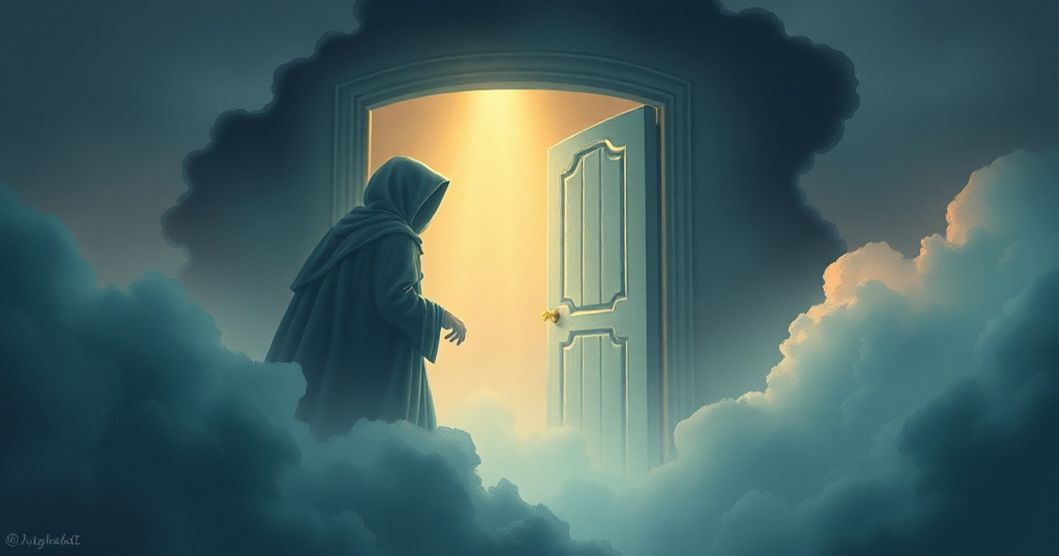
Part 1: Dream Presentation
Dreams often materialize as portals to our inner landscapes, bridging the conscious and unconscious realms in ways that defy ordinary explanation. In this particular dream experience, the bedroom—a space of intimacy and vulnerability—becomes the stage for an encounter with a spectral presence that challenges the boundaries between reality and imagination. The scene unfolds with deliberate stillness: the dimly lit room, the dog’s peaceful slumber, and the sudden intrusion of a translucent boy emerging from a partially open closet. His form, neither fully solid nor ethereal, carries an air of earnest sadness, his presence both unsettling and strangely familiar. As he approaches, the dreamer experiences a paralyzing stillness, unable to speak—a common dream phenomenon that heightens the emotional intensity. The boy’s swift retreat into the closet, followed by the abrupt awakening and the dog’s protective barking, creates a narrative tension that lingers beyond the dream’s conclusion. This dream, with its blend of fear and curiosity, invites exploration into the symbolic language of the unconscious, where hidden aspects of ourselves and our emotional landscape may manifest in unexpected forms.
The rewritten dream narrative follows: The other evening, I found myself in our dimly lit bedroom, the air thick with the quiet stillness of late night. My dog, curled beside me on the bed, slept soundly, its breathing steady and unhurried. I’d just drifted off when a subtle movement at the foot of the bed caught my eye—a faint, translucent figure standing in the doorway of our bedroom closet. The closet door, which had been ajar, now seemed to glow with an otherworldly light, casting long shadows across the wooden floorboards. As I watched, a young boy emerged from the darkness—a spirit, perhaps, or a memory made tangible. He wore no clothes, his form slightly blurred at the edges, yet his eyes were clear and earnest, filled with a sadness I couldn’t quite place. He moved slowly toward me, not threateningly, but with a quiet urgency that made my heart race. I tried to speak, but no words came. Then, without warning, the boy turned and vanished back into the closet, the door swinging shut behind him with a soft click. In that instant, I woke with a start, my breath coming in quick gasps. The room was still, except for my dog, who had bolted upright beside me, ears pricked and tail rigid. He let out a low, insistent bark, his gaze fixed on the closed closet door. I reached for him, my hand trembling, and he leaned into my touch, though his barking continued. I knew logically this must be a dream, a product of my overactive imagination or some residual anxiety from the day. Yet the weight of the experience lingered—the boy’s presence, the dog’s reaction, the sense that something real had occurred in the threshold between sleep and wakefulness. I couldn’t shake the feeling that it hadn’t been just a nightmare.
Part 2: Clinical Analysis
Want a More Personalized Interpretation?
Get your own AI-powered dream analysis tailored specifically to your dream
🔮Try Dream Analysis FreeSymbolic Landscape: Unpacking the Dream’s Visual Language
Dreams function as symbolic messengers, and each element in this narrative carries layers of meaning that extend beyond literal interpretation. The bedroom itself serves as a powerful symbol of vulnerability and intimacy—a space where we let our guard down, revealing our most private selves. The closet represents a threshold between the conscious and unconscious mind, a place where repressed thoughts, memories, or emotions may reside. In dream symbolism, closets often signify hidden aspects of the self or unresolved issues that demand attention. The spectral boy’s appearance introduces the concept of an “unseen presence” within the dreamer’s psyche—perhaps a part of the self that feels neglected or misunderstood, manifesting as a childlike figure to evoke empathy and recognition.
The boy’s translucent form suggests fluidity between states of being, embodying the dreamer’s uncertainty about boundaries and reality. His sadness hints at unresolved emotional themes, possibly related to childhood experiences, lost innocence, or unmet emotional needs. The dog’s reaction is particularly significant: dogs in dreams often symbolize intuition, loyalty, and protective instincts, acting as the dreamer’s “inner watchman” attuned to subtle energies. The dog’s barking, occurring precisely at the moment of the boy’s disappearance, suggests an intuitive response to something the dreamer’s conscious mind cannot fully process—a primal awareness of potential threat or significance.
Psychological Perspectives: Layers of Interpretation
From a Freudian perspective, the dream may represent repressed childhood desires or anxieties, with the closet symbolizing forbidden thoughts that emerge during sleep. The boy could embody the “id” or primitive urges, while the dog’s barking reflects the “superego” intervening to protect the dreamer from disturbing imagery. Jungian analysis might view the boy as a manifestation of the “shadow self”—the unconscious aspects of the personality that remain unintegrated. The closet, as a liminal space, becomes a portal to the shadow, where the boy’s spectral form represents the shadow’s attempt to communicate with the conscious mind.
Neuroscientifically, the dream’s vividness and emotional intensity suggest activation of the amygdala (processing fear) during REM sleep, while the dog’s barking may reflect the body’s attempt to regulate emotional arousal upon awakening. The sleep paralysis-like quality (inability to speak or move) often occurs during rapid eye movement sleep, where the brain temporarily paralyzes the body to prevent acting out dreams—a phenomenon that can enhance the dream’s emotional impact.
Emotional and Life Context: Threads of Waking Reality
The dream’s emotional tone—unsettling yet not overtly terrifying—suggests the dreamer may be navigating uncertainty in waking life. The boy’s sadness could mirror the dreamer’s own feelings of vulnerability or a sense of being “out of place” in a familiar environment. The closet, as a space of hidden memories, might reflect a period of reflection on childhood or past relationships, where unresolved emotions resurface unexpectedly.
The dog’s protective behavior hints at the dreamer’s need for security and validation, possibly in a relationship or professional context. The dog’s intuitive response may also indicate the dreamer’s own protective instincts toward certain aspects of their life that feel threatened or neglected. The dream’s lingering uncertainty—whether the experience was real or imagined—reflects the tension between rational understanding and visceral emotional experience, a common theme when the unconscious communicates through symbolic imagery.
Therapeutic Insights: Navigating the Unseen in Waking Life
This dream invites the dreamer to explore the “unseen” aspects of their emotional landscape with curiosity rather than fear. Journaling exercises could help unpack the boy’s message: What emotions feel neglected or unexpressed? How does the closet symbolize a space needing attention in waking life? Reflective questions like “What parts of myself feel like they’re hiding in the shadows?” can guide self-discovery.
The dog’s role as protector suggests cultivating awareness of intuitive signals. The dreamer might benefit from trusting their gut instincts, even when they lack concrete explanation. Additionally, exploring the boundary between “real” and “imagined” experiences can help distinguish between psychological projections and genuine threats, fostering emotional resilience.
FAQ Section: Clarifying Dream Meanings
Q: What does it mean to dream of a spectral boy?
A: A spectral boy often represents an aspect of the self needing recognition—perhaps innocence, vulnerability, or unmet emotional needs. His sadness may signal unresolved childhood themes or repressed emotions.
Q: Why did my dog react so strongly?
A: Dogs in dreams symbolize intuition. Your dog’s barking reflects your inner “watchdog” responding to something the conscious mind hasn’t fully processed, suggesting an important emotional signal to investigate.
Q: Is this a premonition or just a dream?
A: Dreams rarely predict the future literally, but they reflect internal states. This dream likely reflects your emotional landscape, prompting reflection on hidden feelings rather than forecasting external events.