
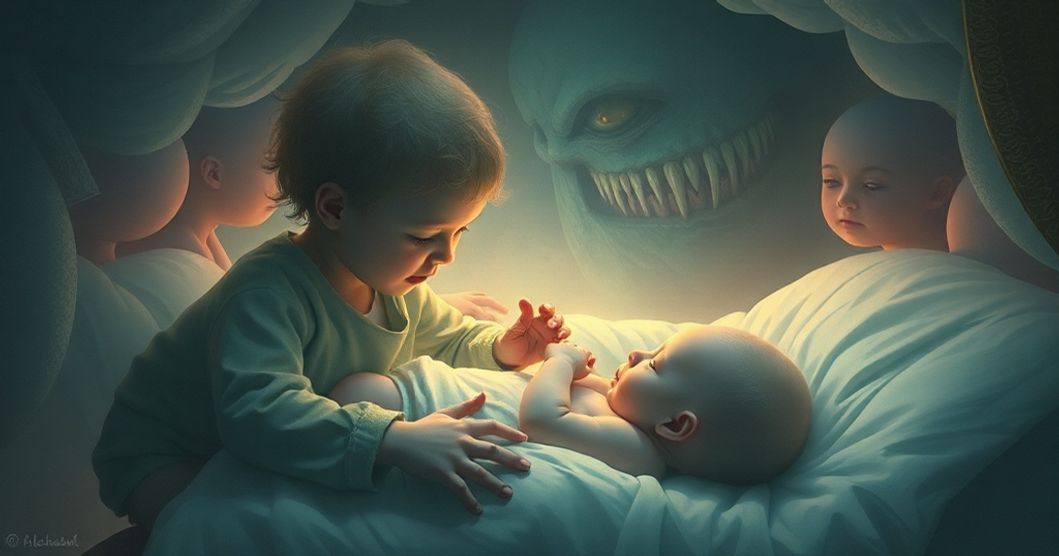
Part 1: Dream Presentation
Dreams often serve as psychological mirrors, reflecting our deepest anxieties through surreal narratives that blend the mundane with the macabre. In this particular dream, the familiar world of Phineas and Ferb—those quintessential creators of elaborate summer adventures—collides with an unsettling vision of parental responsibility and unnatural birth. The scene opens in a liminal space: an RV beside a wealthy home, a setting that suggests both mobility and confinement, security and displacement. Phineas and Ferb, the archetypal 'lost boys' of childhood, wander too far from safety, their disappearance triggering a frantic search by their mother and the wealthy family matriarch. The dreamer, positioned as the rescuer beneath the RV, embodies the role of both protector and observer. The narrative shifts abruptly into birth—a biological process twisted into something nightmarish—when the wealthy matriarch delivers a creature with dozens of hands, a being both beautiful and terrifying in its abnormality. The collective reaction—everyone deems it 'cute'—contrasts sharply with the dreamer's visceral revulsion, creating a tension between societal norms and personal unease.
The rewritten dream unfolds as follows: In a sun-dappled landscape, Phineas and Ferb resided with their mother in a weathered RV, parked beside the imposing estate of a wealthy family. The RV, with its faded paint and mismatched windows, served as both home and refuge for the boys, while their mother worked as a housekeeper for the affluent household—a position that now felt increasingly strange and unsettling to her. One afternoon, as the boys explored nearby fields, they wandered too far from the RV and became lost, their laughter echoing in the distance until it faded into silence. When their mother discovered them missing, she and the wealthy family matriarch launched a frantic search, calling out their names across manicured lawns and through shadowed garden paths. Despite their best efforts, the boys remained unseen, their small forms lost in the world of grown-up responsibilities and hidden spaces. That's when I stepped into the dream, drawn by an inexplicable intuition to check beneath the RV. In the dim, cool recesses beneath the vehicle, where shadows clung like living things, I found them huddled together—safe, though frightened, their faces streaked with dirt and tears. They were no longer lost, and a wave of relief washed over everyone as they were reunited. Just as the tension dissolved into joy, the wealthy family matriarch clutched her abdomen with sudden urgency. Her composure shattered, and she collapsed to the ground, declaring she was in labor. In a flurry of activity, medical professionals appeared (though I never saw them clearly), and moments later, a strange, guttural cry split the air. The woman had given birth—a grotesque, misshapen infant with a bloated, pale body and arms sprouting from every possible surface: dozens of hands, writhing and grasping, covered its torso and limbs. Its head, misshapen and too large for its body, stared with unblinking eyes, yet the onlookers—including the boys, their mother, and the wealthy family—cooed and declared the creature adorable. To me, however, it was profoundly unsettling, its unnatural form triggering a primal dread. The dream concluded as the baby's writhing hands seemed to reach toward me, and I woke with a sense of queasy unease.
Part 2: Clinical Analysis
Want a More Personalized Interpretation?
Get your own AI-powered dream analysis tailored specifically to your dream
🔮Try Dream Analysis FreeThe Symbolic Landscape: Distorted Childhood and Parental Anxiety
The dream's symbolic architecture is rich with layered meanings, beginning with the RV—a mobile home that simultaneously represents safety and instability. Phineas and Ferb, iconic for their boundless creativity and childhood freedom, embody youthful innocence and adventure. Their 'loss' within the dream speaks to anxieties about maintaining control over one's environment, particularly regarding children's safety. The wealthy family's estate, by contrast, symbolizes societal expectations of success and proper parenting—a stark contrast to the RV's more modest, makeshift existence. The mother's dual role—housekeeper for the wealthy family while raising her own children in an RV—suggests the tension between professional obligations and maternal responsibilities, perhaps reflecting real-life pressures the dreamer or someone close experiences.
The most striking symbol is the 'giant mutated baby with many hands.' In dream psychology, multiple hands often represent the complexity of emotional or physical boundaries, while a 'mutated' form signals the distortion of natural processes. The baby's many hands, writhing uncontrollably, may symbolize overwhelming caregiving demands or the fear of being smothered by responsibility. The collective reaction to the baby—everyone deems it 'cute' despite its grotesque appearance—highlights the theme of forced normalcy or societal pressure to accept the unacceptable, particularly in family contexts where love and duty override discomfort.
Psychological Perspectives: Jungian, Freudian, and Neurocognitive Frames
From a Jungian perspective, the dream contains both personal and collective archetypes. Phineas and Ferb represent the 'Child Self' archetype, embodying curiosity and untamed energy. The RV as a home symbolizes the 'shadow' of parental responsibility—the parts of parenting that feel confining rather than nurturing. The wealthy family's estate could represent the 'Anima/Animus' or the 'Persona,' the mask we present to society versus our authentic selves.
Freud might interpret the dream through the lens of repressed childhood memories or unresolved conflicts. The lost boys could symbolize the dreamer's own inner child, temporarily lost to adult responsibilities. The baby's mutation might represent the dreamer's fear of sexual or reproductive anxieties, though the 'many hands' element complicates this interpretation beyond typical Freudian phallic symbolism.
Neurocognitive theory suggests dreams process emotional memories and consolidate neural pathways. The dream's abrupt shift from adventure to horror could reflect the brain's attempt to integrate conflicting emotional states—perhaps the dreamer is simultaneously experiencing freedom and constraint in waking life. The 'many hands' might represent the brain's struggle to manage multiple competing demands, visualized as a physical distortion.
Emotional & Life Context: Uncanny Valley of Family Dynamics
The dream likely reflects the dreamer's relationship with family structures and societal pressures. The mother's 'weird and creepy' behavior hints at suppressed maternal anxiety or guilt—perhaps the dreamer feels their mother is struggling to balance work and parenting responsibilities. The RV as a home might symbolize the dreamer's own sense of displacement or the feeling of not belonging in traditional family structures.
The 'mutated baby' as a focal point suggests deep-seated fears about biological or emotional boundaries. The hands could represent the overwhelming feeling of being pulled in multiple directions—parenting, career, personal relationships—creating a sense of being 'overwhelmed' or 'smothered' by responsibilities. The collective 'adoration' of the monstrous baby despite its grotesque nature might mirror the dreamer's experience of societal pressure to accept certain norms, even when they feel psychologically toxic.
Therapeutic Insights: Unpacking the Uncanny
The dream offers several therapeutic takeaways. First, it suggests the dreamer is experiencing anxiety about maintaining control over their environment, particularly regarding children or vulnerable aspects of self. The act of finding the boys beneath the RV highlights the importance of acknowledging hidden spaces within ourselves—areas we might be avoiding or repressing.
Practical reflection exercises could include journaling about moments when the dreamer feels 'lost' or overwhelmed, identifying what 'RV spaces' in waking life need attention. The baby's mutation invites exploration of which societal expectations feel unnatural or oppressive, and how to reclaim agency over one's sense of 'normalcy.'
Integration strategies might involve creating more flexible family structures that honor both independence and connection, rather than rigidly adhering to societal norms. The dreamer might benefit from setting boundaries around responsibilities that feel like 'many hands'—learning to say 'no' to overwhelming demands while nurturing their own inner 'Phineas and Ferb'—the part of themselves that still embraces adventure and creativity.
FAQ Section
Q: Why did the dreamer feel creeped out by a 'cute' baby?
A: The 'cute' baby's grotesque nature creates the 'uncanny valley' effect—something that should be familiar (a baby) but is distorted, triggering primal fear of the unnatural. This reflects the dreamer's discomfort with forced normalcy.
Q: What do the many hands symbolize?
A: Multiple hands often represent overwhelming responsibilities or conflicting emotional states. The baby's many hands may signal feeling smothered by caregiving demands or struggling to manage competing life pressures.
Q: How does the RV symbolize the dreamer's inner state?
A: The RV represents both safety and instability, suggesting the dreamer feels temporarily displaced or in transition, with responsibilities pulling them in conflicting directions. It may reflect feelings of not belonging in traditional family structures.