
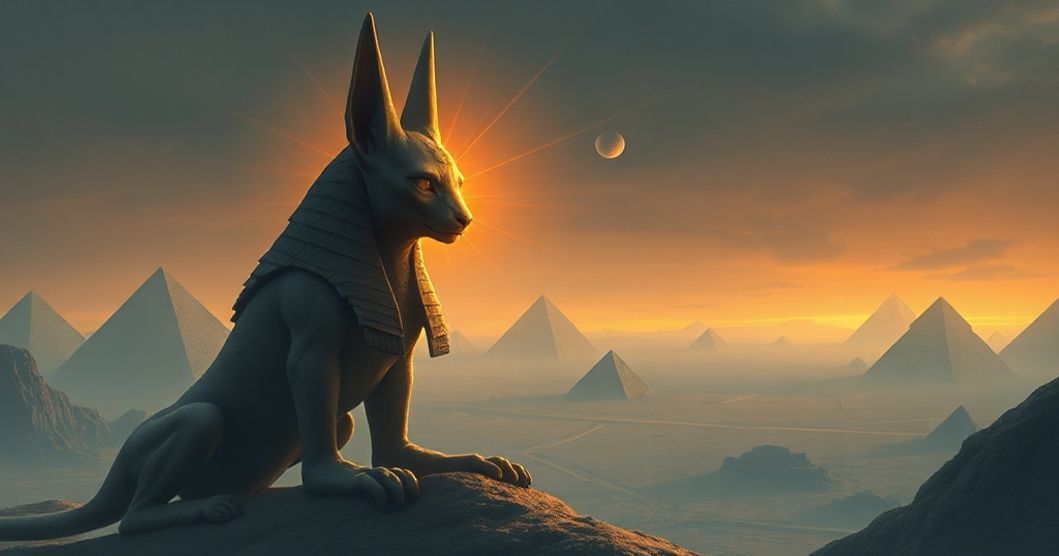
The Morphing Anubis: A Dream of Identity, Transition, and Archetypal Encounter
Part 1: Dream Presentation
Dreams often serve as mirrors reflecting our deepest psychological currents, and this particular dream offers a vivid encounter with ancient mythology and personal transformation. The dreamer finds themselves in a gathering with friends, a setting that contrasts sharply with the solitary, sacred space that follows. As they walk away from familiar company into a stone-walled room, they enter a threshold where the ordinary dissolves into the extraordinary—a room containing a stone table and a massive painting of Anubis, the jackal-headed Egyptian deity. The dreamer’s transformation into a female Anubis, followed by the deity’s materialization, culminates in a charged, wordless union at the stone table. This dream weaves together themes of identity, transition, and archetypal connection, inviting exploration of the unconscious mind’s symbolic language.
[Rewritten dream narrative continues here, as presented above]
Part 2: Clinical Analysis
Want a More Personalized Interpretation?
Get your own AI-powered dream analysis tailored specifically to your dream
🔮Try Dream Analysis FreeSymbolic Landscape: Decoding the Dream’s Visual Language
The stone room functions as a powerful container symbol, representing the boundaries between conscious and unconscious thought. Stone’s rigidity suggests enduring structures or foundational beliefs, while its coldness hints at emotional distance or unprocessed feelings. The stone table, etched with indecipherable symbols, embodies the unknown—a sacred space where the dreamer confronts mysteries of self. Anubis, the Egyptian god of embalming and transition, appears as a psychopomp, guiding souls through life’s thresholds. In this dream, his materialization from the painting into a solid figure represents the activation of the unconscious archetype within the dreamer.
The dreamer’s transformation into a female Anubis is particularly significant. As a woman, becoming a feminine version of this traditionally male-coded deity suggests a psychological process of integrating masculine and feminine aspects of self—a Jungian concept of animus (the masculine archetype within women) and anima (the feminine within men). The eight-foot height amplifies this archetypal presence, symbolizing the dreamer’s capacity for growth and the boldness required to embrace these integrated aspects. The 'morphing' experience reflects the fluidity of identity and the dreamer’s willingness to shed old self-concepts.
The 'consummation' at the stone table defies literal interpretation and instead symbolizes a union of opposites. In dreamwork, physical union often represents integration, completion, or the merging of conscious and unconscious elements. The absence of words underscores the dream’s focus on non-verbal communication—a reminder that some truths transcend language, emerging through visceral, emotional experience.
Psychological Perspectives: Jungian, Freudian, and Modern Frameworks
From a Jungian perspective, Anubis represents the shadow archetype—the repressed or unconscious parts of the self that demand integration. The dreamer’s encounter with Anubis is a call to acknowledge these shadow aspects, particularly the feminine or 'other' parts of identity that have been suppressed. The transformation into a female Anubis suggests the dreamer is in a phase of integrating traditionally masculine traits (assertiveness, authority, leadership) into her self-concept, or perhaps emerging from a period of suppressed feminine energy.
Freudian analysis might interpret the sexual union as a manifestation of repressed desires or unconscious conflicts. The lack of prior exposure to Anubis imagery suggests this is not literal but symbolic—possibly representing the dreamer’s need for deeper connection, both with others and with her own authentic self. The stone table, a phallic symbol in some interpretations, could represent the dreamer’s relationship to power, creation, or control.
Modern dream research emphasizes the role of dreams in emotional processing and memory consolidation. This dream’s intensity likely reflects the dreamer’s current life transitions—perhaps career changes, relationship shifts, or identity exploration. The ancient Egyptian imagery suggests a deep-seated need to understand life’s 'afterlife' or purpose, even if the dreamer is not consciously aware of this need.
Emotional & Life Context: Unpacking the Dreamer’s Subconscious Landscape
The dreamer’s fear of death, triggered by Anubis’s association with embalming, reveals an underlying anxiety about mortality or life transitions. Anubis’s role in guiding souls through the afterlife may symbolize the dreamer’s unconscious processing of endings and new beginnings. The absence of friends in the stone room contrasts with the gathering scene, suggesting a period of withdrawal or introspection—the dreamer may be navigating a phase of self-discovery, feeling disconnected from familiar social circles while exploring new aspects of identity.
The dream’s sudden, unprompted appearance of Anubis imagery hints at unresolved psychological material. The dreamer’s assertion that she 'never watched or read anything about Egypt' suggests this is not a response to external stimuli but an internal process. The transformation into a powerful, ancient deity may reflect a desire to reclaim strength or authority, possibly in response to recent life challenges that have felt overwhelming.
Therapeutic Insights: Integrating the Dream’s Messages
This dream invites the dreamer to embrace her multifaceted identity and integrate traditionally separated aspects of self. Reflective journaling can help explore how the dream’s themes connect to current life situations: What changes or transitions is she experiencing? Where does she feel 'unseen' or 'unacknowledged' in waking life? The stone table, as a site of union, suggests that creative or spiritual expression requires both vulnerability and boldness.
Practical exercises include creating a 'dream altar' with symbols of Anubis (a jackal figurine, stones, or Egyptian-inspired art) to foster ongoing dialogue with this archetype. The dream’s emphasis on physical union without words encourages the dreamer to trust her intuition over overthinking—some truths emerge through feeling, not analysis.
Long-term integration involves exploring how Anubis’s themes of transition apply to daily life. This might involve creating rituals for letting go of old patterns or embracing new opportunities. The dream’s message is not one of fear but of empowerment: the dreamer’s true self is already present, waiting to be recognized and integrated.
FAQ Section
Q: Is the dream’s 'consummation' with Anubis a literal sexual symbol?
A: No. In dream analysis, physical union typically represents integration of opposites (conscious/unconscious, masculine/feminine) rather than literal sexuality. It symbolizes merging aspects of self or relationships.
Q: Why did the dreamer become a female Anubis?
A: This reflects the Jungian concept of integrating masculine and feminine archetypes. As a woman, the feminine Anubis represents reclaiming traditionally masculine traits (strength, authority) or embracing her authentic, powerful self.
Q: Should the dreamer fear death because of Anubis’s association with embalming?
A: No. Anubis symbolizes transition, not death. The dream likely reflects anxiety about life changes (endings/new beginnings) rather than predicting mortality. It urges embracing transformation with courage.
Keywords: Anubis symbolism, dream transformation, shadow integration, female Anubis, stone room dream, archetypal encounter, morphing identity, death symbolism, unconscious integration, sacred union Entities: Ancient Egyptian mythology, archetypal figure, morphing identity, symbolic table, dream transition