
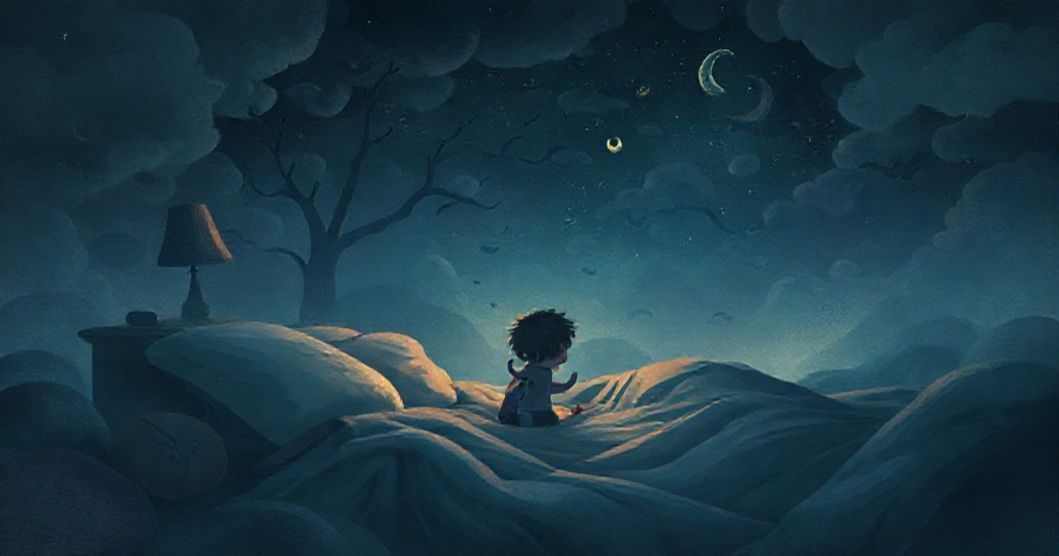
Part 1: Dream Presentation
Children’s dreams often reveal the raw, unfiltered landscape of their developing minds, where fears and imaginations collide in vivid, sometimes unsettling ways. This parent’s account of their 4-year-old son’s night terror offers a window into the complex emotional world of early childhood, where concrete thinking and emerging self-awareness intersect with primal fears of bodily harm.
My four-year-old son woke with a piercing scream that jolted me from sleep. In the dim light of our bedroom, I rushed to his side, finding him trembling beneath his covers, tears streaming down his face. He clutched his arm protectively, as if shielding a wound, and gasped out the words, 'Bad dream... scary...' When I asked what had frightened him, his small voice, still shaky with terror, described a shadowy figure with 'sharp scissors' cutting away his skin—'like peeling off a bandage but it hurt so much.' The details were so vivid and his fear so palpable that I felt my own heart constrict with worry. As a parent, I’ve read about childhood nightmares, but this felt unusually intense for a boy his age, leaving me to wonder if such darkness was developmentally appropriate or if there was deeper meaning beneath the surface of his frightened words.
Part 2: Clinical Analysis
Want a More Personalized Interpretation?
Get your own AI-powered dream analysis tailored specifically to your dream
🔮Try Dream Analysis FreeSymbolic Landscape: Decoding the Child’s Nightmare Imagery
The imagery in this dream—'bad guy,' 'sharp scissors,' and 'cutting skin'—contains layers of symbolic meaning that reflect the child’s developing understanding of self and the world. In the context of a four-year-old’s cognitive development, 'cutting skin' represents a primal fear of bodily integrity and vulnerability. Young children often lack the verbal nuance to express abstract fears, so their dreams translate internal anxieties into concrete, visceral imagery. The 'bad guy' embodies the externalization of fears—perhaps separation anxiety, fear of loss, or uncertainty about boundaries in a world that feels both new and potentially threatening.
The 'sharp scissors' introduce another layer of symbolism: they represent cutting through boundaries, either physical or emotional. For a child, scissors are tools of creation and destruction, capable of both harm and helpfulness. In this dream, they become instruments of violation, reflecting the child’s perception of threats to safety. The act of 'cutting off skin'—a bodily function associated with protection and identity—amplifies the sense of vulnerability. Skin symbolizes the self, the boundary between inside and outside, and the fear of having that boundary breached taps into primal survival instincts.
Developmental Psychology Perspectives on Child Dreams
From a developmental psychology lens, four-year-olds are in Piaget’s 'preoperational stage,' where they struggle to distinguish between reality and fantasy, relying on concrete, sensory experiences to make sense of the world. Their dreams often mirror this concrete thinking, transforming abstract fears into tangible, violent imagery. This is not a sign of trauma but rather a natural part of cognitive development as children process complex emotions.
Freud’s psychoanalytic perspective might interpret the 'bad guy' as an externalization of repressed fears, while Jung’s analytical psychology would view the 'bad guy' as a shadow figure—an archetypal representation of the child’s own unintegrated fears and anxieties. For a four-year-old, the 'bad guy' is less about literal evil and more about the child’s emerging sense of self-preservation against unknown threats.
Neuroscientifically, children’s developing brains process emotions more intensely during sleep, as the amygdala (emotional center) remains active while the prefrontal cortex (reasoning center) is less regulated. This creates the vivid, emotionally charged dreams we sometimes observe in young children, particularly around developmental transitions like starting school or changes in family routines.
Emotional Context: Connecting to Waking Life
Children this age often experience a range of emotional challenges that manifest in dreams. Separation anxiety, fear of bodily harm, and emerging independence can create internal tension. The 'bad guy cutting skin' might reflect the child’s anxiety about new experiences, such as starting a new activity, encountering a stranger, or feeling out of control in a situation.
The parent’s anxiety is also significant here. When adults respond with alarm to a child’s nightmares, they inadvertently reinforce the idea that these dreams are dangerous or 'too much' for a young child. This creates a feedback loop where the child’s fears are amplified by the parent’s emotional response. The parent’s question, 'Isn’t he too young to be dreaming like this?' reveals a common adult concern about developmental norms, which can sometimes overshadow the child’s actual experience.
Therapeutic Insights: Supporting the Child Through Nightmares
For parents navigating such nightmares, several strategies can help the child process these emotions without reinforcing fear. First, validate the child’s feelings: 'It sounds like you were really scared' acknowledges their experience without minimizing it. Then, help the child reframe the dream in less threatening terms: 'Sometimes our brains play tricks when we’re sleeping, and we see things that aren’t real.'
Creating a consistent bedtime routine can reduce anxiety by providing predictability. This might include reading calming stories, gentle physical contact, or a special comfort object that becomes a symbol of safety. For the 'cutting skin' imagery, you might use a soft toy or drawing to 'heal' the wound together, helping the child externalize and process the fear.
If nightmares persist or intensify, consider discussing the dream with a pediatrician or child psychologist, who can help rule out underlying concerns. However, most four-year-old nightmares resolve with reassurance and consistent support, as children this age have remarkable resilience and adaptability.
FAQ Section
Q: Is a 4-year-old having such a dark dream normal?
A: Yes, though intense dreams can signal developmental milestones or minor stressors. Most children experience occasional nightmares, and they typically resolve with reassurance.
Q: Should I be concerned about the 'cutting' imagery?
A: The scissors likely represent fear of harm, not literal violence. Focus on helping him express feelings rather than interpreting the imagery as a prediction.
Q: How can I help my child process this dream?
A: Create a calm space, use concrete language to normalize the dream, and reinforce safety in his environment. A drawing or stuffed animal 'healing' exercise can help externalize the fear.