
Part 1: Dream Presentation
Dreams often serve as windows into the unconscious, revealing truths our waking minds struggle to articulate. This particular dream unfolds against the backdrop of a deeply personal and recurring experience: sleep paralysis, a phenomenon that has become a familiar part of the dreamer’s nightly landscape since 2020. In the dream, the dreamer finds themselves suspended between wakefulness and sleep—a liminal state where consciousness drifts yet the body remains immobilized. This paradoxical position becomes the stage for a psychological drama centered on self-recognition, agency, and fear.
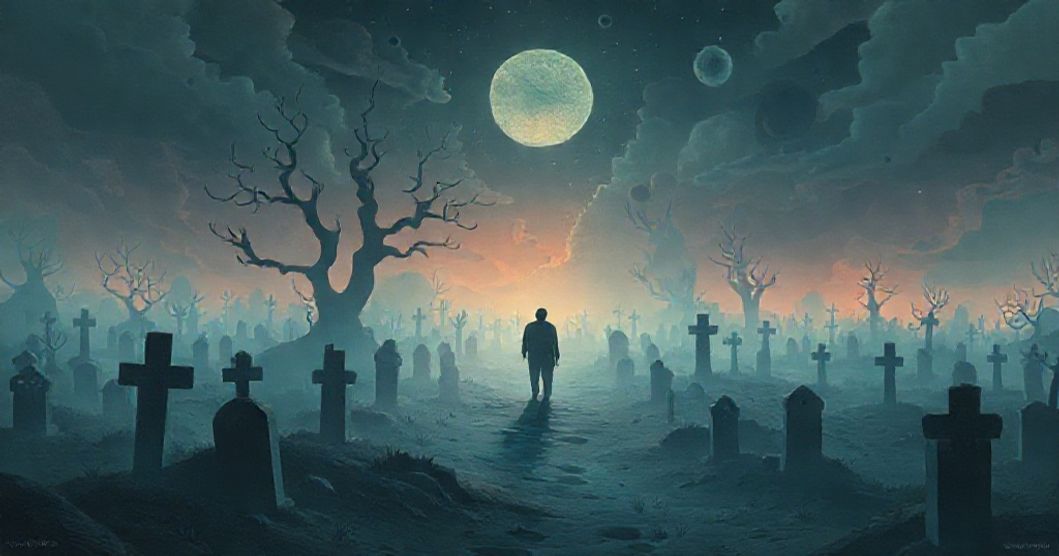
The narrative begins with the dreamer’s attempt to assert control over the dream state by recognizing it as such: 'This is just a dream'. Each repetition of this phrase triggers the sleep paralysis, creating a frustrating loop of recognition and restraint. The third iteration introduces a new dimension: the dreamer considers astral projection, a practice symbolizing spiritual or psychological liberation, only to be derailed by primal fear of spectral figures in a cemetery setting. This dream weaves together themes of dream control, the uncanny, and the body’s protective mechanisms, offering rich material for psychological exploration.
Symbolic Landscape: Decoding the Dream’s Imagery
Want a More Personalized Interpretation?
Get your own AI-powered dream analysis tailored specifically to your dream
🔮Try Dream Analysis FreeSleep paralysis itself is a powerful symbol of liminality—the state of being caught between two worlds, neither fully present nor absent. In dreams, this physical immobility often reflects psychological barriers or unresolved conflicts that feel equally inescapable. The dreamer’s repeated assertion of 'This is just a dream' is a classic attempt at lucid dreaming, where dreamers recognize their dream state and attempt to manipulate it. However, the paralysis that follows suggests the unconscious mind’s resistance to such control—a defense mechanism, perhaps, that protects against confronting deeper truths.
The cemetery setting introduces another layer of symbolism. Cemeteries universally represent death, transformation, and the unknown—archetypal spaces where the boundary between life and afterlife blurs. The ghosts materializing here are not literal specters but manifestations of the dreamer’s unconscious fears: unresolved grief, existential anxieties, or repressed memories. The dreamer’s fear of these spectral figures reveals a deeper resistance to confronting the unknown aspects of their psyche, even in the supposedly safe space of dreams.
Psychological Perspectives: Multiple Lenses on Dream Experience
From a Freudian perspective, the sleep paralysis could represent repressed desires or anxieties that the unconscious mind deems too threatening to process while awake. The repetition of 'This is just a dream' might signal a defense mechanism—the ego’s attempt to rationalize away the dream’s emotional intensity, only to be met with the id’s resistance in the form of paralysis. For Jung, the cemetery and ghosts embody the shadow self—the parts of the psyche we refuse to acknowledge. The dream’s attempt at astral projection, a Jungian symbol of individuation and spiritual growth, is sabotaged by the fear of the shadow, highlighting the tension between the conscious desire for growth and the unconscious fear of what lies beyond.
Neuroscience offers a complementary perspective: sleep paralysis arises from the overlap of REM sleep and wakefulness, where the brain’s motor control systems fail to disengage, creating the sensation of immobility. The dreamer’s attempt to will consciousness out of this state reflects the brain’s meta-awareness during sleep—a cognitive process known as 'dream lucidity'—where the prefrontal cortex remains partially active, attempting to impose logic on the illogical nature of dreams.
Emotional & Life Context: Unpacking the Subtext
The dreamer’s experience of sleep paralysis since 2020 suggests a recurring theme of feeling trapped or powerless in waking life—a sense of being caught between responsibilities, expectations, and personal desires. The repeated phrase 'This is just a dream' could be a metaphor for the dreamer’s attempt to rationalize away stress or discomfort, to treat life’s challenges as temporary or illusory, only to have the reality of those challenges feel equally inescapable. The cemetery, too, might reflect a recent loss, transition, or confrontation with mortality—a universal human concern that often surfaces in dreams during periods of life change.
The fear of ghosts in the cemetery taps into primal anxieties about the unknown, the past, and the afterlife. This could indicate unresolved grief, guilt, or trauma that the dreamer has not yet processed. The allure of astral projection, meanwhile, represents a longing for freedom—from emotional constraints, from physical limitations, or from the sense of being 'stuck' in a particular life path.
Therapeutic Insights: Learning from the Dreamer’s Journey
This dream offers several therapeutic takeaways. First, it highlights the importance of acknowledging rather than resisting liminal states—both in sleep and in waking life. The dreamer’s repeated attempts to 'wake up' from the paralysis mirror the human tendency to avoid discomfort, yet the fear of confronting the unknown ultimately leads to retreat. By recognizing this pattern, the dreamer can practice mindfulness in waking life, allowing themselves to sit with uncertainty rather than immediately trying to control or escape it.
Second, the dream’s emphasis on fear and the uncanny suggests the need to explore these emotions more deeply. Journaling about the cemetery setting, the spectral figures, and the sensation of paralysis could reveal underlying anxieties. For example, asking: What does 'death' or 'transformation' symbolize in my waking life? or What am I avoiding by retreating from the unknown? can uncover hidden psychological patterns.
Finally, the dream’s message about dream control and paralysis might encourage the dreamer to practice lucid dreaming techniques. By gradually building awareness during REM sleep, the dreamer can learn to navigate the liminal space more effectively, transforming the paralysis from a source of fear into an opportunity for exploration and self-discovery.
FAQ Section
Q: Why does saying 'This is just a dream' trigger sleep paralysis?
A: This phrase activates the brain’s prefrontal cortex, which distinguishes between dream and reality. In sleep paralysis, the brain’s motor inhibition systems remain active, creating the paradoxical effect where recognizing the dream state actually reinforces the paralysis.
Q: What does the cemetery symbolize in this dream?
A: The cemetery represents unresolved emotions, past traumas, or fears of mortality. It signals the need to confront what feels 'dead' or stagnant in waking life and embrace transformation.
Q: How can I use this dream to reduce sleep paralysis?
A: Practice grounding techniques before sleep, focus on breath awareness, and gradually build lucid dreaming skills. The dream’s message is to meet paralysis with curiosity rather than fear, allowing you to observe without being controlled by it.