
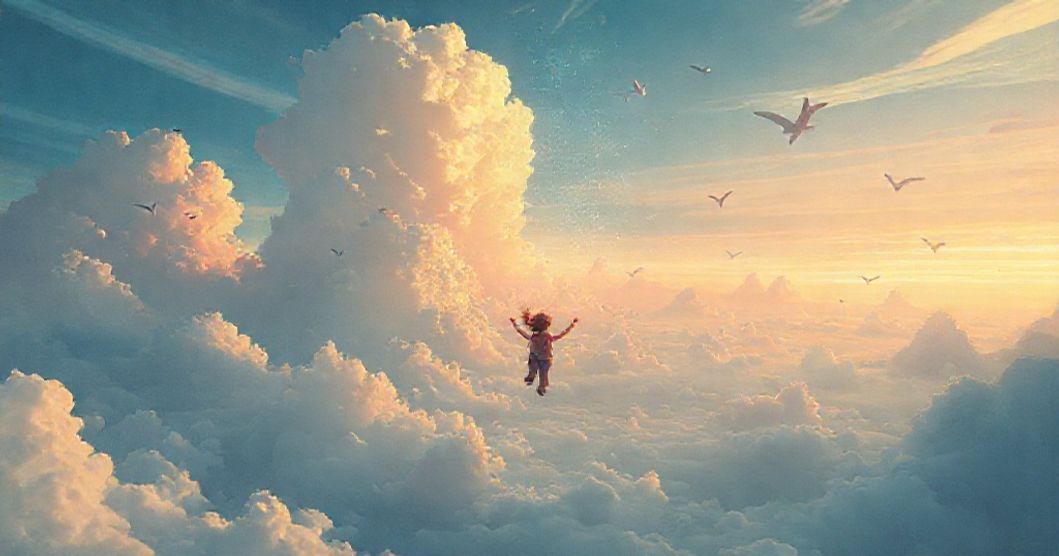
Part 1: Dream Presentation
Dreams often serve as windows into the unconscious, and this collection of childhood dreams offers a rich tapestry of imagery centered on flight, transformation, and protection. In these recurring visions, the dreamer found themselves in the midst of magical journeys that transcended ordinary reality.
As a child, I often found myself soaring through dreamscapes in ways that felt both ordinary and magical. In one recurring vision, I’d stand in our cozy family room, the familiar scent of my mother’s baking lingering in the air, and discover a curious power: by pressing downward with my hands as if pushing against invisible currents, I could lift myself higher and higher. Each firm push propelled me upward a foot, my heart racing with exhilaration as I drifted above the couch, the ceiling fan blades spinning like distant propellers below. Sometimes this flight was playful—a game of weightless exploration among the furniture, my laughter echoing in the silent room. Other times, it carried urgency: evil fairies, their wings shimmering with malevolent light, would descend upon my family, their tiny, pointed ears and glowing eyes fixed on my parents. In those moments, I’d panic into action, launching myself upward with desperate pushes, my hands stinging from the invisible effort, determined to shield my loved ones from harm. The living room walls would blur as I ascended, the fairies’ shrill cries fading below me as I fought to protect the safety of my family, who remained unaware of my extraordinary power.
Another dream, equally vivid, unfolded in our backyard. A massive hot air balloon, its silk envelope painted with faded floral patterns, would appear seemingly out of nowhere, tethered to the grass but already pulsing with the promise of flight. Without hesitation, I’d climb aboard, the wicker basket swaying gently beneath me, and feel the wind rush through my hair as we drifted upward, leaving the mundane world of childhood chores and arguments far below.
Want a More Personalized Interpretation?
Get your own AI-powered dream analysis tailored specifically to your dream
🔮Try Dream Analysis FreeThen there were dreams of transformation—a different kind of liberation. I’d wake to find my body shifting, my skin hardening into tiny, polished red shells, my legs merging into six delicate, patterned limbs. In an instant, I became a ladybug, and with a flutter of my new wings, I’d take flight from my bedroom window, exploring the neighborhood rooftops and gardens, marveling at the world from an insect’s perspective. These dreams felt like secret adventures, each one a different key to unlocking the sky.
As I’ve grown older, these dreams have become less frequent, though no less vivid. The magic of soaring, the thrill of transformation, and the protection of loved ones—these elements persist in my nightly journeys, reminding me of a time when the world felt both vast and full of possibility, and when I believed in the power of flight, both literal and metaphorical.
Part 2: Clinical Analysis
Symbolic Landscape: The Language of Flight and Transformation
The recurring dreams of flight in this narrative reveal a powerful symbolic landscape centered on themes of freedom, self-discovery, and protection. The act of “pushing air” to achieve lift represents the dreamer’s active engagement with their inner potential—an attempt to overcome limitations by channeling energy and willpower. This physical action mirrors the psychological process of asserting one’s agency, as the dreamer discovers they can rise above ordinary constraints.
The evil fairies introduce a layer of conflict and protection. In dream symbolism, fairies often represent the “shadow” aspects of childhood—unseen anxieties, imaginary threats, or the fear of disappointing loved ones. The dreamer’s family’s ignorance of their flying ability underscores the separation between the conscious self and the deeper, more powerful aspects of identity that remain hidden or unacknowledged. This dynamic suggests a tension between the need to protect loved ones and the desire to reveal one’s true capabilities.
The hot air balloon and ladybug transformations further illustrate the theme of metamorphosis. The balloon, with its gentle ascent and connection to the earth through its basket, represents a journey of exploration without fear—a balanced approach to growth that honors both stability and adventure. The ladybug, a small yet resilient creature, symbolizes the power of small, incremental changes (the “tiny steps” of growth) and the ability to see the world from a fresh perspective.
Psychological Perspectives: Understanding the Unconscious Journey
From a Jungian perspective, these dreams reflect the archetype of the “anima/animus” or the “Self”—the integration of conscious and unconscious elements. The recurring flight motifs align with the “sky” as a symbol of the collective unconscious, where new possibilities and transformations reside. The dreamer’s ability to transform into different creatures suggests a fluidity of identity, a willingness to explore multiple aspects of self that may have been suppressed in waking life.
Freudian theory might interpret these dreams as manifestations of repressed desires for freedom and control. Childhood often involves feelings of powerlessness (limited by parental authority, physical constraints, or social expectations), and dreams of flight become a symbolic escape from these restrictions. The fairies could represent repressed anger or fear of authority figures, while the family’s absence of awareness reflects the dreamer’s internal conflict between wanting to be seen and protected versus wanting to remain hidden.
Cognitive psychology frames dreams as a processing mechanism for memories and emotions. The repetition of these dreams suggests the brain is working through themes of identity, freedom, and self-expression that were particularly salient during childhood. The ladybug and balloon dreams might be processing the transition from childhood to adulthood, where the dreamer is reworking their relationship with independence and responsibility.
Emotional & Life Context: The Resonance of Childhood Themes
These dreams likely emerged during a period of significant psychological development—ages when children first grapple with identity, fear, and the desire to explore beyond familiar boundaries. The family room, a safe space, becomes a stage for both play and protection, reflecting the dreamer’s need for security while asserting their emerging independence.
The emotional core of these dreams is the tension between vulnerability and empowerment. The dreamer’s decision to fly alone against the fairies (without family knowledge) suggests a parallel to real-life situations where they feel compelled to act bravely despite feeling unsupported or misunderstood. The recurring nature of these dreams indicates an ongoing dialogue with these feelings, even as the dreamer matures.
In adulthood, the persistence of these themes (albeit less frequent) suggests the dreamer is still processing unresolved aspects of childhood—perhaps reconnecting with a sense of wonder, or struggling with the balance between freedom and responsibility in current life. The shift from “bizarre dreams” to “much less recurring” dreams might indicate a period of psychological integration, where these themes have been partially resolved or integrated into waking life.
Therapeutic Insights: Reclaiming the Skyward Self
These dreams offer valuable clues for self-awareness and personal growth. The dreamer can begin by exploring the current “air” they are pushing against—what limitations or constraints exist in their waking life that they might be trying to overcome? The recurring flight motifs suggest a need to reconnect with their inner “flying self”—the part of them that believes in possibility and transformation.
Practical reflection exercises might include journaling about moments when they feel “weightless” or “free” in waking life, and comparing these to the dream experiences. Mindfulness practices that cultivate awareness of breath and movement could help the dreamer access the same sense of agency they felt in the dream world.
For long-term integration, the dreamer might benefit from exploring the relationship between protection and self-expression. The fairies represent inner challenges, and the dream’s resolution (flying above them) suggests that acknowledging these challenges and acting with courage can lead to empowerment.
FAQ Section
Q: Why do I keep dreaming about flight?
A: Dreams of flight often reflect a deep-seated desire for freedom, control, or transcendence. They may signal that you’re ready to overcome limitations in waking life or reconnect with your inner child’s sense of possibility.
Q: What do the fairies symbolize in my dreams?
A: Fairies typically represent the “shadow” of childhood—unseen anxieties, fears of inadequacy, or the pressure to please others. They may also symbolize repressed anger or the need to protect loved ones from perceived threats.
Q: How can I use these recurring dreams for healing?
A: Reflect on moments when you felt “weightless” or empowered in waking life. Journal about the emotions in the dreams, and consider creative outlets (art, writing) to express the themes of transformation and freedom. These dreams may be inviting you to reclaim parts of yourself that feel suppressed.