
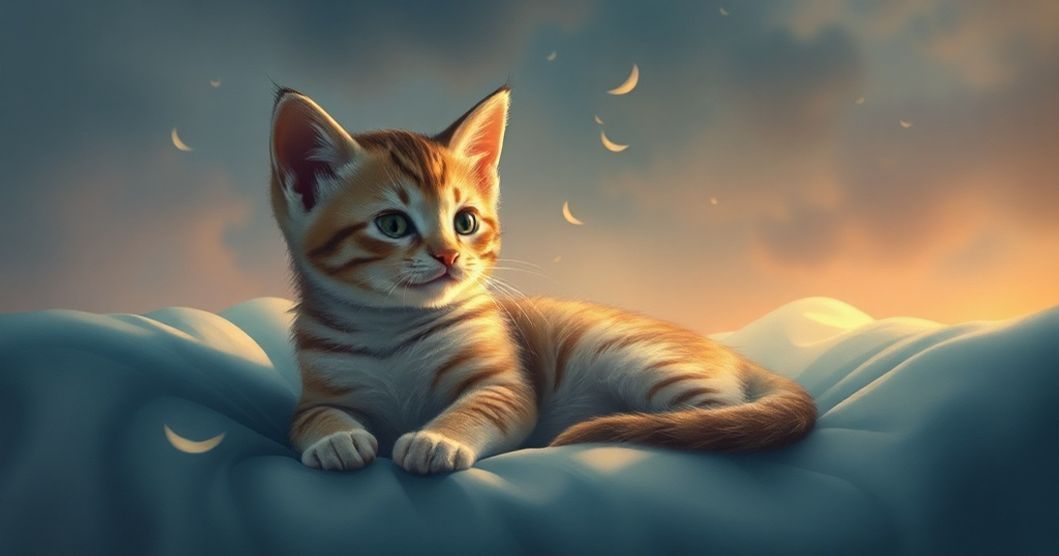
Part 1: Dream Presentation
Dreams often arrive unannounced, carrying symbolic messages from our deeper consciousness. Consider this vivid dream experience: In the quiet hours of sleep, the dreamer finds themselves wandering a familiar neighborhood, where an orange-and-white kitten perches precariously in a gnarled tree branch. The kitten’s fur, a patchwork of burnt sienna and ivory, stands out against the muted greens of the trees, and its tiny body trembles with a mix of fear and defiance. The dreamer feels an immediate twinge of guilt, knowing this small creature belongs to them yet having forgotten to care for it. Despite unfamiliarity with cats, the dreamer climbs the tree, retrieving the kitten despite its hissing and clawing, then carries her home.
Inside, the kitten paces restlessly on the kitchen counter, eyes narrowed in judgment. The dreamer offers water and food, which the kitten eagerly consumes, though her claws still scratch at the ceramic bowl. After eating, she softens slightly, allowing the dreamer to pick her up again. This cycle repeats—first in the neighborhood trees, then in hidden home corners—with the dreamer always forgetting, always feeding, always feeling guilty. The dream ends with the dreamer waking, heart heavy with the weight of their forgetfulness yet comforted by the knowledge that they’ve at least provided sustenance.
Part 2: Clinical Analysis
Want a More Personalized Interpretation?
Get your own AI-powered dream analysis tailored specifically to your dream
🔮Try Dream Analysis FreeSymbolic Landscape: The Kitten as Unconscious Self
The orange-and-white kitten serves as a powerful symbol of the dreamer’s inner self—perhaps their overlooked needs, repressed emotions, or unacknowledged responsibilities. The kitten’s coloration, with its warm orange tones and cool white accents, suggests a blend of passion and purity, vulnerability and strength. The recurring cycle of finding, feeding, and forgetting mirrors the dreamer’s relationship with their own emotional needs: they seek connection but repeatedly neglect to follow through, then feel guilty for their oversight.
The kitten’s anger and eventual acceptance reveal a deeper psychological dynamic. Her claws symbolize both defense mechanisms and the pain of unmet expectations, while her willingness to accept food despite her irritation represents a fundamental need for care that cannot be ignored. The dream’s repetition—finding the kitten in different locations—suggests that the issue is not one-time neglect but an ongoing pattern, with the home representing the dreamer’s internal space where forgotten responsibilities accumulate.
Psychological Perspectives: Jungian and Modern Interpretations
From a Jungian perspective, the kitten may represent the dreamer’s shadow self—the aspects of personality they’ve rejected or neglected. The dream’s repetition acts as a mandala-like pattern, drawing attention to an unintegrated part of the psyche. Jung emphasized that dreams function as a bridge between conscious and unconscious, and this recurring dream may be urging the dreamer to recognize their shadow aspects and integrate them into their waking life.
Freudian analysis would likely interpret the kitten as a manifestation of repressed guilt or unresolved childhood conflicts around caregiving. The dreamer’s stated preference for dogs over cats may reflect an unconscious conflict between different aspects of self—perhaps the need for structure (dogs) versus the need for flexibility (cats)—with the dream highlighting areas where flexibility and care are being neglected.
Contemporary dream research adds that the dream’s repetition indicates an emotional issue requiring attention. The cycle of forgetting and remembering suggests that the mind is attempting to process a message through repetition, much like a loop that cannot resolve itself until the underlying issue is addressed.
Emotional & Life Context: Unprocessed Responsibilities
The dreamer’s admission that they’ve never owned a cat, yet feel responsible for this one, reveals a deeper layer of self-perception. The kitten’s anger mirrors the dreamer’s internalized sense of inadequacy—perhaps they worry about failing at responsibilities, even when they don’t have direct experience. The contrast between their stated preference for dogs and their dream’s focus on cats suggests a conflict between different life choices or values.
The dreamer’s guilt about being an