
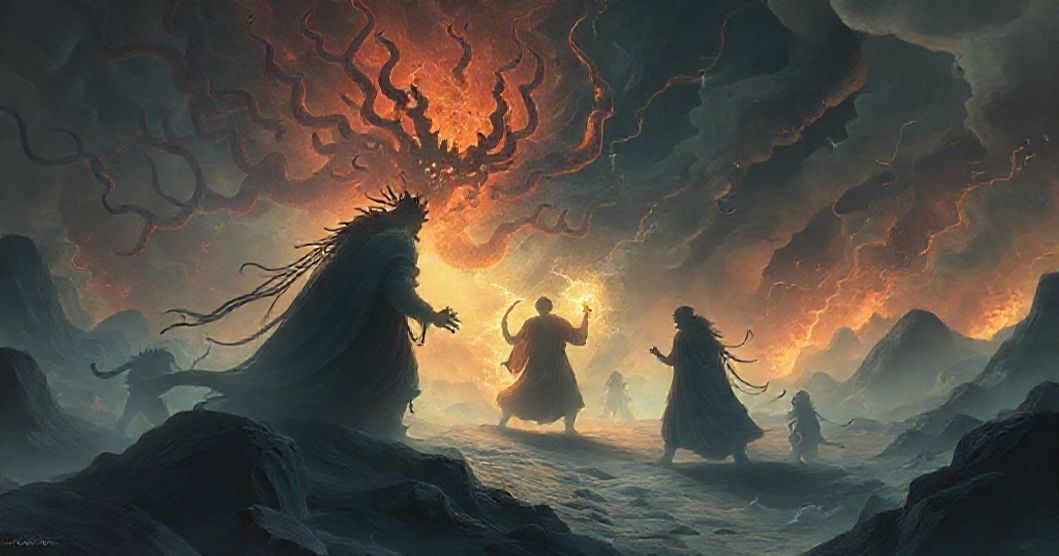
Part 1: Dream Presentation
Dreams often serve as mirrors reflecting our unconscious conflicts and deepest anxieties. This particular dream, filled with familial dynamics and a powerful, intimidating presence, offers a window into the dreamer's relationship with authority, fear, and identity. The dreamer enters a courtyard where family members flee, creating a scene of collective panic. Despite this chaos, the dreamer remains, seeking connection with one remaining family member, only to be interrupted by an exotic language and a figure of regal authority. The encounter triggers profound terror, culminating in the dreamer's collapse before this king-like figure, whose anger shakes the ground beneath them.
I recently experienced a profoundly unsettling dream that has left me with lingering questions about its meaning. I found myself walking into a courtyard where my family members were frantically fleeing, their faces twisted with fear. Despite this chaos, I continued forward, seeking out one family member who had remained behind. As I approached, we exchanged words, though I cannot recall their exact content—only the weight of our conversation felt heavy and urgent. Suddenly, an exotic language filled the air, unfamiliar yet strangely compelling, and I turned to identify its source. In that moment, a figure turned toward me, and his gaze locked onto mine with a regal intensity. He appeared to be a king—his posture exuded authority, his presence commanding attention. His eyes held a mix of surprise and irritation at my interruption, as if I had dared to disturb his important discourse. The power of his stare was paralyzing; I felt myself falling to the ground, my body trembling uncontrollably, desperate for the earth to open and swallow me whole. Yet he ignored me entirely, returning to his speech as if my presence meant nothing. Almost immediately, the ground beneath us began to shake violently, each tremor growing stronger as if fueled by his anger. The dream ended abruptly, leaving me gasping awake in a cold sweat.
Part 2: Clinical Analysis
Want a More Personalized Interpretation?
Get your own AI-powered dream analysis tailored specifically to your dream
🔮Try Dream Analysis FreeSymbolic Landscape: Decoding the King, Family, and Courtyard
The king-like figure represents a powerful archetype of authority, whether internalized or external. In dream symbolism, kings often embody the dreamer's relationship with power structures—both those in waking life and those within the unconscious mind. The 'jinn king' reference in the title suggests cultural or spiritual associations with otherworldly power, possibly reflecting ancestral fears or cultural narratives about unseen forces. The courtyard itself functions as a transitional space between public and private realms, symbolizing a threshold where identity and self-confrontation occur.
Family members fleeing the courtyard represent collective anxiety or unresolved relationship dynamics. Their panicked departure may signify the dreamer's perception of others avoiding conflict or authority, or perhaps a projection of the dreamer's own avoidance of difficult situations. The remaining family member with whom the dreamer speaks introduces an element of personal connection amidst chaos, suggesting a desire for resolution or understanding despite overwhelming circumstances.
Psychological Currents: Theoretical Perspectives
From a Jungian perspective, the king figure could represent the 'wise elder' or 'shadow' archetype—the part of the self we fear or resist acknowledging. The king's anger and the shaking ground might symbolize the shadow's activation, where repressed emotions erupt into awareness. The dreamer's paralysis before this figure aligns with Jung's concept of the 'anima/animus' projection, where the unconscious projects powerful archetypal forces onto external figures.
Freudian analysis might interpret the king as a representation of repressed anger or authority conflicts, particularly in relation to parental figures. The 'exotic language' could symbolize the dreamer's difficulty articulating unconscious desires or fears. The family's flight might reflect unresolved childhood dynamics or familial expectations the dreamer struggles to meet.
Contemporary cognitive dream theory frames dreams as the brain's attempt to process emotional memories and unresolved conflicts. The random neural activity activating the visual cortex creates the vivid, symbolic imagery, while the emotional intensity (terror, fear) indicates processing of significant emotional material.
Emotional and Life Context: Waking Triggers and Unconscious Messages
The dream likely reflects the dreamer's current relationship with authority—perhaps in professional settings, family dynamics, or personal identity. The family's collective panic suggests a situation where the dreamer feels overwhelmed by external pressures or internal expectations. The king's dismissal and subsequent anger mirror feelings of powerlessness in the face of authority figures who dismiss the dreamer's concerns.
The 'jinn king' reference hints at cultural or spiritual beliefs influencing the dreamer's unconscious. If the dreamer has engaged with mythology or spiritual texts recently, these might have primed the mind to project ancient archetypes onto modern experiences. The act of 'reading mythology to identify him' suggests the dreamer seeks meaning in these symbolic figures, indicating a conscious effort to understand the unconscious messages.
The emotional intensity—the terror, the desire for the earth to swallow the dreamer—reflects deep-seated fears of humiliation, rejection, or failure in the face of authority. The shaking ground symbolizes the destabilizing effect of these fears on the dreamer's sense of stability.
Therapeutic Insights: What the Dream Reveals and How to Integrate Its Lessons
This dream invites the dreamer to examine relationships with authority in waking life. The first step is to identify specific authority figures triggering similar feelings of powerlessness. Journaling about interactions with these figures can reveal patterns of dismissal or invalidation.
Reflection exercises should include exploring the 'king' within—identifying internalized authority figures (perfectionism, self-criticism) that feel overwhelming. The dreamer might benefit from assertiveness training to address situations where their voice is dismissed.
The family members' flight represents the dreamer's need to distinguish between genuine support and enabling behavior. Setting boundaries with those who dismiss or abandon during conflict can reduce feelings of powerlessness.
For long-term integration, the dreamer might explore the 'exotic language' as a metaphor for unspoken truths. Engaging in creative expression or symbolic art could help articulate these repressed emotions.
FAQ Section
Q: Why did the family members flee in the dream?
A: Their flight likely symbolizes the dreamer's perception of others avoiding conflict or authority, or represents the dreamer's own avoidance of difficult situations.
Q: What does the king's anger and shaking ground signify?
A: The king's anger and seismic activity represent repressed rage, power struggles, or overwhelming emotions the dreamer is experiencing but cannot fully express.
Q: How can the dreamer apply this insight to waking life?
A: Reflect on relationships with authority figures, practice assertiveness while acknowledging vulnerability, and explore ways to process anger constructively through journaling or creative outlets.