
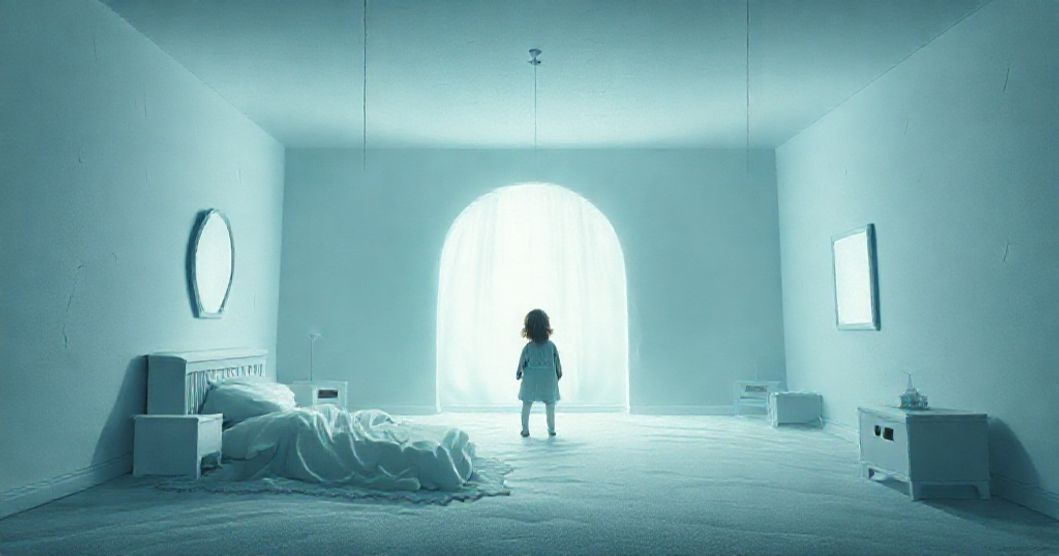
Part 1: Dream Presentation
Childhood fever dreams possess a unique quality—they blur the boundaries between physical illness and psychological state, creating vivid, emotionally charged landscapes that linger in memory long after recovery. This recurring dream, experienced during periods of high fever, unfolds in a stark, luminous white room that feels both vast and confining, a liminal space suspended between reality and the unconscious mind. The floating shapes drift like abstract thoughts made tangible, their ever-shifting forms reflecting the dreamer’s internal state of anxiety and urgency.
In this dreamscape, the dreamer faces a dual threat: a family member in danger, held at gunpoint by a historical figure, and the necessity of solving a shape-fitting puzzle to save them. The dreamer’s physical response—slamming the bedroom door shut to 'fit the shapes'—reveals the unconscious connection between waking actions and the dream’s symbolic demands. This narrative, with its repeated attempts, inevitable failure, and resulting grief, offers profound insights into childhood anxieties around control, protection, and the weight of responsibility.
The dreamer’s emotional journey—from frantic concentration to heartbreak upon failure—culminates in waking sobs, marking this as more than a mere nightmare; it is a psychological document of childhood vulnerability and unspoken fears.
Want a More Personalized Interpretation?
Get your own AI-powered dream analysis tailored specifically to your dream
🔮Try Dream Analysis FreePart 2: Clinical Analysis
Symbolic Landscape: The White Room and Floating Shapes
The white room functions as a powerful symbol of emotional purity and vulnerability—a blank canvas where the dreamer’s unconscious fears and anxieties materialize. Its sterility and lack of defining features suggest a state of psychological liminality, where the usual structures of reality (walls, boundaries, purpose) dissolve during fever-induced sleep disruption. The floating shapes represent the dreamer’s internal conflicts, perhaps unresolved childhood tensions or fears of inadequacy, rendered as abstract, ungraspable entities that demand precise action.
The gun, held by a historical figure, introduces themes of historical influence and authority. Historical figures often appear in dreams as archetypes of societal pressures, parental expectations, or cultural narratives. Their presence alongside a family member creates a tension between external threats (historical/societal) and internal safety (family), suggesting the dreamer’s perception of loved ones as vulnerable to external forces.
Psychological Perspectives: Understanding the Dreamer’s Internal World
From a Freudian lens, this dream reveals repressed childhood anxieties around loss and protection. The fever, as a physical stressor, amplifies emotional vulnerability, making unconscious fears more accessible in dreams. The repeated 'shape-fitting' task mirrors the dreamer’s attempt to impose order on chaos—a common defense mechanism during periods of stress.
Jungian psychology offers another framework, viewing the historical figure as a collective unconscious archetype representing societal pressures or the 'shadow' aspects of the dreamer’s psyche. The family member, conversely, embodies the 'anima/animus' or the self, suggesting a core conflict between protecting one’s essence and external threats.
Neuroscience explains fever dreams as heightened emotional processing during REM sleep disruption. Fever increases brain activity in the limbic system, amplifying emotional intensity and creating more vivid, emotionally charged dreams that reflect the body’s stress response.
Emotional & Life Context: Unpacking Childhood Anxiety
Childhood fevers create a unique vulnerability, as the body’s physical discomfort heightens emotional sensitivity. The recurring nature of this dream suggests it addresses persistent childhood concerns about safety, control, and protection. The act of 'fitting shapes' in the dream may symbolize the child’s attempt to master a difficult situation—perhaps academic pressure, family conflicts, or the fear of disappointing caregivers.
The physical manifestation of slamming the bedroom door in waking life (to 'fit the shapes') reveals the dreamer’s unconscious attempt to externalize and resolve internal conflict. This physical action represents a primal need to control one’s environment—a response to the feeling of powerlessness in the face of threats, whether real or perceived.
Therapeutic Insights: Processing the Dream’s Lessons
This recurring dream offers an opportunity to revisit childhood emotional patterns and recognize how they continue to influence adult responses. Reflective journaling can help identify recurring themes in waking life that mirror the dream’s core conflict: the need to 'fit pieces together' to resolve anxiety, protect loved ones, or assert control.
Therapeutic work with such dreams involves exploring the historical figure’s identity and meaning. Is this a specific historical figure or a representation of authority figures in the dreamer’s life? Understanding this can illuminate unresolved relationship patterns or societal pressures.
Creating a 'safe space' to process these childhood anxieties—through mindfulness or creative expression—can help transform the dream’s emotional charge into self-awareness. The dream’s message is not one of failure but of resilience: the dreamer’s persistent attempts to save the family member, even in the face of failure, reflect an inherent protective instinct that deserves acknowledgment and integration.
FAQ Section
Q: Why do fever dreams feel so physically intense and recurring?
A: Fever disrupts normal sleep cycles, activating the limbic system and amplifying emotional processing. Recurrence suggests unresolved emotional themes that persistently surface during periods of physiological stress.
**Q: What does the