
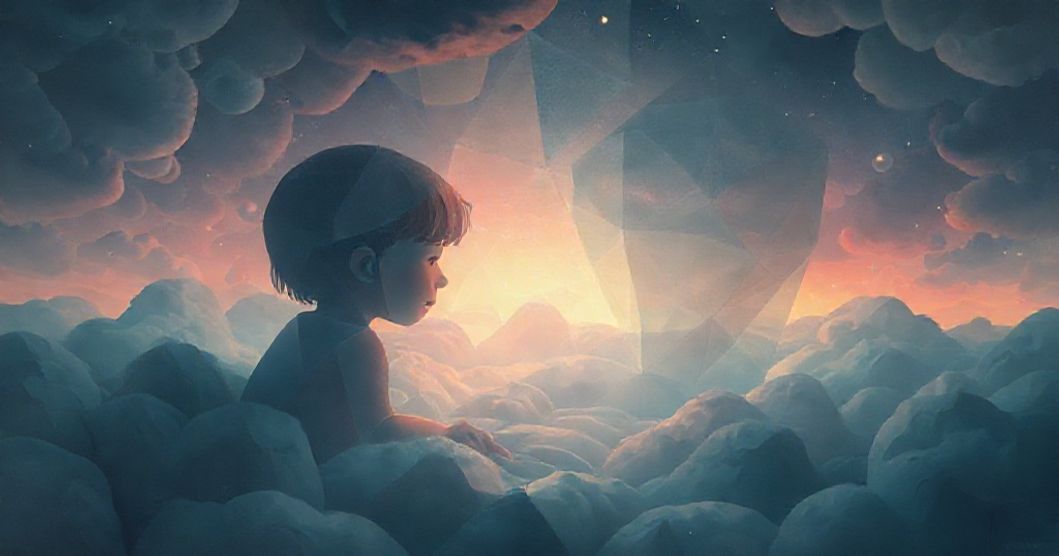
Part 1: Dream Presentation
Childhood dreams often feel like fragments of a foreign language, their meanings slipping through our grasp as we wake. I experienced such dreams repeatedly during my early years—experiences that defied the ordinary logic of daytime reality. In these dreams, geometric patterns unfurled like living organisms, their angles shifting in ways that felt both familiar and alien. Tiny dots, like microscopic stars, would zoom in and out of focus, creating a dizzying rhythm that stirred unease rather than wonder. Most terrifying was a chaotic, messy pattern—a swirling jumble of lines and shapes that lacked any discernible order—triggering an overwhelming sense of existential fear. It felt as though the very fabric of reality was unraveling, and I couldn't escape the weight of that chaos. When these dreams ended, I'd wake up screaming, tears streaming, heart hammering against my chest. My mother would be there, her arms wrapping around me, trying to soothe the terror, but I couldn't articulate what I'd seen or felt. The words simply wouldn't form, leaving only a hollow, unspoken terror that persisted long after waking. That silence, that inability to explain, became a silent shadow I carried, its meaning unresolved until now.
Part 2: Clinical Analysis
Symbolic Landscape: Geometry and Chaos as Emotional Metaphors
Want a More Personalized Interpretation?
Get your own AI-powered dream analysis tailored specifically to your dream
🔮Try Dream Analysis FreeThe geometric patterns in this dream serve as powerful symbolic representations of childhood's struggle with order and meaning-making. In dreams, geometric shapes often emerge from the collective unconscious, reflecting fundamental human concerns about structure and predictability. The dots that zoom in and out can be interpreted as manifestations of childhood curiosity colliding with overwhelming uncertainty—a common developmental tension where the world feels both fascinating and threatening. Jungian psychology might view these patterns as archetypal representations of the