
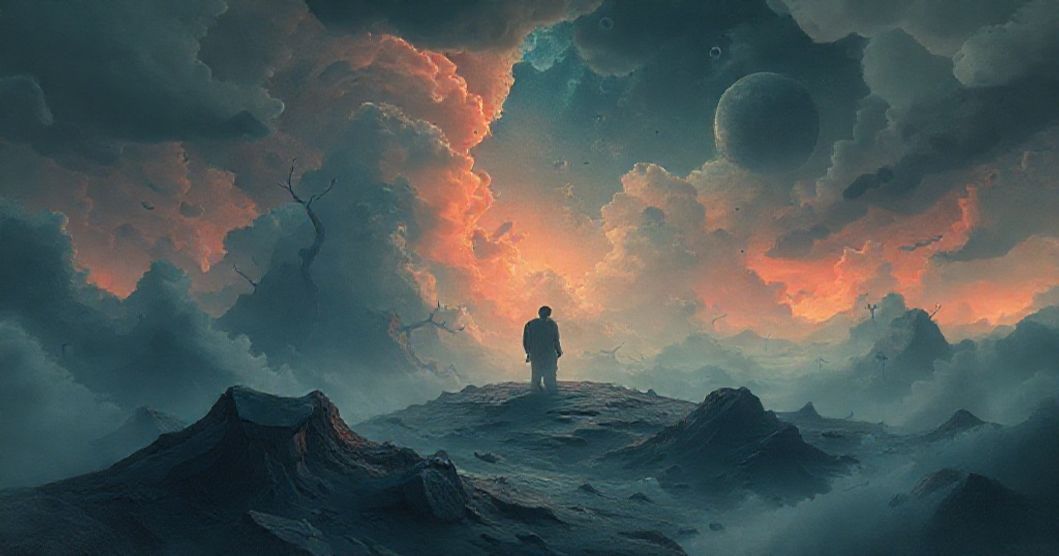
Part 1: Dream Presentation
Dreams of recurring death can feel both terrifying and strangely familiar, offering a unique window into our psychological landscape. Consider this vivid account of semi-lucid dreams where the weight of dying is palpable, yet the dreamer’s movements bear the burden of a half-realized awareness:
I find myself in a curious liminal space of semi-lucid dreaming—aware that I might control my actions, yet constrained by an invisible weight that slows every movement. These dreams unfold in two distinct, yet equally unsettling scenarios: the first in a shadowed forest where wolves lurk, their eyes glinting with predatory intelligence; the second in a surreal industrial landscape where massive sea containers tower impossibly high, stacked like metallic monoliths against a leaden sky. In both, I die repeatedly, yet the experience feels strangely familiar. When I attempt to alter the dream’s course—perhaps to flee the wolves or climb higher in the container maze—my movements become sluggish, as if weighted by invisible chains. Each step, each breath, feels heavy and deliberate, as though my very willpower is being tested by some internal resistance.
In the forest dreams, the wolves are not mindless predators but seem to know my intentions. Their bites are not just painful but disorienting, robbing me of strength in a matter of seconds. The woods themselves feel alive with tension—every rustle in the underbrush a potential threat. In the industrial dreams, the containers stretch upward beyond the limits of logic, their metallic surfaces glinting in a dim, artificial light. When I finally summon the courage to climb, my hands slip on the cold metal, and I plummet. The fall is slow, each second stretching into an eternity of weightlessness, followed by an abrupt, searing pain upon impact. Then either the dream shatters into wakefulness or shifts into something entirely new, leaving me with a dull, persistent disappointment.
Want a More Personalized Interpretation?
Get your own AI-powered dream analysis tailored specifically to your dream
🔮Try Dream Analysis FreeI recognize these dreams immediately, a strange mixture of dread and resignation coloring my awareness. There’s a sense of inevitability, as if I’ve seen this script before. Despite the semi-lucid quality and my attempts at control, I remain trapped in these death scenarios. This disappointment, I realize, is more significant than the fear itself—it feels like a reflection of something unresolved in my waking life. These dreams do not seem to affect my other dreams, but I worry about what they might signify. I’ve never actively pursued lucid dreaming techniques, and my usual dreams unfold without any such awareness, making these semi-lucid moments even more perplexing. It’s as though my unconscious is staging a dialogue I cannot fully participate in, yet somehow understand.
Part 2: Clinical Analysis
Symbolic Landscape: The Language of Death and Weight
The recurring theme of dying in these dreams carries profound symbolic weight, particularly in the context of semi-lucid states where the dreamer experiences partial control yet encounters significant limitations. The forest with wolves represents primal, instinctual fears that feel both external and internalized. Wolves, in dream symbolism, often embody our most primal anxieties—those that feel uncontrollable, predatory, and capable of undermining our sense of safety. The act of being bitten and dying in this context may reflect a feeling of being