
Part 1: Dream Presentation
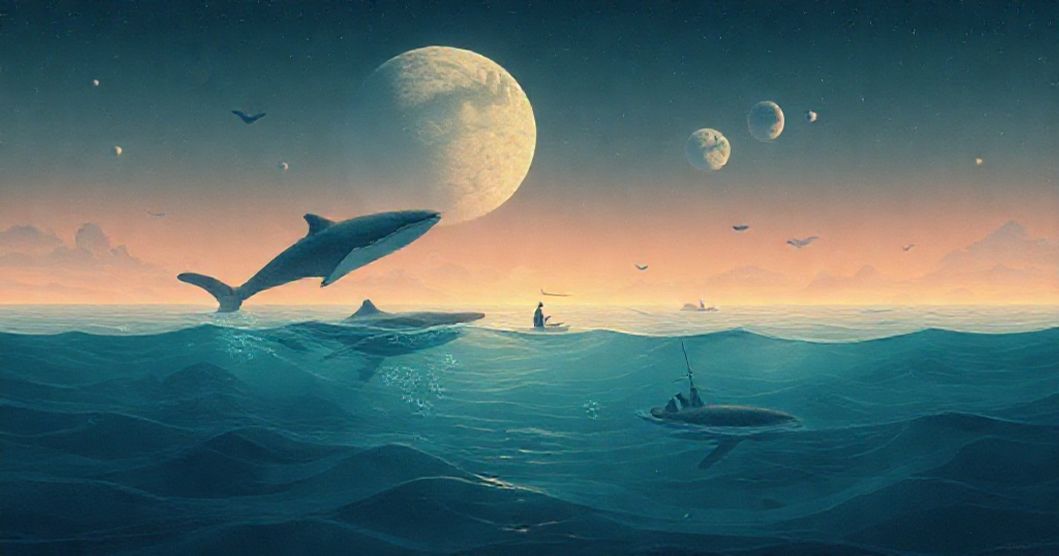
Dreams often serve as portals to the unconscious, bridging the gap between our waking awareness and deeper psychological landscapes. In this particular dream, the dreamer stands at the threshold of reality and fantasy, observing a surreal tableau that blends familiar elements with unexpected transformations. As night falls, the bedroom window becomes a frame for cosmic symbols and liminal spaces, where the ordinary (a backyard, a moonlit sky) collides with the extraordinary (liquid grass, bioluminescent whales).
As I stood at my bedroom window one night, the world outside blurred into a dreamscape where reality and fantasy intertwined. The sky blazed with celestial light—a perfect full moon hung low, its silver glow contrasting sharply with a delicate crescent moon nestled nearby, as if two phases of the same cosmic story were unfolding simultaneously. In the distance, shadowy shapes drifted like silent sentinels: enormous blimps, their outlines faint against the starry expanse, moving with the unhurried detachment of something both observed and unknowable. Below me, the grass beneath my window had transformed into something alien yet familiar—a liquid expanse that rippled and flowed like water, yet retained the texture of the 'skulk' blocks from Minecraft, shifting under my gaze with an otherworldly fluidity. What truly stunned me was what lay beneath this surreal lawn: colossal humpback whales, their bodies glowing with bioluminescent light that pulsed like a heartbeat beneath the surface. I felt a strange awe mixed with anxiety as I watched them navigate this confined space—their massive forms seemed to barely fit within the boundaries of my backyard, their tails brushing against invisible walls. My concern grew as more of these luminous creatures appeared, swimming in single file from one backyard to another, as if following an invisible path through the dreamworld. I wondered if they had any space to truly move, or if their journey was注定 to be confined within these artificial boundaries.
Part 2: Clinical Analysis
Want a More Personalized Interpretation?
Get your own AI-powered dream analysis tailored specifically to your dream
🔮Try Dream Analysis FreeSymbolic Landscape of the Dream
The dream’s symbolic elements create a rich tapestry of meaning that invites exploration of the unconscious mind. The dual moon imagery—full and crescent—represents complementary aspects of the dreamer’s inner world. The full moon, a universal symbol of wholeness, illumination, and emotional depth, contrasts with the crescent moon’s association with transition, growth, and intuition. Together, they suggest a dialogue between completion and potential, between the conscious and unconscious aspects of the psyche. In Jungian psychology, the moon often symbolizes the feminine principle, the collective unconscious, and emotional cycles—here, their simultaneous presence may indicate the dreamer’s awareness of both wholeness and the ongoing process of becoming.
The blimps in the distance introduce an element of detachment and observation. These airborne sentinels, faint and distant, can symbolize the dreamer’s perspective as an external observer within their own psyche—a witness to their inner life rather than an active participant. Their stillness and distance may reflect a need to maintain emotional boundaries or a sense of separation from overwhelming feelings, as if the dreamer is watching rather than engaging directly.
The liquid grass, described as resembling Minecraft’s skulk but flowing like water, represents a liminal space—a threshold between the solid and the fluid, the known and the unknown. In dream symbolism, grass often signifies growth, fertility, and connection to the earth, while liquid grass introduces instability and transience, suggesting a psychological state of flux or uncertainty. The reference to Minecraft’s skulk (a block associated with detection and movement in the game) adds a layer of digital-age anxiety about surveillance and artificial constraints, perhaps reflecting the dreamer’s awareness of being 'watched' or confined by modern life’s expectations.
Psychological Undercurrents
From a Jungian perspective, the bioluminescent whales represent the numinous—a powerful, awe-inspiring force of life that emerges from the depths of the collective unconscious. Whales, with their size and grace, symbolize ancient wisdom, emotional depth, and the interconnectedness of all living things. Their bioluminescence suggests a life force that illuminates the dark, bringing awareness to previously hidden aspects of the dreamer’s psyche. The concern about their limited space to move reflects an unconscious fear of restriction—a theme that may resonate with the dreamer’s waking life, where they feel confined by obligations, relationships, or self-imposed limitations.
Freudian analysis might interpret the whales as repressed desires or unacknowledged emotional needs. The confined space could represent the dreamer’s fear of these desires overwhelming them if not properly contained, while the movement from backyard to backyard suggests an attempt to find a suitable outlet for these energies. The blimps, as distant observers, might symbolize the dreamer’s superego or internalized judgment, watching and potentially censoring these desires.
Neuroscientifically, dreams are the brain’s way of processing emotions and memories during sleep, with the amygdala (emotional center) and hippocampus (memory consolidation) actively involved. The dream’s surreal elements—the liquid grass, the whales in a backyard—reflect the brain’s tendency to combine disparate neural patterns, creating novel scenarios that help integrate emotional experiences. The whales’ bioluminescence could represent the activation of the default mode network, a brain system associated with self-referential thought and creativity during rest.
Emotional Context and Life Triggers
The dream’s emotional tone—wonder mixed with concern—suggests the dreamer is navigating a period of transition or uncertainty. The whales’ confined movement may mirror real-life constraints: perhaps the dreamer feels restricted in their career, relationships, or personal growth, with little space to 'breathe' or express themselves fully. The full and crescent moons might reflect a tension between completion (full moon) and potential (crescent), mirroring the dreamer’s feelings of having achieved certain goals while still seeking new growth.
The backyard setting, typically a private, personal space, becomes a public thoroughfare for whales, suggesting a blurring of boundaries between the dreamer’s internal and external worlds. This could indicate a period of self-reflection, where the dreamer is examining how their inner emotions (the whales) impact their daily life (the backyard), and vice versa. The dream’s emphasis on observation (standing at the window) might reflect a desire to step back and assess one’s life circumstances, seeking clarity amid confusion.
Therapeutic Insights
This dream invites the dreamer to explore their relationship with freedom and constraint. The whales’ struggle for space suggests a need to create more room for emotional expression and personal growth, whether through setting boundaries, pursuing new interests, or reconnecting with neglected passions. The liquid grass and blimps remind the dreamer to balance awareness of their surroundings with trust in their inner guidance—sometimes, stepping back (like the blimps) allows for clearer observation, while stepping forward (like the whales) requires courage to move beyond comfort zones.
A practical reflection exercise could involve journaling about times when the dreamer feels 'confined' or 'observed' in waking life, mapping these experiences to the dream’s symbols. The dreamer might ask themselves: 'Where in my life do I feel like a whale in a backyard—limited by invisible boundaries?' This self-inquiry can help identify concrete areas for change, whether through setting clearer boundaries at work, exploring creative outlets, or practicing mindfulness to reduce anxiety about being 'watched' or judged.
Integration of dream insights into daily life might involve creating physical or mental spaces for 'whale-like' movement—perhaps a daily walk in nature, journaling about emotional 'flow,' or setting small, intentional boundaries to reclaim a sense of freedom. The dream’s message is not to fear the 'confined' spaces but to recognize them as opportunities for growth and self-discovery.
FAQ Section
Q: What does the combination of a full moon and crescent moon symbolize in dreams?
A: Together, they represent the balance between wholeness (full moon) and potential (crescent), reflecting the dreamer’s awareness of both completion and ongoing growth. This duality often signals a period of transition or self-reflection.
Q: Why would whales appear in a backyard in a dream?
A: Whales symbolize deep emotional life force and interconnectedness. Their appearance in a backyard suggests the dreamer is bringing these powerful, transformative energies into their daily life, potentially feeling constrained by limited space or resources to express them fully.
Q: How does the liquid grass imagery connect to modern life concerns?
A: Liquid grass (like Minecraft’s skulk) reflects digital-age anxieties about surveillance and artificial constraints, suggesting the dreamer feels watched or confined by modern expectations, technology, or social pressures.
Keywords: moon symbolism, bioluminescent whales, liquid grass, surreal dream, liminal space, unconscious mind, dream psychology, backyard boundaries, full moon, crescent moon Entities: full moon, crescent moon, bioluminescent whales, liquid grass, backyard liminal space