
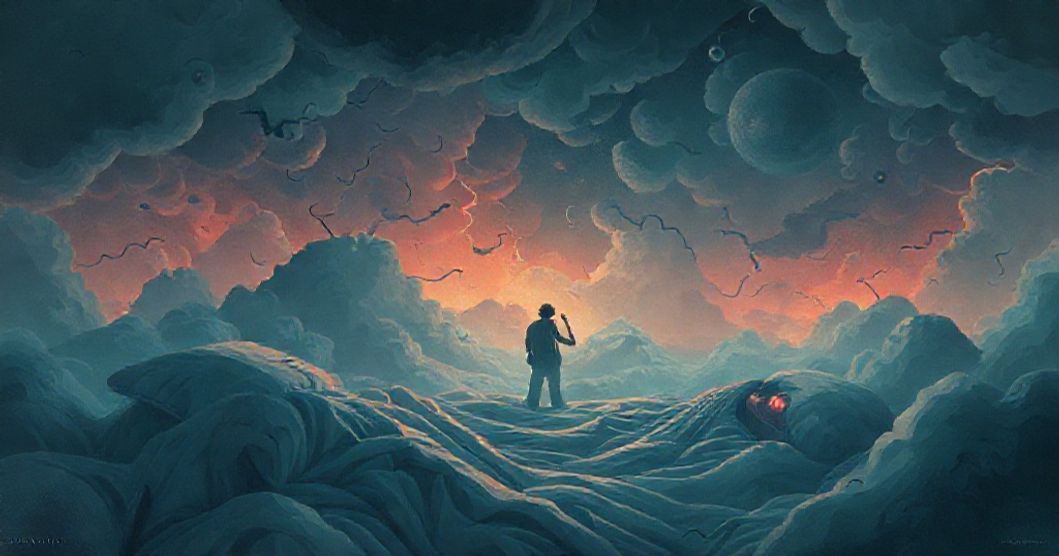
The Lucid Nightmare: Unpacking Fear, Control, and Symbolic Threats in a Dream\n
Part 1: Dream Presentation
Dreams often manifest our deepest anxieties through surreal scenarios that feel disturbingly real. This vivid dream experience captures a moment of existential tension between waking reality and the dream state itself, revealing complex emotional undercurrents through symbolic imagery. The dreamer navigates a familiar route to school, only to encounter impossible obstacles: a suitcase falling from the sky, a threatening stranger with a knife, and a desperate crash into authority. Each element—from the red light to the silent Siri—serves as a psychological mirror, reflecting the dreamer’s internal landscape of fear, control, and unresolved tensions.
The dream unfolds in three distinct phases: the disruption of routine, the confrontation with a symbolic threat, and the paradoxical attempt to seek safety by destroying it. The journey begins with the comfort of familiarity—the well-known route to school—before a red light forces a pause. This pause becomes the trigger for an impossible event: a suitcase materializes in the road, defying physical laws. The suitcase, a universal symbol of transience and unprocessed burdens, falling into the path of a routine commute, suggests the intrusion of unexpected, uncontrollable forces into life’s familiar patterns. The dreamer’s immediate thought—“Suitcases don’t just fall from the sky”—reveals the dream’s core tension: the clash between the logic of waking life and the illogical, yet emotionally charged, reality of the dream.
As the dream progresses, the narrative shifts to confrontation. A woman with Eastern European features (a detail that may reflect cultural anxieties or fears of the unknown) appears, crossing the road and locking eyes with the dreamer. Her sudden, violent attack with a knife introduces a primal fear of physical threat and loss of control. The dreamer’s attempt to swerve, scream, and command Siri for help underscores the universal human response to danger: seeking safety through action, only to discover that external systems (like technology or authority) may fail in moments of crisis.
Want a More Personalized Interpretation?
Get your own AI-powered dream analysis tailored specifically to your dream
🔮Try Dream Analysis FreeThe climax—the deliberate crash into the police station—represents a paradoxical solution. The police station, a symbol of order and protection, becomes the target of the dreamer’s desperate maneuver. This choice suggests the unconscious’s recognition that traditional avenues of safety may themselves be flawed or inaccessible, forcing the dreamer to confront the fragility of relying on external validation or protection.
Part 2: Clinical Analysis
Symbolic Landscape: Unpacking the Dream Elements
The suitcase, the first critical symbol, embodies the dreamer’s relationship with unprocessed responsibilities or emotional burdens. In waking life, suitcases often represent travel, transition, or the carrying of expectations. Its impossible appearance in the middle of a familiar route suggests that stressors or unresolved issues have unexpectedly intruded into life’s predictable patterns. The suitcase’s fall from the sky—an impossible event—reflects how anxiety can distort reality, making even mundane paths feel fraught with danger.
The woman with the knife introduces the archetype of the shadow figure, a concept from Jungian psychology representing repressed aspects of the self or external threats we project onto others. Her specific ethnicity may reflect cultural anxieties or fears of the unknown, while her homeless appearance (implied by the dreamer’s observation) could symbolize marginalization or the fear of being overwhelmed by societal pressures. The knife, a tool of both protection and violence, becomes a metaphor for emotional cutting—either being attacked by external criticism or lashing out at internalized anger.
The red light, a traffic signal that halts forward motion, symbolizes a pause in decision-making. In dream analysis, red lights often represent moments of uncertainty or moral dilemmas. Here, it functions as a threshold between the known (familiar route) and the unknown (the suitcase’s appearance), forcing the dreamer into a state of liminality—neither fully awake nor asleep, neither in control nor adrift.
The car itself, a vehicle of agency and control, becomes a site of vulnerability. The dreamer’s attempt to swerve and accelerate reflects the unconscious’s struggle to regain control in the face of chaos. The inability to use Siri—representing modern technological dependence—highlights the dreamer’s reliance on external systems for safety, a common anxiety in an increasingly disconnected world.
Psychological Perspectives: Multiple Lenses on the Dream
From a Freudian perspective, the dream’s violent elements may represent repressed anger or fear of authority. The police station, a symbol of societal control, becomes both the target and the source of the dreamer’s desperation—a classic Freudian example of the id (unconscious drives) clashing with the superego (moral constraints). The dreamer’s decision to crash into the station rather than flee suggests an unconscious fear of confronting the very authority meant to protect them, reflecting unresolved tensions with rules, expectations, or judgment.
Jungian psychology offers a complementary framework, viewing the woman as a shadow archetype—an aspect of the self the dreamer fears or rejects. Her Eastern European features may symbolize cultural projections or fears of difference, while her homeless state could represent the dreamer’s own sense of marginalization or disconnection from community. The knife attack, in this context, becomes a confrontation with one’s own repressed anger or vulnerability, urging the dreamer to integrate these aspects rather than flee from them.
Cognitive dream theory provides another layer: dreams as problem-solving tools. The dream’s structure—encountering a threat, attempting to control it, failing to seek help, and then destroying the source of safety—mirrors the brain’s attempt to process stressors through simulation. The amygdala, which regulates fear responses, may be hyperactive during the dream, amplifying the emotional intensity of the confrontation. The dream’s ending—crashing into the police station—suggests the unconscious’s recognition that traditional “solutions” to fear (like calling the police) may be inadequate, forcing a reckoning with deeper vulnerabilities.
Neuroscience adds biological context: REM sleep, when most dreaming occurs, activates the default mode network, responsible for self-referential thoughts and emotional processing. The dream’s focus on fear and control aligns with studies showing that dreams often reflect waking emotional states, particularly anxiety about performance, safety, or social evaluation. The car crash, a visceral and abrupt event, may represent the unconscious’s attempt to “reset” or resolve emotional overwhelm.
Emotional & Life Context: Connecting the Dream to Waking Reality
The dream’s emotional core centers on two primary tensions: the disruption of control and the paradox of seeking safety through destruction. In waking life, the dreamer may be experiencing high-stakes situations—academic pressure, career uncertainty, or relationship stress—that feel like “red lights” forcing a pause in decision-making. The suitcase, falling into the path of routine, could symbolize an unaddressed project, obligation, or emotional burden that has unexpectedly resurfaced.
The woman with the knife likely reflects the dreamer’s fear of confrontation or criticism. In academic or professional settings, the threat of judgment (represented by the knife) may feel omnipresent, while the homeless appearance hints at feelings of being “on the margins” of social acceptance. The inability to use Siri to call for help underscores a broader anxiety about modern communication: even as technology promises connection, it can fail in moments of crisis, leaving the dreamer feeling isolated and vulnerable.
The crash into the police station, the final act of desperation, reveals a deeper fear: that the systems meant to protect us (authority, technology, social norms) may themselves be flawed or dangerous. This reflects a growing cultural anxiety about institutional trust, particularly in education or work environments where safety and accountability feel compromised. The dream’s resolution—destroying the source of safety rather than seeking it—suggests the unconscious’s frustration with systems that fail to deliver on their promises of security.
Therapeutic Insights: What the Dream Reveals and How to Integrate It
The dream’s most powerful message is that fear and vulnerability are not separate from the self but essential parts of the human experience. The suitcase, as an unprocessed burden, urges the dreamer to examine waking life for unaddressed responsibilities or emotional blocks that feel like “falling from the sky”—unexpected, yet deeply personal. Journaling about recent stressors, identifying which ones feel like “suitcases” in your path, and reflecting on how you might “pack” or release them can help transform this anxiety into actionable steps.
The woman with the knife, as a shadow figure, invites self-compassion rather than fear. Instead of seeing external threats as enemies, the dream suggests exploring internal anger or criticism that may be manifesting as “attacks.” Mindfulness practices, such as grounding exercises during moments of panic, can help transform reactive fear into intentional action. Asking, “What part of me feels attacked right now?” rather than “Who is attacking me?” shifts the narrative from victimhood to agency.
The paradox of crashing into the police station offers a metaphor for redefining safety. Instead of seeing external systems as either saviors or threats, consider creating your own “safety station”—a personal sanctuary of boundaries, self-care, or trusted relationships. The dream’s chaotic ending can be reframed as a call to build resilience: sometimes, the path forward requires radical self-acceptance rather than desperate action.
FAQ Section: Answering Key Questions About the Dream
Q: Why did the suitcase falling feel so impossible in the dream?
A: The suitcase represents unprocessed responsibilities or emotions. Its impossible appearance reflects how stressors can feel out of control, even when familiar with their source. This “impossibility” mirrors waking life’s tendency to feel illogical when overwhelmed.
Q: What does the woman’s ethnicity symbolize in the dream?
A: Her features likely reflect cultural anxieties or fears of the unknown, rather than literal ethnicity. The dream uses her appearance to externalize internal fears of difference, marginalization, or confrontation.
Q: Why did the dream end with crashing into the police station instead of a more rational solution?
A: This paradoxical choice reveals the unconscious’s frustration with relying on external systems (like police or technology) for safety. It suggests a need to build internal safety through self-trust and resilience, rather than external validation.