
Part 1: Dream Presentation
Lucid dreams create a paradoxical reality where dreamers simultaneously know and experience their dream world, offering unique insights into the relationship between consciousness and the unconscious mind. In this narrative, the dreamer embarks on a journey from the freedom of self-aware dreaming to the unexpected confinement of a dark room, ultimately finding liberation through a primal scream and spiritual connection. Here is the complete dream as experienced:
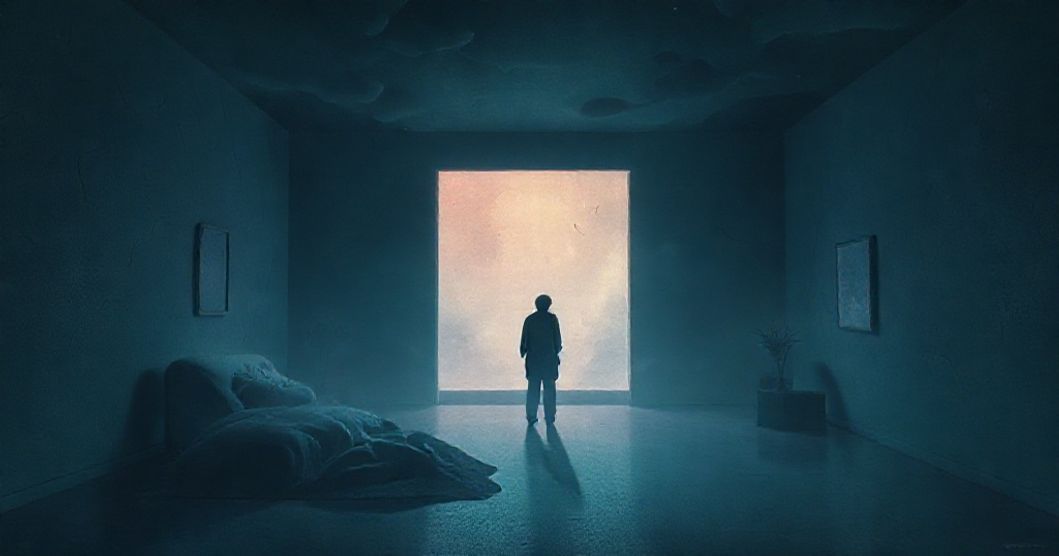
I’d been struggling to sleep for hours, my mind racing despite exhaustion. When I finally drifted into slumber, I found myself in a familiar bedroom, lying in bed as if resting in my own body. Yet this time, I recognized the dream state immediately—a lucid moment, where the boundaries between consciousness and sleep dissolved. With that clarity, I felt myself 'leaving' my physical form, a sensation both exhilarating and disorienting, yet entirely familiar. In this dream, I explored freely, doing the things I love without constraint, my awareness steady that this was not ordinary sleep. Then, from somewhere beyond the dreamscape, I heard my mother’s voice calling me, urgent and familiar. I turned toward the sound and saw my physical body lying still on the bed, just as I’d left it. Without hesitation, I stepped back into that form, the connection feeling like returning home. But as I settled into my body, the dream shifted dramatically. The room around me began to collapse inward, darkness swallowing the edges like ink spreading on paper. What followed was a sudden, overwhelming sense of entrapment—a dark room, impenetrable and oppressive, where negative energy seemed to press against me from all sides. Panic surged through me, a cold dread that felt both real and symbolic. I tried to move, but my limbs felt heavy, rooted in place. Anxious, I began to scream, the sound echoing within the dream and, I realized upon waking, resonating in the real world as a primal cry. In that moment of desperation, I called out to a higher power, not as a plea for help but as a raw expression of my struggle. The scream, issued from the deepest part of my being, shattered the darkness—a crack of light split the void, and suddenly I was awake, heart pounding, yet with a strange sense of liberation.
Part 2: Clinical Analysis
Want a More Personalized Interpretation?
Get your own AI-powered dream analysis tailored specifically to your dream
🔮Try Dream Analysis FreeSymbolic Landscape: The Dark Room and Boundary Crossing
The dark room serves as a powerful symbolic threshold between the dreamer’s conscious control and the unconscious’s resistance to integration. In lucid dreaming, the initial freedom—'leaving the body' to explore freely—represents the ego’s confidence in self-awareness. The abrupt transition to darkness and entrapment suggests a deeper psychological process: the shadow self, or repressed aspects of the personality, asserting itself. The 'negative energy' in the room embodies unresolved emotions, fears, or anxieties that the dreamer has unconsciously avoided. These elements collectively form a boundary-crossing experience, where the dreamer confronts parts of themselves they previously avoided.
The mother’s voice and physical form represent maternal protection and identity integration. In dream symbolism, maternal figures often embody emotional safety and the need for guidance. The act of 'entering the body' after leaving it reflects a desire to reclaim wholeness—a common theme in lucid dreams, where the dreamer seeks to reconcile fragmented aspects of self.
Psychological Undercurrents: Lucid Dreaming and the Unconscious
From a Jungian perspective, the dark room mirrors the 'shadow,' the repressed parts of the psyche that demand integration. The dreamer’s initial lucid freedom (active self-awareness) collides with the shadow’s resistance, manifesting as entrapment. The mother’s voice, as the anima/animus archetype, symbolizes the dreamer’s need for balance between conscious will and intuitive wisdom. When the dreamer calls out to 'God' during the scream, this spiritual connection represents the unconscious’s attempt to bridge the gap between conscious fear and deeper meaning.
Freudian analysis might interpret the scream and negative energy as repressed anxiety, with the dark room symbolizing forbidden desires or unresolved childhood conflicts. The mother’s voice could project unresolved attachment issues, while the sudden darkness reflects the ego’s struggle against the id’s demands. Cognitive dream theory, however, frames the experience as a natural progression in lucid dreaming: the dreamer’s attempt to control the environment (a hallmark of lucidity) is disrupted by the dream’s inherent unpredictability—a metaphor for life’s unexpected challenges.
Emotional Context: Waking Life Stressors and Dream Themes
The difficulty sleeping and exhaustion suggest emotional overload in waking life, where the mind cannot rest. The transition from freedom to entrapment likely mirrors real-life experiences where the dreamer feels in control but suddenly faces unexpected constraints—perhaps in relationships, work, or personal goals. The mother’s voice, echoing from the dream, may signal a subconscious longing for safety during periods of uncertainty.
The scream, which 'echoes in reality,' indicates the dreamer’s need to release pent-up emotions. In waking life, this could manifest as suppressed anger, anxiety, or grief. The dream’s resolution—'darkness cracked and light comes through'—suggests that confronting these emotions, even symbolically, leads to clarity and emotional release.
Therapeutic Insights: Confronting Fear Through Dreamwork
This dream invites the dreamer to reflect on moments of feeling 'trapped' in waking life—perhaps in unfulfilling roles, relationships, or self-imposed limitations. The scream, a primal emotional release, teaches the value of honoring raw feelings rather than suppressing them. Practices like journaling to explore triggers of anxiety can help identify recurring patterns.
For lucid dreamers, this experience offers a reminder: even in self-aware states, the unconscious guides the dream narrative. Rather than resisting darkness, the dreamer can experiment with 'collaborative dreaming'—acknowledging the shadow’s presence and using it as a source of insight. The 'light breaking through' suggests that integrating fear leads to illumination, both in dreams and waking life.
FAQ Section
Q: What does the dark room symbolize in lucid dreams?
A: The dark room represents repressed emotions, the shadow self, or fear of losing control. It signals the need to confront aspects of yourself previously avoided, often triggered by unresolved psychological issues.
Q: Why did the mother’s voice appear in the dream?
A: The mother’s voice symbolizes emotional safety, maternal guidance, or attachment needs. In dreams, maternal figures often reflect the dreamer’s subconscious search for comfort during periods of uncertainty or stress.
Q: How does the scream relate to the dream’s resolution?
A: The scream is a primal emotional release, shattering the dreamer’s sense of entrapment and activating the 'light' of clarity. It represents courage in facing fear, a powerful tool for emotional healing.