
Part 1: Dream Presentation
Dreams often serve as emotional bridges, connecting the conscious and unconscious realms in ways that language alone cannot. This particular dream arrives at a moment of profound loss, where the dreamer’s heart yearns to hold onto the comforting presence of a beloved pet. The narrative unfolds as follows:
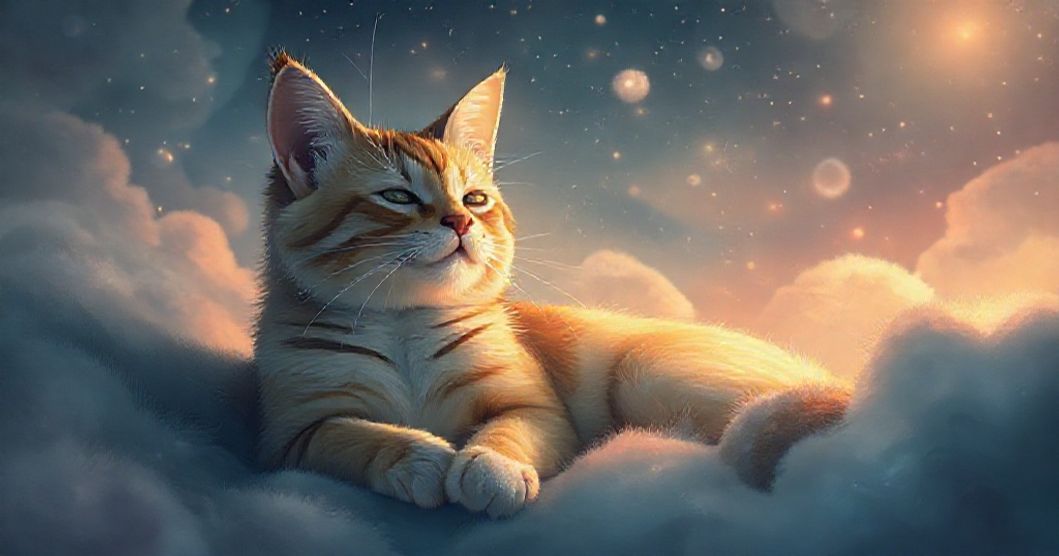
My orange Maine Coon cat was a fluffy, intelligent companion whose presence filled my life with warmth and comfort. He had the most expressive face—round and gentle, with eyes that transitioned from bright blue to a rich amber as he aged. His favorite spots included my clothing baskets, where he’d curl into a perfect ball, and the bathroom sink beside my bedroom door, where he’d greet me each morning with a soft meow as I brushed my teeth. He was remarkably social, interacting with everyone in my family, and would position himself by the front door to welcome guests home. His intelligence was evident in his litter training—he never used the floor, even when others did—and his ability to respond to my voice, whether I was calling him for treats or simply speaking to him. We shared countless nights, with him nestled against my chest as I fell asleep, and he’d often wake me at dawn with soft nudges, demanding attention or a snack. His purrs became my anchor during last year’s hardships, providing solace when nothing else could. He was born under my bed, growing from a tiny kitten to a large, majestic creature—just two months shy of his first birthday. When he suddenly escaped the house and was struck by a car, the shock of his absence shattered my world. I’ve cried continuously since learning the news, still struggling to believe he’s gone at such a young age. That night, I dreamed of a grand prom—a place I’d never attended, yet somehow felt deeply familiar. I wore a long black dress with a slit up one side, its hem adorned with glimmering black gems that caught the light as I moved. A girl nearby wore the same style in pale green, and I recognized the dress as something I’d never designed but felt perfectly suited to the moment. Then he appeared: a boy with the same orange, fluffy hair and amber eyes I’d adored. He wore a simple white tank top and khaki pants, his expression kind and open. He approached me quietly and asked if I’d keep him company for the night. In that moment, I felt his gentle presence—the same one I’d known for years—and realized, with a surge of emotion, that this was my cat reborn, his essence preserved in human form. I woke with tears, recognizing the dream as my heart’s attempt to hold onto his comfort, his familiarity, in a world where he was no longer physically present. I wonder if this is what others call ‘catboys’—a way to honor his memory while allowing his spirit to connect with me in a new form. I still can’t believe he’s gone, but his love and mine will always remain.
Part 2: Clinical Analysis
Want a More Personalized Interpretation?
Get your own AI-powered dream analysis tailored specifically to your dream
🔮Try Dream Analysis FreeSymbolic Landscape: Dream Elements and Archetypal Meanings
The dream’s power lies in its deliberate blending of the mundane and the magical, where a beloved pet’s essence transcends physical form. The orange Maine Coon cat embodies the archetype of the familiar guardian—a creature who provided unconditional love, comfort, and routine during a period of personal struggle. In dreamwork, animals often represent aspects of the self or unconscious desires; here, the cat’s intelligence and adaptability symbolize resilience and emotional intelligence. The transition from feline to human form introduces a layer of liminality—a space between two states of being, where the past (the cat’s physical presence) merges with the present (the dreamer’s ongoing grief). This transformation mirrors the psychological process of mourning, where the self seeks to maintain connection with what has been lost.
The prom setting functions as a rite of passage—a symbolic threshold between youth and adulthood, social connection and independence. For someone who has never attended prom, this setting may represent unfulfilled experiences or societal expectations of coming-of-age. The black dress with its slit and black gems carries dual meaning: black often signifies mourning and transformation, while the slit and gems suggest a delicate balance between vulnerability and strength. The presence of another girl in a pale green version of the same dress hints at shared experiences or collective memory, suggesting the dreamer is not alone in processing grief.
Psychological Currents: Theoretical Frameworks
From a Jungian perspective, the cat-human figure represents the shadow-self—the unconscious aspects of the dreamer’s psyche that seek integration. The cat’s intelligence and loyalty reflect the dreamer’s own values, while the human form allows for symbolic interaction with the dreamer’s anima (the feminine aspect of the male psyche) or animus (the masculine aspect of the female psyche). In this case, the boy’s gentle demeanor and orange hair (matching the cat’s fur) suggest a reconnection with the child self—a part of the dreamer that felt safe and unburdened during the cat’s companionship.
Freudian theory might interpret this dream as wish fulfillment—a manifestation of the dreamer’s unconscious desire to maintain the cat’s presence after physical loss. The prom setting, with its emphasis on social connection, aligns with the cat’s role as a social creature who greeted family and guests. The boy’s request to “keep him company” mirrors the cat’s habit of seeking attention, reinforcing the idea of the dream as a psychological attempt to fill an emotional void.
Modern dream psychology, particularly attachment theory, frames this dream as a secure base—a way to maintain emotional connection with a lost attachment figure. The cat’s appearance in human form allows the dreamer to re-enter the relationship with the cat in a new context, preserving the bond without the pain of physical absence.
Emotional Landscape and Waking Context
The dreamer’s waking context—grief over the sudden loss of a beloved pet—shapes the dream’s emotional tone. The cat’s death, occurring just two months before his first birthday, represents a premature end to potential growth and companionship. The dreamer’s description of the cat as “already really big than a senior cat” hints at a sense of loss of potential—a theme common in pet bereavement. The cat’s features (orange hair, blue-to-amber eyes) serve as emotional anchors in the dream, triggering immediate recognition and comfort.
The “catboy” reference reflects a broader cultural trend of anthropomorphizing beloved pets, where people find comfort in imagining their animals as human-like companions. This trend highlights the deep emotional bond between humans and pets, and the dream’s validation of this perspective suggests the dreamer is processing grief by honoring the cat’s unique personality through symbolic reimagining.
Therapeutic Insights: Honoring the Bond While Moving Forward
Dreams like this offer valuable clues for healing. The first step is to recognize the dream as a compassionate gesture from the unconscious—an attempt to bridge the gap between loss and acceptance. Reflective practices such as journaling can help the dreamer externalize these emotions, allowing them to process grief without judgment.
Creating a memory ritual—such as planting a tree, making a scrapbook, or donating to an animal shelter in the cat’s name—can transform the dream’s symbolic reconnection into tangible action. This honors the cat’s memory while redirecting energy toward new forms of connection.
The dream also suggests the importance of emotional flexibility: grief is not linear, and moments of comfort (like the dream’s gentle interaction with the cat-boy) are valid parts of the healing process. The dreamer should allow themselves to feel the full spectrum of emotions without pressure to “move on.”
FAQ Section
Q: Why did the cat appear as a human in the dream?
A: The human form represents the dreamer’s unconscious attempt to preserve the cat’s essence while allowing for emotional connection in a new context. It bridges the physical absence with symbolic presence.
Q: What does the prom setting symbolize?
A: Prom represents coming-of-age themes and social connection. For someone who hasn’t attended, it may reflect unmet expectations or a desire to experience life’s milestones despite loss.
Q: How can I differentiate between meaningful dream symbolism and wishful thinking?
A: Meaningful dreams validate emotions and experiences. Notice recurring themes (like the cat’s features) and how they feel emotionally resonant, not just “pleasant.” Your grief itself confirms the dream’s authenticity.