
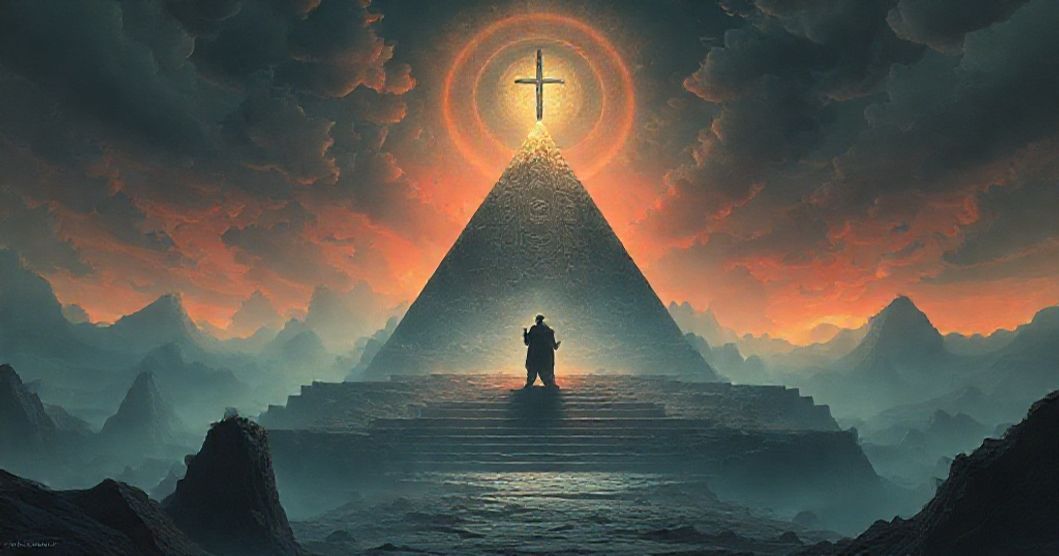
Part 1: Dream Presentation
Dreams often blur the boundaries between reality and the unconscious, delivering cryptic messages that demand interpretation. This dream, rich with symbolic imagery and emotional intensity, offers a window into the dreamer’s inner conflicts regarding power, identity, and the weight of unexamined choices. In it, the dreamer encounters a devil who reveals an unremembered pact, promising kingship in Israel and half his power. The setting—a pyramid surrounded by worshippers, with a hellish vision of a flame-encircled chair—suggests themes of ambition, moral compromise, and the consequences of spiritual deals.
I found myself in a narrow hallway, its walls lined with peeling wallpaper that seemed to pulse with an otherworldly energy. There, standing before me, was the devil—not the horned, fire-breathing creature of myth, but a figure with sharp eyes and an air of calculated authority. In his hand, he held a small, rectangular object that glinted oddly—a Vodafone card, its logo stark against his dark attire. 'Remember our pact?' he asked, his voice a low, resonant growl that felt both familiar and alien. I stood frozen, my mind racing to recall a deal I couldn’t remember making. The devil’s lips curled in a knowing smirk as he continued: 'You agreed to serve me, and in return… I would make you king in Israel.' With a sharp snap of his fingers, a golden throne materialized behind me—a magnificent seat with rich red velvet upholstery, its legs carved with intricate patterns that seemed to shift as I watched. Suddenly, we were transported to the peak of a towering pyramid, the desert stretching endlessly around us. Sand-colored houses dotted the landscape, their walls sun-bleached, and winding streets that appeared newly paved, as if trampled by an asphalt-finishing machine. Below, a crowd had gathered: young boys in simple garments, middle-aged women draped in white robes, their heads covered, and men with bare heads, all facing the pyramid with bowed heads and solemn expressions. As I watched, they began to kneel, their bodies swaying in unison, as if in prayer or worship. The devil placed a hand on my shoulder, his touch cold despite the heat of the desert. 'I will grant you half my power,' he said, and in that moment, I felt a surge of both excitement and dread. But before I could process this offer, he conjured an image in my mind—a vision of hell itself. Before me appeared a semicircle of flames, each one a foot and a half tall, their orange glow illuminating only the immediate area. Beyond this fiery ring, darkness reigned. At the center of the flames sat an empty wooden chair, its backrest simple yet forbidding. The devil’s voice dropped to a whisper: 'This is your future. You will die at eighty, and this chair will be your throne of torment.' I woke with a jolt, still haunted by the dream’s clarity and the strange knot of emotions it left in my chest: confusion about the unremembered pact, fear of the promised throne of torment, and a strange connection to the Vodafone card that felt both out of place and deeply significant.
Part 2: Clinical Analysis
Want a More Personalized Interpretation?
Get your own AI-powered dream analysis tailored specifically to your dream
🔮Try Dream Analysis FreeSymbolic Landscape: Decoding the Dream’s Imagery
The devil, a classic archetype of temptation and the shadow self, appears here not as a literal demon but as a representation of the dreamer’s repressed desires and unacknowledged moral conflicts. The Vodafone card introduces a striking modern element into this mythic encounter—a digital-age symbol of contracts, connectivity, and corporate power. This juxtaposition suggests the dreamer’s struggle to reconcile ancient spiritual themes with contemporary life, where agreements often take technological forms. The hallway, a transitional space between conscious and unconscious realms, reinforces this theme of threshold experiences.
The golden throne with red velvet represents the allure of power and authority. Its sudden appearance via the devil’s snap suggests the dreamer’s unconscious recognition that ambition often arrives unbidden, unearned, and without ethical consideration. The promise of 'king in Israel' taps into collective mythology of chosen leadership and national identity, reflecting the dreamer’s potential yearning for significance or leadership roles. The pyramid, an ancient symbol of spiritual ascent and cosmic order, anchors this desire in both historical and metaphysical terms, while the desert setting evokes isolation, testing, and the harsh realities of power.
The crowd of worshippers—young boys, middle-aged women in white robes, men bare-headed—represents the collective unconscious, societal pressures, or the dreamer’s need for validation. Their unified posture of kneeling and bowing suggests a desire for belonging or a fear of being ostracized. The empty wooden chair in the hellish vision is perhaps the most powerful symbol: it embodies the emptiness of power without purpose, the loneliness of authority, or the fear of a meaningless legacy. Its placement in the middle of the flames, a space of torment, underscores the dreamer’s anxiety about the consequences of unethical choices.
Psychological Perspectives: Layers of Interpretation
From a Jungian perspective, the devil embodies the shadow archetype—the parts of the self we disown or fear. The unremembered pact represents an unconscious agreement made between the conscious and unconscious self, often formed in response to unmet needs or unintegrated aspects of personality. The 'king in Israel' could reflect the dreamer’s anima/animus projection—the masculine or feminine aspects of self they seek to embody or lead.
Freud might interpret the dream as wish fulfillment and fear of punishment. The desire for kingship represents repressed ambition or a need for control, while the hellish vision serves as a punitive superego, warning against moral compromise. The Vodafone card, in this framework, could symbolize modern anxieties about digital contracts and surveillance, manifesting as a devilish presence in the dream.
Neuroscientifically, dreams process emotional memories and integrate daily experiences. The dreamer may have recently encountered situations involving power dynamics, leadership opportunities, or ethical dilemmas that triggered this symbolic narrative. The repetition of 'half his power' suggests a fear of corruption or the overwhelming nature of influence—taking on too much without understanding the costs.
Emotional & Life Context: Unpacking the Dreamer’s Inner World
The dream likely arises from the dreamer’s current life circumstances involving power, identity, or unexamined agreements. The 'unremembered pact' may reflect real-life situations where the dreamer has made implicit deals—with employers, relationships, or societal expectations—without conscious awareness. The promise of kingship hints at career aspirations, leadership desires, or a search for meaning.
The fear of the throne of torment suggests underlying anxieties about mortality and legacy. The dreamer may be grappling with questions of how they will be remembered, whether their ambitions will lead to fulfillment or emptiness, and the moral compromises inherent in seeking power. The desert setting and worshippers imply isolation despite apparent connection—a common modern experience where people seek belonging but find only performative unity.
The dream’s emotional tone—mixing excitement and dread—reflects the tension between desire and fear of consequences. The dreamer’s confusion about the pact indicates a need to examine their values and boundaries, to distinguish between healthy ambition and destructive compromise.
Therapeutic Insights: Integrating the Dream’s Lessons
The dream invites the dreamer to reflect on unexamined agreements in waking life. Journaling exercises focusing on recent decisions where they felt pressured to compromise could reveal patterns of unconscious pacts. Mindfulness practices to distinguish between authentic ambition and shadow-driven desires would help integrate these insights.
Reflective questions might include: 'What power do I seek, and at what cost? What agreements have I made without conscious choice?' The empty chair serves as a reminder to seek purpose in leadership, not just authority. The dream suggests that true power comes from ethical choices, not unearned influence.
Actionable steps could involve setting clear boundaries, examining career or relationship goals for authenticity, and exploring leadership styles that align with personal values. The dream’s warning about the 'throne of torment' urges the dreamer to consider whether their desired power is a path to growth or isolation.
FAQ Section: Clarifying the Dream’s Meaning
Q: What does the Vodafone card symbolize in this dream?
A: The Vodafone card represents modern contracts, digital agreements, or corporate power. It suggests the dreamer’s struggle to reconcile ancient spiritual themes with contemporary life and the anxiety of unexamined digital-era deals.
Q: Why did the devil offer half his power?
A: Offering half power reflects the fear of corruption by influence—taking on too much without understanding the moral or emotional costs. It suggests the dreamer’s ambivalence about ambition.
Q: What does the empty chair in hell signify?
A: The empty chair represents spiritual emptiness, unfulfilled potential, or the loneliness of power without purpose. It warns against pursuing authority at the expense of authenticity and connection.