
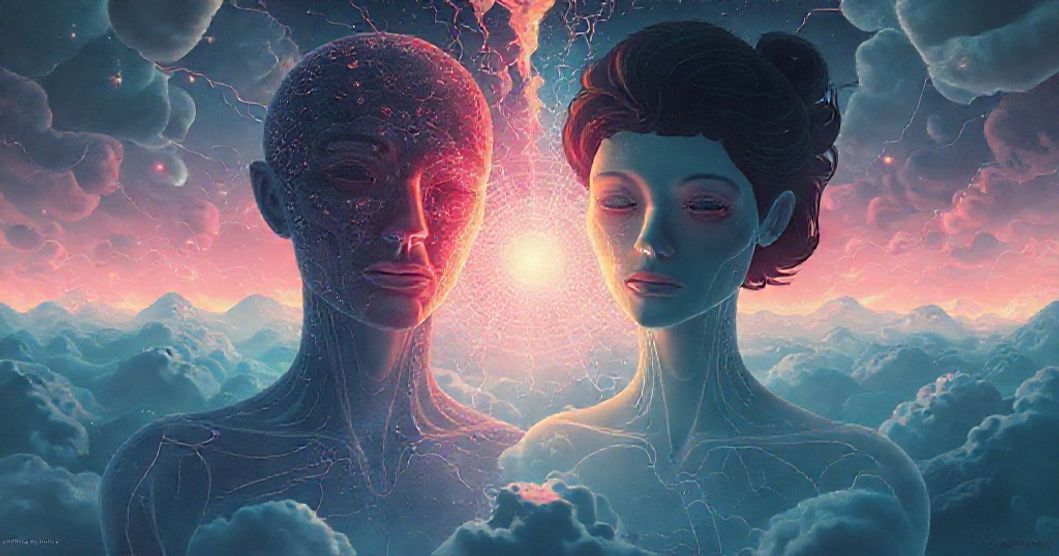
Part 1: Dream Presentation
Dreams often speak in riddles, using language that defies waking logic yet carries profound emotional truth. Consider this unsettling dream exchange that left its mark on the dreamer's consciousness: in the dim, dreamlike realm of unconscious imagery, a voice—soft yet resolute—spoke with quiet sorrow, 'I'm sorry, my hyper thermo nucleus no longer aligns with yours. We can't be together anymore.' The dreamer woke abruptly, heart still thrumming from the encounter, the phrase echoing in their mind like a half-remembered prophecy. This occurred a few nights prior, leaving the dreamer both perplexed and haunted by the strange specificity of the rejection: 'hyper thermo nucleus'—a term that defied scientific recognition yet felt viscerally personal, as if referencing a vital, unspoken part of self that had irrevocably shifted.
The dream unfolds in a liminal space where boundaries between reality and imagination blur. The 'you' addressed in the quote remains unnamed, lending an air of universality to the rejection—suggesting the dreamer may feel disconnected from a relationship, career, or even their own sense of purpose. The emotional tone is one of quiet resignation, not anger, yet the finality of 'can't be together anymore' carries the weight of loss. The dreamer's confusion upon waking—the need to ask 'what?' and 'why?'—reflects the unconscious's tendency to deliver truths through symbolic language, bypassing rational understanding to reach deeper emotional layers.
Part 2: Clinical Analysis
Want a More Personalized Interpretation?
Get your own AI-powered dream analysis tailored specifically to your dream
🔮Try Dream Analysis FreeSymbolic Landscape: The 'Hyper Thermo Nucleus' as Core Identity
The phrase 'hyper thermo nucleus' defies literal interpretation, suggesting a symbolic construct of profound psychological significance. The term combines 'hyper' (excessive, heightened) with 'thermo' (heat, temperature) and 'nucleus' (core, center)—creating a metaphor for one's emotional core, vital energy, or essential identity. In dreams, such neologisms often represent aspects of self that feel intensely personal yet elusive to waking awareness. The 'nucleus' implies centrality, while 'hyper thermo' evokes intensity, passion, or emotional temperature—qualities that might be perceived as mismatched or incompatible in relationships.
The rejection itself—'no longer aligns with yours'—frames this misalignment as relational, suggesting the dreamer feels their core self has diverged from another's needs, values, or expectations. The specificity of the anatomical-sounding term ('nucleus') contrasts with the abstract nature of 'aligns,' creating tension between concrete self-perception and abstract relational dynamics. This tension mirrors the dreamer's waking experience of feeling both deeply connected and fundamentally out of sync with someone or something significant.
Psychological Undercurrents: Jungian and Freudian Perspectives
From a Jungian perspective, the 'hyper thermo nucleus' could represent the Self—the integrated whole of conscious and unconscious identity—experiencing a significant shift. The 'misalignment' might signal a crisis of individuation, where the dreamer's core essence is evolving beyond previous relational frameworks. Jung emphasized that dreams often address the need for psychological integration, and this dream's rejection could reflect the unconscious urging the dreamer to recognize a necessary separation from outdated patterns.
Freudian theory might interpret the dream as a manifestation of repressed anxieties about intimacy or loss. The 'can't be together anymore' echoes separation anxiety, while the 'hyper thermo nucleus' could symbolize repressed anger or passion that has become too intense to maintain in a relationship. The dream's emotional tone—quiet sorrow rather than rage—suggests a more unconscious, internalized conflict rather than overt external conflict.
Neuroscientifically, dreams process emotional memories and unresolved conflicts, with the limbic system prioritizing emotional tone over logical coherence. The 'hyper thermo nucleus' might represent the amygdala's emotional core, signaling a shift in emotional regulation that feels disorienting yet necessary.
Emotional Context: Waking Life Triggers
The dream likely reflects waking-life experiences of relational or identity-based dissonance. The 'misalignment' could stem from a romantic relationship where the dreamer feels their core values or emotional needs have diverged from a partner. Alternatively, it might symbolize career dissatisfaction, where professional roles no longer align with personal passions or core strengths. The 'nucleus' metaphor suggests this misalignment is felt at the deepest level of self.
The timing—'a couple of nights ago'—coincides with periods of relationship uncertainty, career transition, or personal reflection. The dream's specificity implies the issue is recent and emotionally charged, with the unconscious processing these tensions through surreal imagery rather than direct narrative. The dreamer's admission of 'not caring about dream meaning' yet fixating on the sentence suggests an urgent need to understand this internal conflict, even if they resist traditional dream interpretation.
Therapeutic Insights: Reflecting on Core Alignment
This dream invites the dreamer to explore areas of life where they feel misaligned with their core values. Journaling exercises could help map relationships, roles, or goals where 'emotional temperature' or intensity feels mismatched. Reflecting on moments of 'hyper thermo'—times of passionate alignment versus recent dissonance—might reveal patterns of compatibility.
Therapeutic work might involve exploring the 'nucleus' of identity: What aspects of self feel most essential? How do these align with current relationships and life choices? The dream suggests that maintaining alignment with one's core identity is vital for authentic connection, even if that means accepting separation from what no longer serves.
FAQ Section
Q: What if the 'hyper thermo nucleus' refers to something more literal?
A: While not a real anatomical term, dreams rarely use literal language. The 'nucleus' likely symbolizes your core self, with 'hyper thermo' representing emotional intensity or vital energy that no longer matches another's needs.
Q: Why use 'aligns' rather than 'matches'?
A: 'Aligns' implies direction and purpose, suggesting the misalignment is about trajectory rather than simple difference—your core path has diverged.
Q: How to tell if this is about a specific person or internal conflict?
A: Notice if waking relationships feel similarly 'misaligned'—the dream often mirrors waking dynamics, but the surreal 'nucleus' suggests it's also about your relationship with yourself.