
Part 1: Dream Presentation
Dreams often serve as mirrors to our inner landscapes, reflecting repressed memories, unprocessed emotions, and symbolic transformations. This particular dream arrives with the clarity of a memory and the urgency of a nightmare, unfolding in a sacred space that once offered comfort but now becomes a theater of psychological tension. The scene opens in the elementary school church—a place of ritual, community, and childhood routine—where the dreamer encounters characters and symbols that bridge past and present, safety and terror.
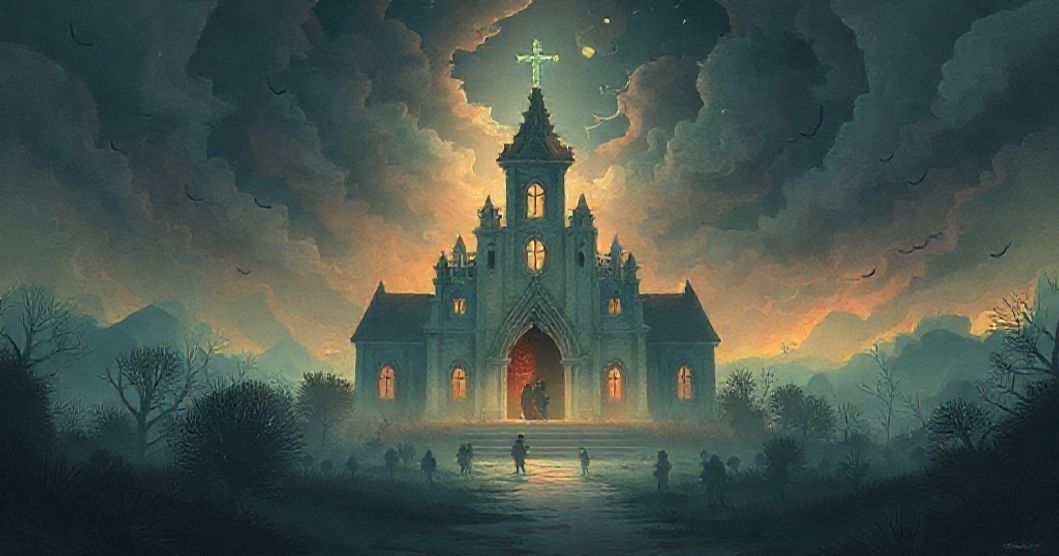
Last night, after months of dreamlessness, I found myself transported back to the elementary school church where I attended weekly mass—a place frozen in time beneath the weight of its blue stained-glass windows and the faint smell of incense that lingered even in memory. The church was filled with children in crisp uniforms, their faces earnest as they filed toward the altar for communion, and today, as if by some strange coincidence, it was Friday—just as it always was for those weekly services. Initially, the dream felt lighthearted: the priest, a stern-faced man with a perpetual scowl, was scolding my high school friend for slouching during communion. I watched from my seat, smiling at the absurdity of seeing him here, a teenager in a kindergarten uniform, as if time had folded in on itself. But then the room shifted. Everyone turned toward me, their eyes unblinking, and the air grew thick with an unspoken tension I couldn’t name. The mass ended, and the priest droned on in the background, his voice dissolving into static as the world around me began to fray. Suddenly, the congregation froze mid-blink, suspended like puppets in a play—everyone except a small boy standing beneath the altar. He was my kindergarten buddy, the one who’d sat beside me in church every Sunday, our fingers tangled in coloring books during the long sermons. In my dream, he was hyperactive as ever, dancing down the aisle with a mischievous grin, skipping back and forth in front of my seat. His laughter echoed, high and bright, until his face transformed—slowly at first, then all at once—into that infamous Spongebob meme: grinning too wide, eyes stretched into empty ovals, mouth a permanent rictus of horror. My blood ran cold. He stopped dancing, turned toward me, and his gaze held a predatory intelligence I’d never seen in his childhood eyes. Then he sat behind me, and a woman I didn’t recognize approached, her face half-burned and charred, as if she’d emerged from a fire. She was checking on him, her movements jerky, and beside her, a little girl with bright red hair—whom I didn’t recognize—suddenly had blood streaming down her face, staining her uniform. The woman’s attention snapped to me, her voice a guttural snarl: “You cannot—” The words cut off as she lunged forward, grabbing my arm with a strength that felt both real and dreamlike. Panic surged through me, and I realized I was dreaming—a crucial realization that brought with it a strange clarity. I fumbled in my pocket, my hand shaking, and found what I needed: a small bottle of holy water, its label faded but familiar. With a desperate calm, I pointed it at her, and a blinding light erupted from the opening, searing my eyes as I woke with a gasp. I’d stirred two hours early, my heart pounding, and now I couldn’t shake the urge to watch horror movies, as if my mind craved to confront the fear I’d just faced in my subconscious.
Part 2: Clinical Analysis
Want a More Personalized Interpretation?
Get your own AI-powered dream analysis tailored specifically to your dream
🔮Try Dream Analysis FreeSymbolic Landscape: The Church as Inner Sanctuary
The elementary school church serves as a powerful symbolic container in this dream—a space where childhood identity, religious conditioning, and repressed emotions converge. Churches often represent moral authority, community, and spiritual guidance in dream imagery, and here, the familiar setting becomes a battlefield where the dreamer’s inner conflicts play out. The uniformed congregation embodies collective expectations and societal pressures, their collective gaze fixing on the dreamer as if demanding conformity. The altar, a central religious symbol, becomes a site of transformation: beneath it, the kindergarten buddy’s mischief and the woman’s distorted presence suggest the corruption of innocence and the blurring of boundaries between safety and danger.
The “Spongebob meme face” represents a particularly modern twist on the classic “uncanny valley” effect—familiarity warped into something disturbing. This transformation symbolizes the dreamer’s relationship with childhood memories: the friend, once a source of comfort, has become alien and threatening, reflecting how time and experience can alter our perception of people and places. The woman with the “dead/half-burnt face” introduces themes of destruction and purification; her charred features suggest both emotional trauma and spiritual decay, while her attempt to “check on” the child hints at a broken system of care.
Psychological Currents: Jungian Archetypes and Repressed Memories
From a Jungian perspective, this dream activates the “shadow” archetype—the repressed aspects of the self that emerge in moments of psychological tension. The burned-faced woman may represent the shadow’s aggressive, destructive potential, while the holy water bottle embodies the dreamer’s attempt to reclaim spiritual integrity. The “altered reality” of the frozen congregation and the sudden face transformation align with Jung’s concept of synchronicity, where symbolic events reflect underlying psychological patterns.
Freudian analysis would likely interpret the dream as a manifestation of repressed childhood anxieties. The priest’s anger at the friend during communion mirrors unresolved guilt or conflict over social performance—perhaps the dreamer felt judged for not conforming to expectations in childhood or adulthood. The bloodied girl and the burning woman suggest repressed fears of failure or abandonment, as well as the dreamer’s struggle to maintain control in threatening situations.
Cognitive theory of dreaming posits that dreams process recent experiences and consolidate memories, with the “lucid moment” (realizing one is dreaming) indicating the brain’s attempt to problem-solve within the dream state. The dreamer’s use of holy water—an object of protection—reflects a cognitive strategy to confront and overcome threats, even in the irrational landscape of sleep.
Emotional & Life Context: Reconnecting with Childhood and Modern Fears
The dream’s emotional arc—from nostalgic comfort to primal terror—suggests the dreamer is processing a significant life transition or confronting unresolved childhood experiences. The kindergarten buddy, a figure from early socialization, represents the dreamer’s earliest sense of self and relationships, while the high school friend in a kindergarten uniform hints at the blurring of developmental stages—a common theme in dreams during periods of life change. The “coincidence” of Friday mass may reflect the dreamer’s current relationship with routine and spiritual practice.
The post-dream urge to watch horror movies suggests a need to process the fear, either by confronting it directly or by understanding its symbolic meaning. The question “Is this a sign to pray more?” reveals the dreamer’s attempt to find meaning in the religious imagery, reflecting a desire for spiritual guidance in the face of psychological uncertainty.
Therapeutic Insights: Confronting the Uncanny and Cultivating Self-Protection
Therapeutically, this dream offers an opportunity to explore the relationship between childhood memories and adult identity. Journaling exercises to unpack the emotions triggered by the dream’s characters and settings can help identify specific fears or unmet needs.
Mindfulness practices during waking hours can help the dreamer recognize the “lucid moment” of self-awareness in daily life, applying the same calm problem-solving approach to real-world challenges. Reflecting on the holy water bottle as a symbol of inner strength—rather than a literal religious object—encourages the dreamer to trust their own resources for protection and transformation.
FAQ Section
Q: Why did the friend’s face transform into the Spongebob meme?
A: This uncanny transformation symbolizes the dreamer’s perception of childhood relationships as distorted by time and experience, reflecting how memory and growth can reshape familiar people into something unrecognizable.
Q: What does the holy water symbolize in this context?
A: Holy water represents the dreamer’s inner resources for protection and transformation—spiritual or psychological tools to confront fear and restore order in chaotic situations.
Q: Why did the dream end with the dreamer waking two hours early?
A: This timing suggests the dream’s emotional intensity disrupted the dreamer’s usual sleep cycle, indicating the psychological significance of the content and the need to address its themes in waking life.