
Part 1: Dream Presentation
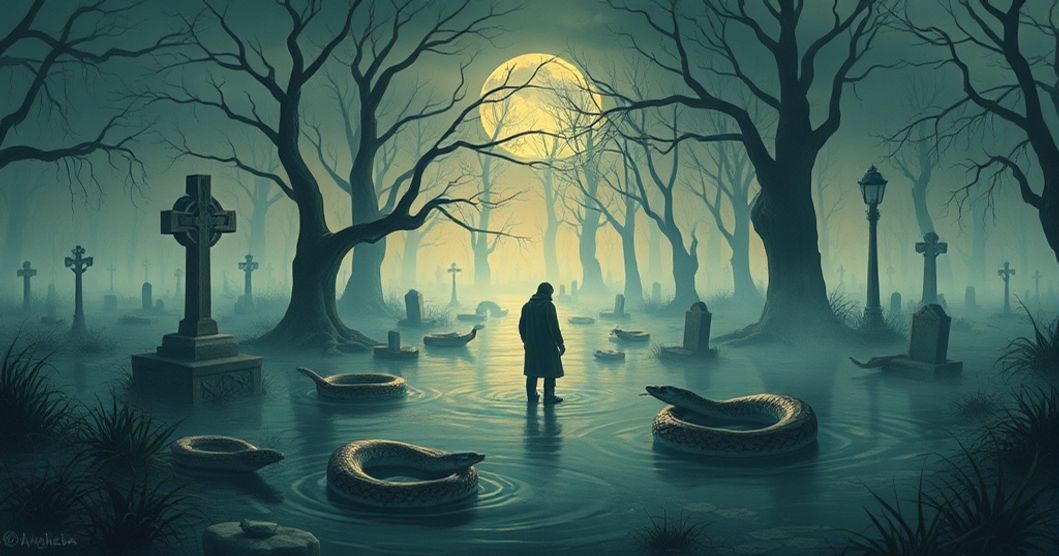
The boundary between sleep and wakefulness dissolved last night, revealing a dreamscape that blended the macabre beauty of a cemetery with the primal energy of a swamp ecosystem—a landscape where ancient fears and unexpected courage intertwined. The dream begins in a familiar, almost ritualistic setting: a tour through a cemetery, where moss-covered tombstones stand as silent witnesses to time’s passage. This opening evokes themes of mortality, legacy, and the collective human experience of confronting endings. Yet the dream swiftly transforms as the terrain shifts from orderly paths to a swampy expanse, where the familiar world of gravestones gives way to an ambiguous, liminal space—a place neither fully land nor water, neither dead nor alive. Here, the dreamer encounters enormous green snakes, specifically anacondas, swimming through the murky depths. Initially, there is no fear, only curiosity—a significant emotional marker that suggests the dreamer’s relationship with these symbols of primal energy is not one of terror but of observation. This detachment hints at a subconscious perspective that views life’s more unsettling aspects with calm curiosity rather than panic.
The transition to swimming in the swamp water—dirty, fetid, and thick with debris—represents a deeper immersion into uncertainty. When the grass “fell off” and the dreamer was forced into the water, it symbolizes a loss of solid ground, a surrender to the unknown, and the necessity of adapting to fluid circumstances. Climbing onto the concrete path afterward—a stark, man-made surface—marks a return to a more structured reality, yet one that remains in the shadow of the swamp’s chaos. This concrete path suggests the dreamer’s attempt to impose order on life’s messier aspects, to find footing in uncertainty. Finally, the cobra appears: a single, more focused threat that demands action. Unlike the anacondas, which were observed from a distance, the cobra approaches directly, triggering a physical response—running and swinging a stick—revealing the dreamer’s capacity for agency and self-defense.
Part 2: Clinical Analysis
Want a More Personalized Interpretation?
Get your own AI-powered dream analysis tailored specifically to your dream
🔮Try Dream Analysis FreeSymbolic Landscape: The Cemetery, Swamp, and Serpents
The cemetery serves as a powerful symbol of mortality and transformation. In dream psychology, cemeteries often represent endings, but they also signify new beginnings—like the shedding of old identities or the need to confront unresolved emotions. The dreamer’s detachment from fear in this setting suggests an emerging acceptance of life’s inevitable changes rather than resistance. The swamp, as a liminal space, embodies the psychological concept of the unconscious—a realm where boundaries blur and ambiguity reigns. Jungian psychology refers to the swamp as a “collective unconscious” space, a place where repressed emotions and archetypal energies surface. The green snakes, particularly anacondas and cobras, carry multiple symbolic layers. In many mythologies, snakes represent transformation (Ouroboros, the eternal cycle of renewal), primal energy, and sometimes danger. The dreamer’s initial lack of fear toward the anacondas contrasts with the more direct threat of the cobra, suggesting a differentiation between fears that can be observed objectively versus those that demand immediate action.
The act of swimming in the swamp water—dirty, murky, and uncomfortable—mirrors the process of psychological integration. Water in dreams often represents the unconscious mind, and swimming through it without fear implies the dreamer is actively engaging with their deeper emotions rather than avoiding them. The concrete path, in contrast, represents the “ego’s” attempt to impose structure on the chaotic unconscious. Its appearance after the swamp suggests a moment of clarity: the dreamer has survived the murky depths and now seeks a more grounded approach to life’s challenges.
Psychological Undercurrents: Fear, Control, and Archetypal Forces
Freudian theory might interpret the snakes as manifestations of repressed sexual or aggressive energies, but in this dream, the snakes’ non-threatening initial presence suggests a more Jungian perspective: they represent the animus/animus archetype—the masculine/feminine aspects of the self that require integration. Jung emphasized that dreams function as “compensations” to the waking mind, offering perspective on areas needing attention. The dreamer’s ability to swing a stick at the cobra reflects the “shadow” archetype—the parts of ourselves we avoid or fear—being faced with intentionality rather than flight.
Neuroscientifically, this dream aligns with the default mode network’s activity during sleep, where the brain processes emotional memories and creates narrative coherence. The sequence of the dream—from ordered cemetery to chaotic swamp to structured path—mirrors the brain’s attempt to organize fragmented experiences into a meaningful story. The lack of fear toward the anacondas and the subsequent action toward the cobra suggests the dreamer’s unconscious is working through a process of differentiation: distinguishing between fears that can be observed from a distance versus those requiring immediate response.
Emotional & Life Context: Confronting Uncertainty and Self-Protection
The dreamer notes rarely remembering dreams, indicating a tendency to avoid deeper self-exploration or dismiss the unconscious. The fact that this dream “felt like meant something” suggests a recent shift in awareness—perhaps a period of significant life change, stress, or reflection on mortality. The swamp’s transition from grassy ground to water mirrors the experience of losing a sense of control in waking life, forcing adaptation. The cobra’s direct threat and the dreamer’s active response (swinging a stick) suggest an emerging sense of empowerment: instead of passively enduring uncertainty, the dreamer is learning to take active steps to protect themselves.
The concrete path, appearing after the swamp, hints at the dreamer’s need for both structure and flexibility. In waking life, this might manifest as a tension between maintaining order (concrete path) and embracing the fluidity of life (swamp). The dream’s message could be that both approaches are necessary: acknowledging uncertainty while also taking intentional action to navigate it.
Therapeutic Insights: Embracing the Swamp as a Teacher
This dream offers several opportunities for self-reflection. First, the initial lack of fear toward the anacondas suggests the dreamer has already begun processing certain fears or uncertainties without conscious effort. The swamp, often a symbol of stagnation in waking life, here becomes a space of transformation—a reminder that even uncomfortable emotional terrain can yield growth. The act of swimming rather than fleeing the water represents the value of immersion in difficult emotions rather than avoidance.
A practical reflection exercise: the dreamer can journal about recent life changes or challenges, noting where they feel “swampy” (unclear, uncertain) and where they’ve found “concrete” structure. This mapping can help identify areas needing both emotional processing and intentional action. The stick, as a tool of self-defense, represents the dreamer’s capacity for agency—reminding them that they have the resources to protect themselves when facing threats, both external and internal.
FAQ Section
Q: Why did the dreamer not fear the anacondas initially?
A: This detachment suggests the dreamer’s unconscious views these larger fears as manageable or already processed. It may indicate emotional resilience toward longstanding challenges.
Q: What does the concrete path symbolize in this context?
A: The concrete path represents the ego’s attempt to create order amid chaos—a healthy balance between structure and adaptability in navigating life’s uncertainties.
Q: How can the dreamer apply this to waking life?
A: The dream encourages embracing uncertainty without fear, using active self-protection when needed, and integrating both emotional processing (swamp) and intentional action (stick, path) to move through life’s transitions with greater confidence.