
Part 1: Dream Presentation
Dreams often serve as mirrors to our inner lives, reflecting the tensions between what we know and what we fear we might not. This particular dream unfolds like a surreal puzzle, weaving together the anxiety of new beginnings with primal symbols of courage, fear, and self-discovery. The narrative begins on the threshold of change—the first day of school—where the familiar becomes disorienting: a lost key card, a misremembered room number, and a choice between the treacherous vine climb and the straightforward stairs. These elements establish a core tension: the allure of difficult paths versus the wisdom of simpler solutions, a metaphor for how we navigate life’s transitions when clarity feels elusive.
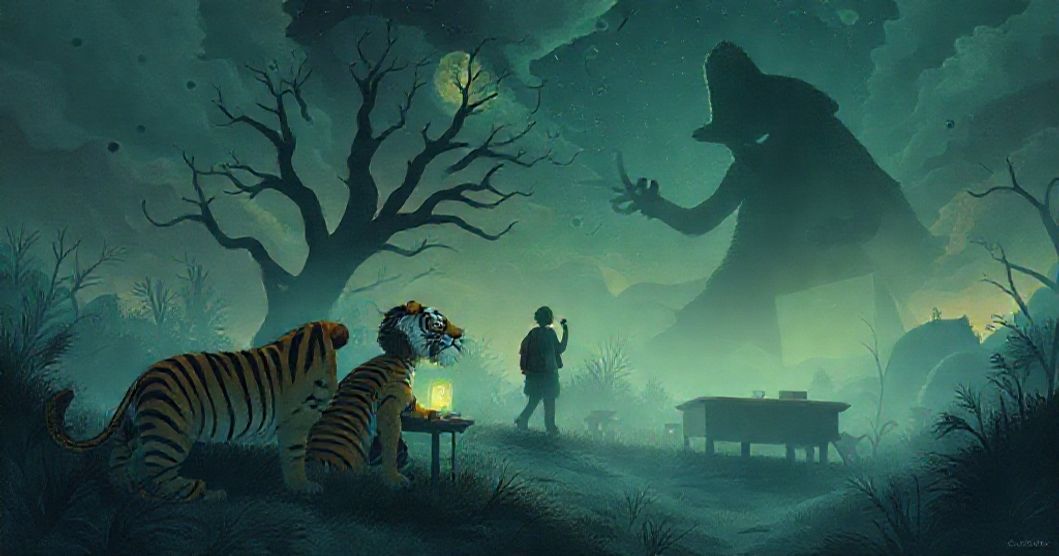
The rewritten dream narrative follows this initial disorientation into deeper surrealism: the dormitory’s Saturn-Jupiter confusion reveals a cosmic metaphor for misplaced priorities, while the tigers—both domesticated and wild—embody conflicting aspects of self. The Grinch, a figure from children’s literature, emerges as a shadowy antagonist, his presence signaling unresolved conflicts with our inner critic. Finally, the lake party with its dual disco balls offers a moment of reconciliation, suggesting that even in chaos, balance between opposing forces (sun and moon, wild and domestic) can be found.
Part 2: Clinical Analysis
Want a More Personalized Interpretation?
Get your own AI-powered dream analysis tailored specifically to your dream
🔮Try Dream Analysis FreeSymbolic Landscape: Navigating the Dream’s Imagery
The dream’s symbolic architecture reveals layers of psychological meaning. The vines and climbing represent the struggle of self-improvement, where the difficulty of scaling them mirrors the challenges of adapting to new environments (the first day of school). The misremembered room number (438 vs. 487) embodies the anxiety of forgetting who we are or where we belong, a common theme during life transitions. The Saturn-Jupiter contrast speaks to astrological archetypes: Saturn symbolizes discipline and structure, while Jupiter represents expansion and opportunity. Finding themselves on the 'wrong' floor suggests a misalignment between external expectations and internal needs—a relatable feeling for those navigating new social or professional spaces.
The tigers serve as powerful animal totems. The pet tiger represents domesticated aspects of our nature—comfort, predictability, and controlled expression of power—while the wild tiger embodies untamed instincts, primal energy, and the shadow self. The Grinch, a figure of holiday mischief repurposed here as a 'mortal enemy,' symbolizes repressed anger, envy, or fear of judgment. His alliance with the bear (another primal archetype, representing strength and protection) suggests a coalition of forces opposing our attempts at self-integration.
The refrigerator incident—where the dreamer accidentally traps the tiger’s tail—reveals the unintended consequences of well-meaning actions. This moment underscores how even good intentions can misfire, leaving us to face the consequences of our choices. The 911 hospital scene, with bones protruding but no pain, hints at emotional rather than physical injury—a disconnect between perceived danger and actual harm, suggesting that our fears often feel more severe than they objectively are.
Psychological Currents: The Dreamer’s Inner World
From a Jungian perspective, this dream explores the process of individuation—the journey toward integrating conscious and unconscious parts of the self. The wild tiger, as a manifestation of the animus or shadow, represents the dreamer’s untapped potential, while the Grinch embodies the shadow’s negative aspects: envy, control issues, or resistance to change. The mission to befriend the wild tiger reflects the dreamer’s unconscious desire to reconcile these opposing forces.
Freud’s framework might interpret the tigers as symbolic of repressed sexual energy, with the Grinch representing forbidden impulses we fear or resist. The 'mortality' of the Grinch (from a children’s story) suggests these repressed elements are not as threatening as they seem, but their appearance in a dream signals our need to acknowledge them rather than suppress them.
Cognitive dream theory offers another lens: dreams as problem-solving tools. The repeated sightings of the wild tiger and bear, followed by the mission to befriend it, may reflect the dreamer’s waking attempts to resolve a conflict or integrate conflicting aspects of their identity. The dream’s structure—beginning with confusion and ending with a lake party—mirrors the process of trial and error in problem-solving, where initial mistakes lead to eventual understanding.
Emotional & Life Context: Transitions and Uncertainty
The dream’s emotional undercurrents suggest the dreamer is navigating significant life changes, likely related to academic or social transition. The first day of school anxiety manifests in the lost key card and misremembered room number—a metaphor for feeling untethered in new environments. The choice between the vine climb and stairs reflects a deeper conflict: whether to take a challenging path (symbolizing growth) or rely on familiar routines (the stairs) that might feel less rewarding but safer.
The Grinch’s appearance as a 'mortal enemy' hints at unresolved conflicts with authority figures or self-doubt about one’s ability to succeed. The bear, a symbol of protective strength, aligns with this shadow figure, suggesting that external challenges (like academic pressure or social anxiety) feel like threats to our sense of safety.
The disco ball imagery—with its dual sun and moon spheres—represents the dreamer’s attempt to harmonize opposing aspects of self: the rational (sun) and emotional (moon), the wild and the domestic. This imagery suggests a need to integrate these dualities rather than see them as conflicting forces, a common theme in dreams during periods of self-exploration.
Therapeutic Insights: Translating Dream to Action
This dream invites the dreamer to reflect on their relationship with uncertainty. The initial confusion about the room number and floor suggests a need to reconnect with core values and priorities, even when external cues feel confusing. The choice between the vine climb and stairs reflects a larger question: are we taking the path of least resistance or the one that truly aligns with our growth?
To integrate these insights, the dreamer might benefit from journaling exercises that map their waking life transitions to the dream’s symbols. Keeping a 'dream log' to track recurring themes—like the tigers, Grinch, or climbing imagery—can help identify patterns in their emotional landscape. Mindfulness practices focusing on breathwork could also help ground them during moments of uncertainty, mirroring the dream’s resolution in the lake party’s acceptance of duality.
The Grinch, as a shadow figure, suggests the dreamer might benefit from self-compassion practices. Rather than viewing their inner critic as an enemy, they can learn to dialogue with it, acknowledging its role in pushing them toward growth while not letting it control their actions. The refrigerator incident, where an accidental action caused harm, reminds us that even well-intentioned efforts can have unintended consequences—an important lesson in self-forgiveness and adaptability.
FAQ Section
Q: What does the Saturn-Jupiter floor mix-up symbolize?
A: Saturn represents discipline and structure, while Jupiter signifies expansion and opportunity. This mix-up suggests the dreamer may be misprioritizing responsibilities (Saturn) over growth opportunities (Jupiter), creating a sense of misplaced direction.
Q: Why does the Grinch appear as a 'mortal enemy'?
A: The Grinch symbolizes the dreamer’s inner critic or repressed fears, appearing as an enemy to highlight unresolved conflicts with self-perceived limitations or external pressures.
Q: How should the dreamer interpret the dual disco balls?
A: The sun and moon disco balls represent reconciling opposing aspects of self—rational and emotional, wild and domestic. This imagery suggests the need to integrate these dualities rather than view them as conflicting forces, leading to greater self-acceptance.