
Part 1: Dream Presentation
Dreams often serve as portals to our unconscious, where unresolved emotions and memories dance in unexpected configurations. Consider this whimsical dream that bridges nostalgia, workplace dynamics, and the surreal logic of the sleeping mind. A former workplace manager materializes not in a traditional afterlife realm, but in the very pub that once symbolized your teenage and young adult years—a space that became a liminal zone between childhood and adulthood, camaraderie and self-discovery.
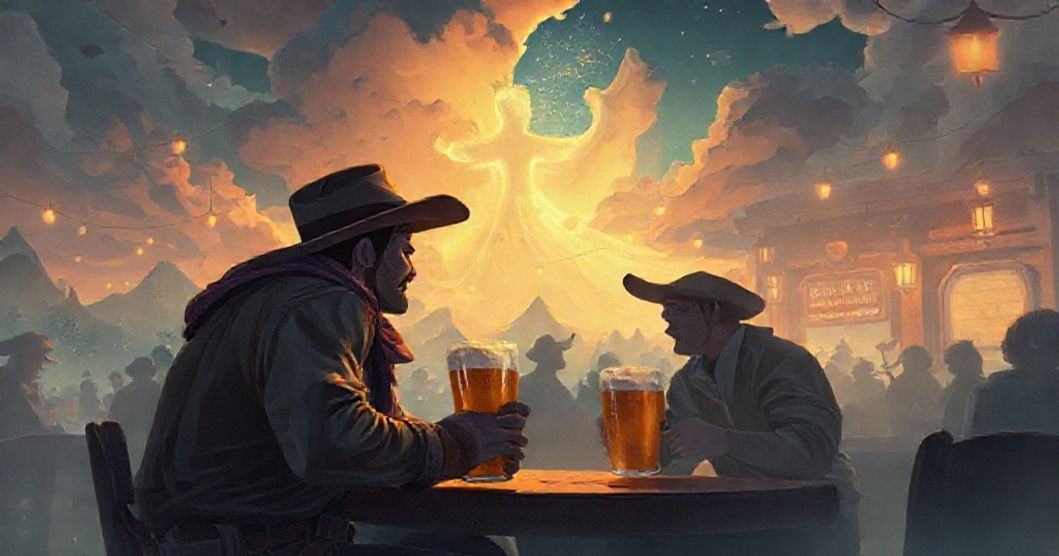
During the early morning hours, I found myself transported to a realm that defied all expectations of what 'heaven' might be—a place that felt simultaneously familiar and fantastically surreal. As I stepped through the threshold, I recognized the space immediately: it was the cozy pub where I spent countless evenings as a teenager and young adult, the one with the creaky wooden floors and dim lighting that always smelled of hops and roasted nuts. Instead of celestial clouds or golden gates, the afterlife in my dream manifested as this beloved establishment, its walls lined with the same faded posters and the hum of conversation echoing through the air.
Seated on a tall, weathered stool at the bar was my former workplace manager, a man whose stern demeanor during our time together had long since faded into nostalgic memory. He held a pint glass in one hand, the amber liquid sloshing gently as he raised it toward me in a toast. What struck me most was his attire: a full cowboy costume, complete with a wide-brimmed hat adorned with tiny silver spurs and a fringed leather vest that seemed to shimmer under the pub’s warm lights. His expression, usually serious in waking life, now wore a playful grin as he declared, 'The milky bars are on me,' a phrase that brought a flood of childhood memories and workplace camaraderie rushing back.
Want a More Personalized Interpretation?
Get your own AI-powered dream analysis tailored specifically to your dream
🔮Try Dream Analysis FreeThe absurdity of the scene—the incongruity of a formal workplace authority figure dressed as a cowboy in a pub-turned-heaven—filled me with laughter that echoed through the dreamscape. Later, I recalled with amusement how this same manager had recently posted a photograph on Facebook dressed as a penguin, complete with a tiny top hat and bow tie, further cementing the dream’s whimsical tone. The dream’s humor, I realized, lay in its ability to transform a potentially awkward past professional relationship into a lighthearted, almost magical encounter.
Part 2: Clinical Analysis
Symbolic Landscape: The Dream’s Visual Metaphors
The pub as 'heaven' represents a profound reimagining of comfort and belonging as spiritual fulfillment—a Jungian 'archetype of the Self' where childhood and adult identity converge. This liminal space, neither purely childhood nor adulthood, symbolizes the unconscious mind’s yearning for integration. The pub’s physical details—the creaky floors, familiar smells, and posters—anchor the dream in concrete sensory memory, while the 'heavenly' designation elevates these mundane experiences to sacred status.
The cowboy costume functions as a powerful symbolic juxtaposition: it merges the manager’s traditional authority (cowboy imagery often represents leadership, masculinity, and western frontier ideals) with the playful absurdity of a costume party. This transformation suggests the unconscious mind’s desire to deflate power dynamics, rendering past workplace tensions in a format that feels safe and humorous. The 'pint of beer' reinforces themes of social connection, while 'milky bars'—a specific reference to childhood comfort food—ties the dream to innocence and nostalgia.
Psychological Undercurrents: The Manager as Archetype
From a Jungian perspective, the manager embodies the 'shadow' aspect of your professional identity—a figure representing unintegrated aspects of your work self. The dream’s humor arises from the shadow’s transformation into a benevolent, almost playful character, suggesting the unconscious mind’s attempt to reconcile past professional conflicts. This aligns with Freud’s concept of the 'dream work' that transforms repressed emotions into symbolic imagery.
Cognitive dream theory offers another lens: the brain synthesizes neural patterns from your memory of the pub, your past interactions with the manager, and recent Facebook activity (the penguin costume post) into a cohesive narrative. The 'heaven' setting reflects your current need for emotional resolution, while the surreal elements demonstrate the brain’s tendency to create meaning from disjointed associations during sleep.
Emotional Resonance: Nostalgia and Workplace Closure
The dream’s emotional core lies in its ability to transform a potentially negative workplace memory into a positive, almost utopian scenario. The pub as 'heaven' suggests that for you, the workplace represented more than just a job—it was a space of identity formation, friendship, and self-expression. The manager’s playful toast and 'milky bars on me' line embody the unconscious’s desire for reconciliation: a rejection of past power dynamics in favor of mutual respect and lighthearted connection.
The 'penguin costume' Facebook post serves as a bridge between waking life and dream imagery, showing how recent external triggers (seeing the manager in a whimsical outfit) can catalyze symbolic transformations in dreams. This demonstrates the dream’s role as a processing mechanism, taking fragmented experiences and reweaving them into a narrative that resolves emotional tensions.
Therapeutic Insights: Finding Humor in Past Relationships
This dream offers valuable therapeutic insights into how humor can reframe negative experiences. The transformation of a potentially strained workplace relationship into a magical, playful encounter suggests your unconscious is already working to reduce anxiety around past professional interactions.
Reflective exercises could include journaling about other workplace relationships and how they might appear in dreams, using humor as a tool to defuse tension. Consider creating a 'dream timeline' of significant workplace moments, noting how they evolve symbolically in your unconscious.
For practical integration, schedule a brief reflection on what 'heaven' might look like in your current life—identifying spaces, relationships, or activities that currently feel nurturing and sacred. These could serve as real-world anchors for the emotional comfort you experienced in the dream.
FAQ Section
Q: Why would a workplace manager appear in a dream as a cowboy in a pub?
A: This likely reflects your unconscious desire to recontextualize past power dynamics, transforming authority figures into playful, non-threatening characters who offer comfort rather than criticism.
Q: What does 'heaven as a pub' symbolize?
A: It suggests your deepest sense of 'heaven' lies in comfort, nostalgia, and connection—places that nurtured your identity during formative years rather than abstract spiritual concepts.
Q: How does the 'milky bars are on me' line add to the dream’s meaning?
A: This phrase represents reconciliation: it inverts the traditional workplace dynamic (where authority figures might withhold rewards) into a gesture of generosity and care, symbolizing your need for positive resolution with past professional relationships.