
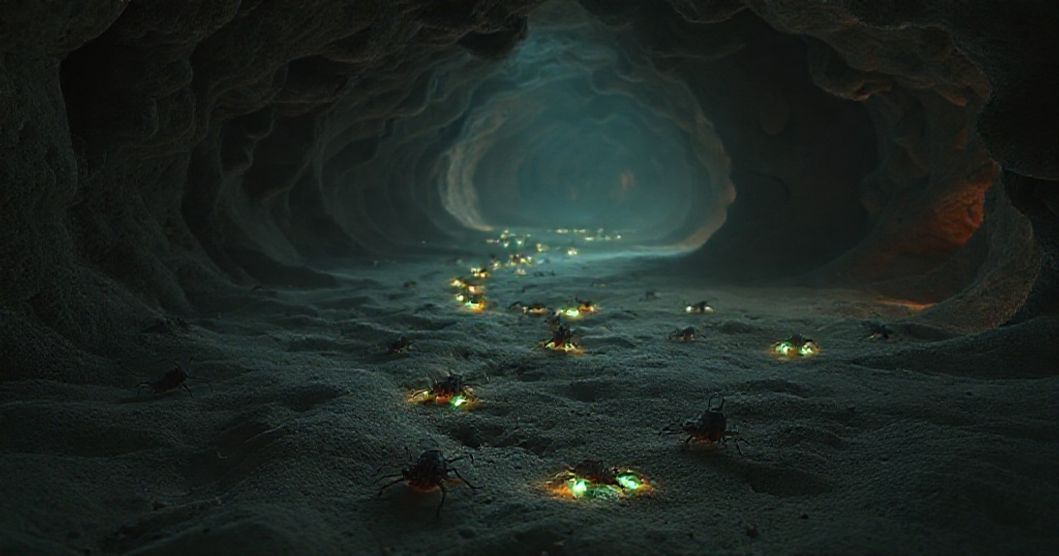
Core Symbols: The Trail, the Insect, the Enclosed Space
Roaches in dreams rarely symbolize literal infestation—more often, they represent life’s persistent, often overlooked challenges. These insects, survivors for millions of years, embody resilience in the face of chaos, a trait your subconscious might be highlighting. When you follow their footprints, you’re not chasing something unclean but engaging with a trail of clues: the footprints themselves signify a journey, a path you’ve unconsciously chosen to explore. Each tiny impression marks progress, even if the direction feels uncertain.
Chambers, meanwhile, are the heart of this dream’s symbolism. Unlike open spaces, enclosed rooms or hidden spaces in dreams represent the inner world—the parts of yourself you’ve locked away, ignored, or deemed too fragile to examine. A roach chamber might be the closet of unprocessed emotions, the office of repressed ambitions, or the corner of your mind where you’ve avoided confronting a truth. The visceral discomfort of roach imagery isn’t just about disgust; it’s your psyche’s way of signaling that something vital is hidden in plain sight.
Psychology Lens: From Jungian Shadows to REM-Driven Exploration
Want a More Personalized Interpretation?
Get your own AI-powered dream analysis tailored specifically to your dream
🔮Try Dream Analysis FreeCarl Jung’s shadow archetype offers a compelling framework here: roaches, with their association with darkness and survival, can represent the parts of yourself you’ve disowned—fears, anxieties, or even strengths you’ve deemed “unworthy” of attention. Following their footprints isn’t about fleeing; it’s about integrating these shadow elements into your conscious self. Jung believed dreams act as messengers, and the “roach chamber” could be your mind’s attempt to guide you toward self-understanding.
Freud, meanwhile, might frame roach dreams as manifestations of repressed anxieties—perhaps fears of contamination, failure, or being “overrun” by responsibilities. The footprints here become a compulsion to face these anxieties directly, rather than letting them spread like an infestation. But modern psychology adds a neuroscience layer: during REM sleep, the brain processes emotional memories, and the “chamber” might be the limbic system’s attempt to organize scattered feelings into a coherent narrative. Your subconscious isn’t just “warning” you—it’s trying to make sense of what you’ve been avoiding.
Life Triggers: When the “Roach Trail” Mirrors Your Real-Life Paths
Roach footprints in dreams often surface when you’re navigating uncharted emotional territory. If you’ve recently started a new project, changed jobs, or ended a relationship, your subconscious might be creating “footprints” to help you track progress—even if that progress feels messy or unglamorous. A “roach chamber” could symbolize a hidden obligation, like a commitment you’ve neglected, or a part of your life you’ve compartmentalized to avoid discomfort.
Social triggers also play a role: conforming to expectations that feel “dirty” or inauthentic can manifest as roach imagery. If you’re in a job or relationship where you feel “infested” by inauthenticity, your mind might use roach trails to urge you to explore the “chamber” of your true desires. The key isn’t literal cleanliness but emotional hygiene—are you avoiding a conversation, a change, or a part of yourself that’s been quietly “trailing” behind?
What To Do Next: From Dream to Daily Action
Start with short-term reflection: journal the dream’s details—where were the chambers? What emotions did the footprints stir? (Disgust? Curiosity? Fear?) Notice if these feelings mirror real-life situations where you’re following a path without clarity.
Medium-term, experiment with “active exploration.” If the roach chambers feel like a project or relationship, ask: What small step could I take to “open the chamber” without overwhelming myself? This might mean scheduling a difficult conversation or revisiting a forgotten goal. Remember, roaches are survivors—your task isn’t to destroy the “infestation” but to understand its role in your resilience.
Long-term, integrate this insight into your daily life. Use the dream as a reminder to honor both the messy and the hidden parts of yourself. Practice “shadow work” by regularly asking: What parts of me feel like “roach trails” I’m avoiding? This isn’t about self-criticism but about building a more complete, authentic self.
FAQ
Q: Why do I feel both repelled and drawn to the roach chambers? A: This duality reflects the tension between your conscious discomfort and your subconscious’s need for growth. The repulsion is your ego’s defense; the attraction is your psyche urging you to face what’s been ignored.
Q: Does this mean I need to “clean up” my life immediately? A: Not necessarily. The dream is more about emotional awareness than literal tidiness. Ask: What “chamber” in my life feels neglected, and how can I approach it with curiosity rather than urgency?
Q: Are roach dreams always negative? A: No. In some cultures, roaches symbolize transformation—they’re survivors who thrive in unexpected places. This dream might also signal resilience in the face of adversity, reminding you that even “unwanted” paths can lead to growth.