
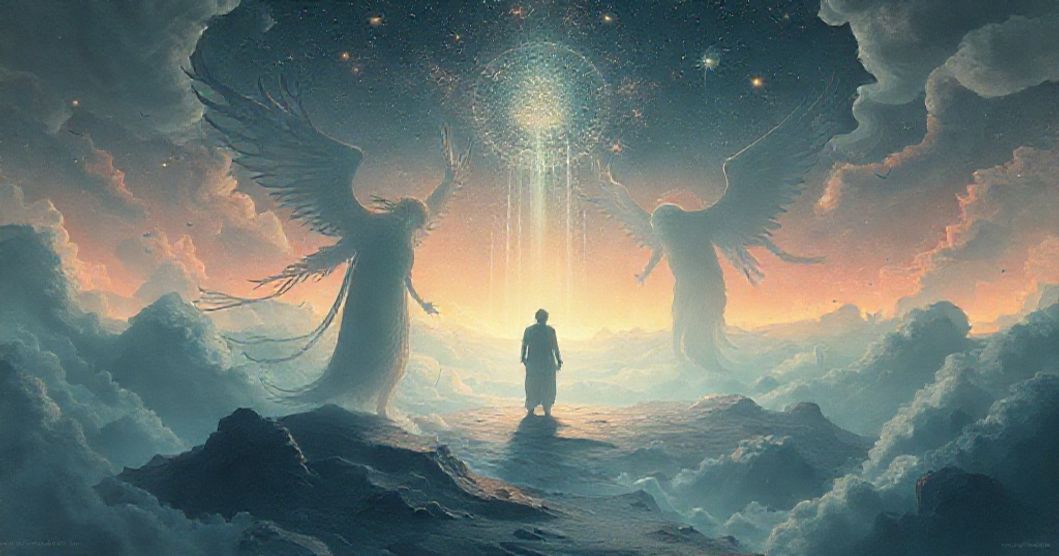
Part 1: Dream Presentation
The threshold between sleep and wakefulness often becomes a canvas for the unconscious to paint its most vivid, and sometimes unsettling, narratives. In this dream, the dreamer navigates a liminal landscape where celestial imagery collides with visceral unease, creating a psychological portrait of spiritual yearning and existential uncertainty. The dream unfolds as follows:
The dream begins with an overwhelming sense of stillness—a churning sky of clouds that feels both vast and oppressive, setting an eerie tone from the start. This atmospheric backdrop transitions into a luminous encounter: a being with six wings, its central feature an eyeball surrounded by additional embedded eyes, holding whip-like objects that shimmer like Kris blades. The dreamer greets this figure as “angel,” a term laden with religious and cultural significance, yet the entity’s form is distinctly uncanny, with its multiple eyes suggesting omniscience or perhaps a disquieting surveillance. A second luminous presence appears, prompting the dreamer to repeat the greeting, emphasizing a ritualistic acknowledgment of these celestial beings. The dreamer’s awareness of holding a phone and hearing TikTok sounds anchors the dream in a half-conscious state, blurring the boundaries between reality and fantasy. This liminal awareness heightens the dream’s surrealism, as does the subsequent appearance of a white light hand on the left side of the head—a gesture both intimate and invasive, followed by a stinging sensation and flashes of a demonic dog formed from red and white static-like dots. Finally, the dream returns to the angelic figures, now rendered more terrifying by the dreamer’s recognition of their recurrence after a two-year absence, underscored by the sleep paralysis that traps the dreamer in this surreal encounter.
Part 2: Clinical Analysis
Want a More Personalized Interpretation?
Get your own AI-powered dream analysis tailored specifically to your dream
🔮Try Dream Analysis FreeSymbolic Landscape: The Uncanny Celestial Figures
The central figures in this dream—angelic beings with multiple eyes and whip-like swords—represent a complex interplay of archetypal symbolism and personal meaning. In Jungian psychology, angels often emerge as manifestations of the anima/animus or spiritual guides, reflecting the dreamer’s unconscious search for meaning or connection. The multiple eyes, however, introduce a layer of complexity: in traditional iconography, eyes symbolize divine vision, omniscience, or the “all-seeing” nature of the unconscious. Here, the embedded eyes may represent the dreamer’s internal scrutiny of their spiritual beliefs or the pressure to see beyond surface appearances. The whip-like swords, meanwhile, could symbolize the dual nature of spiritual guidance—sometimes nurturing, sometimes challenging, cutting through illusions or protecting against threats. The second light figure, lacking the whip-like weapons, suggests a purer, perhaps more benevolent aspect of this celestial archetype, or a reminder of the dreamer’s own capacity for spiritual discernment.
The hand of white light on the head introduces a physical, almost invasive element. In dreamwork, hands often symbolize action, protection, or the transfer of energy. Here, the hand’s placement on the left side of the head (a hemisphere associated with creativity, intuition, and emotional processing in neuroscience) suggests a direct interaction with the dreamer’s inner world, possibly awakening repressed emotions or memories. The stinging sensation accompanying this touch may represent the discomfort of confronting these inner truths—a necessary pain of psychological growth. The demonic dog figure, formed from red and white dots like static, embodies the shadow archetype (Jung’s shadow—the repressed, unconscious aspects of self). The red and white color scheme evokes danger, alertness, and the uncanny valley effect (where something familiar becomes unsettling), suggesting the dreamer’s fear of being overwhelmed by repressed anxieties or unresolved trauma.
Psychological Undercurrents: Sleep Paralysis and the Unconscious
Sleep paralysis, a state where the body temporarily cannot move during transitions between sleep stages, often amplifies dream imagery, blurring the line between conscious and unconscious experience. In this dream, the dreamer’s awareness of holding a phone and hearing TikTok sounds during the encounter reflects the “hypnagogic” state—where fragments of waking life intrude into the dream, creating a sense of surreal realism. From a Freudian perspective, the angelic figures might represent the dreamer’s superego, imposing moral or spiritual demands, while the demonic dog could symbolize repressed desires or fears that the superego struggles to contain. The repetition of “angel” after a two-year absence suggests a reemergence of spiritual themes the dreamer has been processing or avoiding in waking life.
Neuroscientifically, the brain’s default mode network (active during wakefulness and dreaming) and the pontine reticular formation (involved in sleep paralysis) create a perfect storm for such vivid, emotionally charged imagery. The multiple eyes on the angelic figure may reflect the brain’s attempt to make sense of chaotic sensory input during hypnagogia, while the whip-like swords could symbolize the brain’s attempt to impose order on the dream’s irrationality. The dream’s uncanny quality—the familiarity of “angel” clashing with the alien form—aligns with Freud’s concept of the Unheimlich (the uncanny), where the familiar becomes threatening, often revealing repressed childhood fears or unresolved emotional conflicts.
Emotional and Life Context: The Weight of Uncertainty
The dreamer’s reference to seeing “biblical angels” only two or three years prior hints at a period of spiritual exploration or crisis. The recurrence of these figures in the dream suggests that whatever spiritual questions the dreamer posed then remain unresolved, resurfacing in the unconscious. The sleep paralysis element—the inability to move while the mind races—often accompanies anxiety, stress, or trauma. The dream’s “stinging” sensation and the demonic dog’s static-like form may reflect the dreamer’s struggle with feeling “pinned down” by responsibilities, relationships, or self-doubt. The TikTok sound, a modern, ephemeral presence, contrasts with the ancient, archetypal imagery of angels, symbolizing the tension between digital, transient experiences and the deeper, timeless questions of existence.
The dream’s emotional core is one of existential uncertainty: the dreamer feels both drawn to and repelled by these celestial figures, much as they might feel about their own spiritual path. The “eerie” atmosphere and the dreamer’s recognition of the surreal quality (“one of the most surreal dreams I had”) suggest a longing for clarity amid life’s ambiguities. The encounter with the angelic beings, despite their beauty, feels threatening—a paradox that mirrors the human experience of seeking meaning while fearing the unknown.
Therapeutic Insights: Navigating the Uncanny
This dream offers an opportunity for self-reflection on spiritual identity and emotional boundaries. First, the dreamer might explore the recurring “angel” figure as a symbol of their own spiritual yearning. Journaling about moments of spiritual connection in waking life could reveal patterns of longing or fear. The multiple eyes on the angel invite the dreamer to examine their capacity for discernment—are they seeing truth clearly, or projecting fears onto spiritual experiences?
For the sleep paralysis element, grounding techniques during waking moments of anxiety could reduce the dream’s intensity. The “stinging” hand and demonic dog suggest unresolved emotional energy; creative outlets like art or writing could help externalize these feelings. The whip-like swords, with their dual nature, might represent the need to set boundaries between spiritual ideals and practical reality—discernment, not dogma, is key.
Long-term integration involves recognizing the dream as a guide, not a warning. The angelic figures, despite their strangeness, offer a message of self-illumination: the “extra eyes” could symbolize developing greater self-awareness, while the hand on the head suggests a call to listen to one’s intuition. The demonic dog, when faced with courage, loses its terror, transforming into a reminder that shadow aspects are not inherently evil but opportunities for growth.
FAQ Section
Q: What does the multiple-eyed angel symbolize?
A: The extra eyes likely represent the dreamer’s unconscious search for clarity, omniscience, or spiritual insight, with the central eye symbolizing the core self observing from multiple perspectives.
Q: Why did the dream include a demonic dog with static-like features?
A: The dog embodies the shadow archetype—repressed fears or anxieties. The static dots reflect the dreamer’s difficulty processing these emotions, which may stem from recent stress or unresolved trauma.
Q: How does the dream’s sleep paralysis element affect interpretation?
A: Sleep paralysis amplifies dream emotions, making the encounter feel more urgent. It suggests the dreamer is in a vulnerable psychological state, needing to address underlying anxiety through grounding practices and self-compassion.