
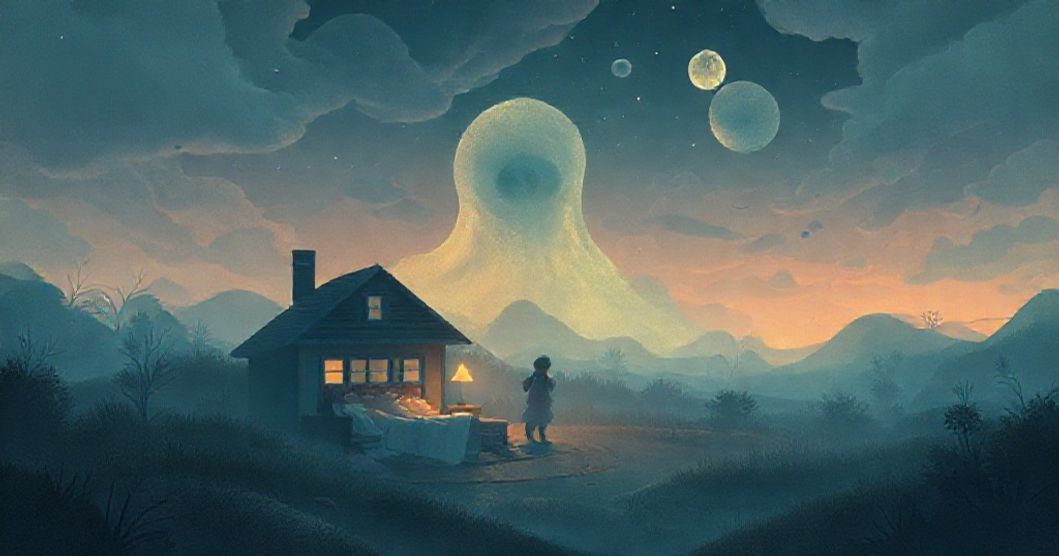
Part 1: Dream Presentation
Dreams have an uncanny way of revisiting what we thought we’d left behind, and for me, the recurring vision of my childhood home has become a persistent thread in my nighttime landscape. Unlike the current house I occupy—a space where I’ve lived for eleven years, shaping my adult identity through conscious choices and daily routines—I never dream of this present residence. Instead, my unconscious consistently returns to a house that physically no longer exists in my life, yet remains vividly alive in my dreamscape.
I lived in that childhood home for fifteen years, a span that feels both eternal and fleeting in the context of my life. It was a place where I first learned to walk, speak, and navigate the world, its walls bearing the weight of both joy and sorrow. The current house, where I’ve resided for over a decade, has been my domain during what I consider my 'most conscious years'—the time when I began to define myself, confront challenges, and build a life separate from my family. Yet despite this, I’ve never dreamt of it. Both homes carry trauma: the childhood residence witnessed fractures that left invisible scars, while the current home became a stage for new struggles I’ve yet to fully resolve. The recurring dreams of my childhood home, then, feel less like a literal return and more like a symbolic invitation to revisit the emotional landscape I’ve been avoiding in my waking life.
Part 2: Clinical Analysis
Want a More Personalized Interpretation?
Get your own AI-powered dream analysis tailored specifically to your dream
🔮Try Dream Analysis FreeThe Symbolic Weight of Home: Identity and Unresolved Experience
A house in dreams often symbolizes the self, with its rooms representing different aspects of identity, memory, and emotional processing. Your childhood home, occupying such a central place in your dream life, suggests it functions as a repository for identity formation and unresolved emotional material. The fact that you never dream of your current residence—despite longer tenure there—highlights how dreams prioritize emotional resonance over physical proximity. The childhood home, with its fifteen years of formative experiences, likely contains the raw material of your earliest identity formation, while the current home, though more recent, may represent a self you’ve actively constructed rather than passively experienced.
The dual presence of trauma in both homes introduces a layer of complexity. Your childhood home, a space of safety and security, became a site of emotional pain, while your current home—once a refuge—now holds unprocessed challenges. This dual trauma suggests a pattern of unintegrated emotional experiences that your unconscious continues to address through recurring imagery. The childhood home, in particular, may symbolize a foundational identity struggle: a place where you first learned to navigate relationships, trust, and vulnerability, and where those lessons were complicated by pain.
Psychological Perspectives: Unconscious Processing and the Unfinished Self
From a Jungian perspective, the childhood home could represent the 'collective unconscious'—the shared human experience of home as a symbol of safety, belonging, and origin. Your persistent dreams might signal that you’re in a phase of individuation, where the unconscious is urging you to reconcile your past and present selves. The fact that you’ve never dreamt of your current home aligns with Jung’s concept of the 'shadow'—the parts of yourself you’ve rejected or buried. Your current home, as a more recent construction, might represent your conscious self, while the childhood home embodies the shadowed aspects of identity you’ve yet to fully embrace.
Freudian theory, meanwhile, would likely interpret these dreams as manifestations of repressed memories and unresolved conflicts. Trauma, whether conscious or unconscious, can manifest in recurring dreams as a way of reprocessing emotional material. The childhood home, with its fifteen years of formative experiences, may contain repressed emotions that your unconscious is trying to resolve through repetition compulsion—a psychological defense mechanism where you unconsciously recreate situations to gain mastery over them. Your current home, with its more recent struggles, might represent a continuation of these patterns, now manifesting in different contexts.
Emotional Resonance: Trauma, Time, and the Unconscious Urge to Heal
The tension between the 'most conscious years' in your current home and the 'unconscious years' of the childhood home suggests a fascinating dynamic: the more you’ve tried to consciously shape your life, the more your unconscious has sought to revisit the foundational experiences that shaped you. This pattern is common in periods of life transition or self-exploration, where the unconscious works to integrate new self-concepts with old ones. The trauma in both homes creates a 'double bind' of safety and threat, where the childhood home—once a place of security—now symbolizes vulnerability, and the current home—once a refuge—may represent the ongoing struggle to feel safe in your own skin.
The fact that you’ve never dreamt of your current home despite longer residency highlights how dreams are not literal reflections of reality but emotional compasses. Your current home, as a space of conscious construction, may feel 'complete' in your waking life, while your childhood home remains a site of incompletion—a place where you haven’t yet resolved the emotional conflicts that defined your early years. This incompletion is what your unconscious is trying to address through repetition: by revisiting the childhood home, you’re given the opportunity to process the emotions and experiences that have shaped your identity but remain unintegrated.
Therapeutic Insights: Navigating the Past to Heal the Present
These recurring dreams offer valuable clues about your emotional landscape and unmet needs. To integrate this insight into your waking life, consider journaling about the sensory details of your dreams: What colors, sounds, or textures stand out? What emotions arise when you return to the house? These details can reveal specific unprocessed emotions or unmet needs. For example, if you dream of a particular room, explore what that room represents in your life and what emotions you associate with it.
Another exercise is to create a 'dream dialogue'—pretending to have a conversation with the house itself. Ask it what it wants you to know or what it represents. This can help you access deeper layers of self-awareness and begin to resolve the conflicts you’ve been carrying. By acknowledging the trauma in both homes, you can start to separate the past from the present, recognizing that the childhood home is no longer your reality but a symbol of the person you were—and the person you’re becoming.
Finally, consider the role of 'home' in your life beyond physical spaces. Your dreams may be urging you to create emotional 'homes' within yourself—a sense of safety and belonging that doesn’t depend on a specific location. This involves self-compassion and intentional work to build the internal structures that external environments once provided.
FAQ Section
Q: Why do I dream about my childhood home but not my current house?
A: Dreams often prioritize emotionally charged spaces over physical proximity. Your childhood home likely symbolizes unresolved identity or trauma, while your current home represents more recent, less emotionally charged experiences. The unconscious uses recurring imagery to process unintegrated emotions.
Q: What does it mean to have trauma in both homes?
A: It suggests a pattern of unprocessed emotional experiences that your unconscious continues to address. This may indicate a need to integrate both past and present healing, recognizing how these spaces shaped your relationship with safety and vulnerability.
Q: How can I use these dreams to understand myself better?
A: Reflect on sensory details and emotions in your dreams to identify unmet needs or conflicts. Journaling and gentle exploration of these themes can reveal valuable insights, helping you separate past from present and build emotional resilience.