
Part 1: Dream Presentation
Dreams often bridge historical eras and personal curiosity, offering portals to explore both grand narratives and intimate emotions. In this vivid dream, the ancient world of Alexander the Great intersects with the labyrinthine halls of the Library of Alexandria, creating a symbolic journey rich with historical and psychological resonance. The dreamer finds themselves at the threshold of one of history’s most iconic repositories of knowledge, where the weight of legacy and the thrill of discovery collide with moments of frustration, anger, and unexpected transformation.
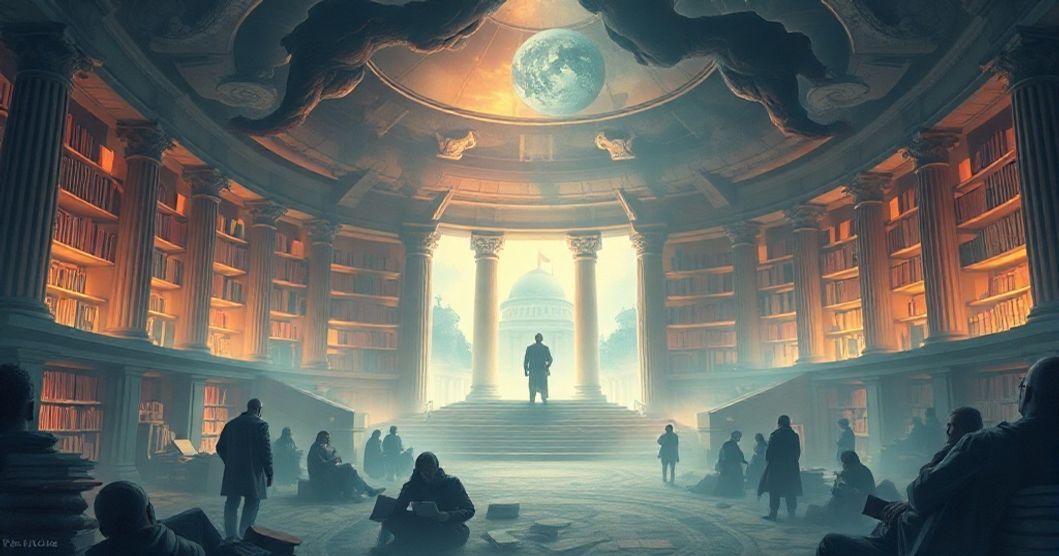
As the sun dipped below the horizon of my consciousness, I found myself standing before a marble colonnade bathed in golden light—the Library of Alexandria, its grandeur whispered through history yet vividly real in my dream. From the shadows stepped Alexander the Great himself, his armor glinting with the faint sheen of ancient bronze, his gaze both commanding and kind. 'I have long awaited someone with curiosity to match my own,' he declared, his voice carrying the weight of a thousand conquests yet the warmth of a mentor. Without hesitation, he invited me inside, and I followed, my heart pounding with a mixture of awe and disbelief. The moment we crossed the threshold, the cool air of the library greeted me, thick with the scent of aged parchment and the faint echo of countless voices who had once sought knowledge here. Shelves upon shelves of scrolls and books rose like silent sentinels, their spines embossed with forgotten scripts and symbols that seemed to pulse with ancient wisdom. Alexander turned to me, a knowing smile on his face, and then—without warning—he vanished. One moment he stood beside me, the next he was gone, leaving only the rustle of his cloak in the still air. 'Explore freely,' his voice lingered, as if carried on the wings of the wind. For what felt like hours (though in dream time, only minutes passed), I wandered through the labyrinthine halls, losing myself in the vast expanse of human knowledge. Each scroll I unrolled offered new insights—a mathematical theorem that made my mind race, a poetic fragment that stirred my soul, a map of lands I’d only read about in books. But as the dream’s internal clock ticked onward, the excitement faded into boredom. The endless rows of books, once a treasure trove, now felt like a prison of information. I craved escape, to return to the world I knew, yet when I turned toward the entrance I’d entered through, I found only blank stone walls where a door should have stood. Panic rose as I searched every corridor, calling Alexander’s name, but he didn’t answer. The library, once a place of wonder, had become a maze without exit. Frustration boiled over into anger. I seized a nearby scroll, its papyrus brittle yet still heavy with meaning, and tore it in half, the sound echoing in my dream. 'This is ridiculous!' I snapped, though no one else was there. In that moment, a figure emerged from a shadowed corner: Alexander, now clad in full battle armor, the same stern expression I’d seen on statues of him, yet his eyes held a flicker of disappointment. Between his arms, I noticed the very door I’d been searching for—now held like a trophy or a burden. 'You’ve defiled what was meant to be cherished,' he said, his voice sharp with displeasure. My heart sank. The anger drained away, replaced by overwhelming shame. 'I’m sorry,' I stammered, words failing me as I tried to apologize. But before I could finish, he lunged forward, his armor clanking, and I felt my body stretching, my limbs elongating until I became nothing but a thin scroll, my consciousness merging with the very knowledge I’d sought to escape.
Part 2: Clinical Analysis
Want a More Personalized Interpretation?
Get your own AI-powered dream analysis tailored specifically to your dream
🔮Try Dream Analysis FreeSymbolic Landscape of the Dream
The Library of Alexandria stands as the dream’s central symbol—a repository of human knowledge, a testament to civilization’s collective wisdom, and a metaphor for the mind’s capacity to both preserve and overwhelm. In dreamwork, libraries often represent the self’s internal landscape of learning, memory, and identity; here, its grandeur and eventual entrapment suggest a relationship with knowledge that is simultaneously alluring and confining. Alexander the Great, too, is a multifaceted symbol: his historical persona embodies ambition, leadership, and intellectual curiosity, yet his armor and stern demeanor also hint at the dreamer’s own defenses or unmet expectations of self-mastery. The act of Alexander vanishing upon invitation reflects the dreamer’s need for guidance or validation, while his reappearance as a figure of authority underscores the internal critic or the weight of responsibility.
The door’s disappearance and reappearance as a burden in Alexander’s arms introduces themes of access and control. Doors in dreams typically symbolize transitions, opportunities, or barriers to growth. Here, the door’s initial absence represents blocked opportunities or a feeling of being lost in one’s own intellectual pursuits. Alexander’s possession of the door suggests that the dreamer’s sense of agency—their ability to choose their path—has been usurped by a deeper, perhaps unconscious, understanding of the consequences of their actions. The destruction of the scroll, an act of anger and frustration, mirrors the dreamer’s relationship with information overload: the overwhelming nature of knowledge, or perhaps the frustration of not being able to