
Part 1: Dream Presentation
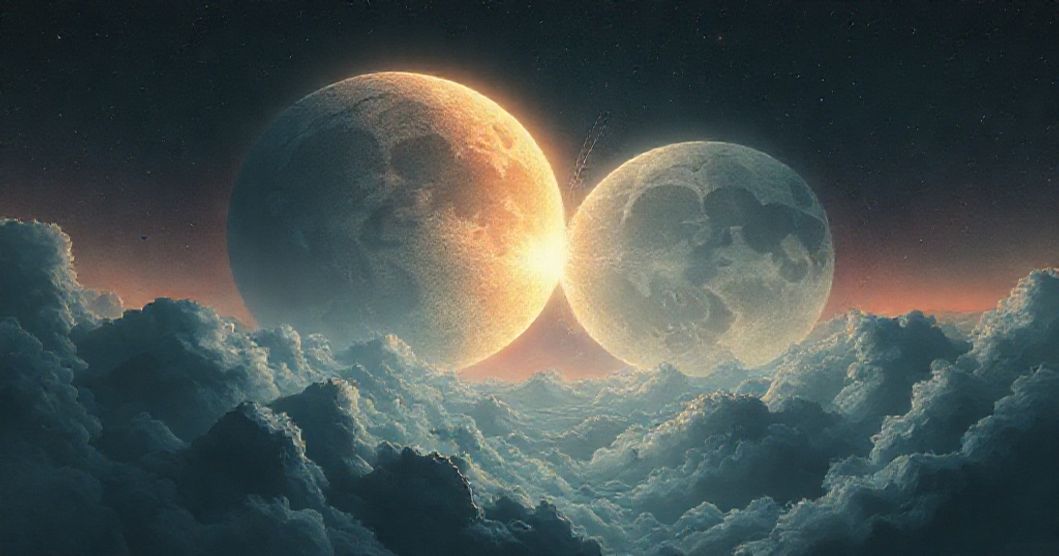
The night sky over the beach pier held a secret that defied all natural laws, revealing itself in a dream where cosmic horror and primal fear intertwined. I stood on weathered wooden planks, salt spray misting my face as I watched the heavens with a dread I couldn’t name. Two moons hung in the sky—two, not one—each casting an unnatural silver light that felt both familiar and profoundly wrong. The others around me treated the spectacle with casual indifference, murmuring about an eclipse as if this were a common celestial event, yet I alone felt the cold weight of impending doom. One moon, its surface pockmarked and irregular, began to descend toward the ocean, moving with a deliberate, menacing slowness that made my breath catch in my throat. It was not spherical like our moon; it resembled a shattered fragment, or perhaps one of Saturn’s smaller moons, its edges jagged and unpredictable. The others still called it an eclipse, but I knew better. This was not a passing phenomenon—it was a collision. Panic surged through me, and I ran, feet pounding against the pier as I fled toward the shore. The crowd parted around me, their attention fixed on the sky rather than my desperation. I reached the street and found myself in my grandmother’s old car, its familiar leather seats and faint cinnamon scent offering a momentary anchor of comfort. I fumbled with the keys, starting the engine as the massive, chipped moon loomed closer behind us. The car sputtered forward, but the celestial body pursued, its gravitational pull evident even in my dream. The road beneath us began to buckle and crack, asphalt shattering under our wheels as the moon’s approach grew more urgent. Then, in a final, surreal moment, the dream transitioned into the moon’s impact: a silent explosion of light and dust, the world shaking beneath me as I felt the full force of cosmic collapse. When I woke, I was left with the taste of ash and the certainty that something primal and overwhelming had visited my unconscious.
Part 2: Clinical Analysis
Symbolic Landscape: Celestial Elements and Their Meanings
Want a More Personalized Interpretation?
Get your own AI-powered dream analysis tailored specifically to your dream
🔮Try Dream Analysis FreeThe dual moons in this dream represent a fundamental tension between the conscious and unconscious realms. In Jungian psychology, the moon is an archetypal symbol of the feminine, intuition, and the unconscious mind—its dual presence suggests a split within the dreamer’s psyche or a confrontation with conflicting aspects of self. The beach pier, a liminal space between land and sea, embodies the threshold between conscious awareness and the unconscious, where the dreamer stands at the edge of understanding. The eclipse imagery, dismissed by others but recognized as profound by the dreamer, reflects how different people process existential threats: some remain in denial while others sense deeper danger. The non-spherical moon—described as 'chipped' or Saturn-like—represents imperfection and chaos in the face of cosmic order, symbolizing the dreamer’s perception of an unstable world or internal turmoil manifesting externally.
The old car, particularly grandmother’s car, introduces a layer of personal history and safety. Cars in dreams often symbolize control, freedom, or the journey through life. Grandmother’s vehicle might represent a source of comfort, nostalgia, or a connection to childhood security—a place of refuge amidst chaos. Its pursuit by the moon suggests that even familiar sources of safety cannot protect against overwhelming external forces, mirroring how childhood security may feel insufficient against adult anxieties. The road’s destruction and the moon’s crash into Earth embody the dreamer’s fear of uncontrollable change or collapse, where the very ground beneath one’s feet (stability) begins to fail.
Psychological Undercurrents: Unconscious Fears and Existential Anxiety
Freudian theory might interpret the moon’s descent as a manifestation of repressed fears—perhaps about mortality, insignificance, or the overwhelming nature of life’s uncertainties. The 'cosmic horror' quality suggests the dreamer’s encounter with existential dread, where the vastness of the universe and human vulnerability collide. From a contemporary psychological lens, this could reflect modern anxieties about climate change, technological disruption, or societal instability—collective fears that feel personal and inescapable.
Jung’s perspective expands this by seeing the moon as the shadow aspect of the dreamer’s psyche—parts of self that feel alien or threatening. The dual moons could represent the shadow’s dual nature: one side that is manageable (the eclipse, dismissed by others) and one that is primal and uncontrollable (the crashing moon). The dreamer’s unique recognition of the threat while others remain oblivious suggests a heightened sensitivity to danger, possibly related to perfectionism or an overactive survival instinct. The moon’s non-spherical shape might symbolize the shadow’s chaotic, irrational nature—something that defies categorization or control.
Emotional Context: Waking Life and Dream Activation
The dream’s emotional core centers on isolation and the inability to escape threat, even with familiar comforts. The dreamer’s fear is palpable, with the moon’s pursuit creating a sense of relentless urgency. This could reflect waking life stressors: perhaps career pressures, relationship conflicts, or health concerns that feel inescapable. The 'cosmic' scale of the threat might mirror the dreamer’s feeling of being small against larger forces—whether societal expectations, work demands, or global events.
The dream’s timing and emotional intensity suggest it may be responding to a period of uncertainty in the dreamer’s life—perhaps a transition, loss, or major decision. The moon’s collision with Earth can symbolize the shattering of old beliefs or structures, forcing the dreamer to confront new realities. The 'taste of ash' upon waking hints at the residue of this transformation: the dreamer carries a sense of loss or disruption even in the safety of consciousness.
Therapeutic Insights: Navigating Cosmic Anxiety and Inner Turmoil
This dream offers valuable insights into the dreamer’s relationship with fear and control. First, acknowledging the 'cosmic horror' as a metaphor for internal chaos can help normalize the feeling of being overwhelmed. The dreamer might benefit from journaling about specific stressors to identify which waking concerns mirror the moon’s approach—whether work pressure, relationship issues, or existential questions.
Reflective exercises could include creating a 'moon journal' to track recurring celestial symbols, noting how they relate to daily emotional states. This helps the dreamer externalize the unconscious conflict, turning abstract fear into concrete observations. The dual moons suggest the need to integrate conflicting aspects of self—perhaps balancing intuition (moon) with rationality (eclipse), or acknowledging both the comfort and danger in familiar structures.
Therapeutic integration involves recognizing that cosmic horror dreams often arise during periods of growth. The moon’s crash, while terrifying, can be seen as a necessary destruction of old patterns to make way for new understanding. The dreamer might benefit from mindfulness practices to ground themselves in the present moment, reducing the feeling of being swept away by external forces. Finally, exploring the personal meaning of 'grandmother’s car'—what specific feelings or memories does it evoke?—can reveal hidden resources of strength or comfort to draw upon during times of uncertainty.
FAQ Section: Understanding the Dream’s Unique Elements
Q: Why did the dreamer feel alone despite others being present?
A: The others’ dismissal of the moon as an eclipse reflects collective denial of existential threats, while the dreamer’s unique perception highlights heightened sensitivity or intuition. This isolation mirrors how the unconscious often processes fears that remain unacknowledged by conscious social groups.
Q: What does the non-spherical moon symbolize?
A: Its irregular shape represents imperfection, chaos, or a distorted sense of reality—suggesting the dreamer views the world as unpredictable or one’s self as flawed, despite societal attempts at normalcy.
Q: How does the moon’s collision relate to waking life challenges?
A: The crash symbolizes inevitable change or loss of control, urging the dreamer to adapt rather than resist. It may signal the need to let go of outdated structures that no longer serve, even when terrifying.