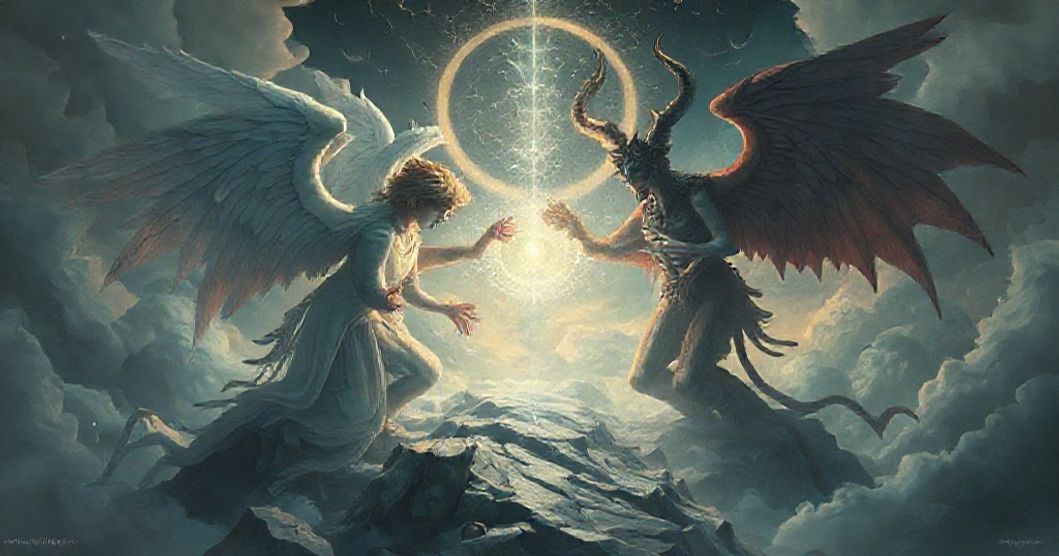
Part 1: Dream Presentation\n\nDreams often serve as portals to the unconscious mind, revealing hidden narratives that our waking selves rarely acknowledge. In this particular dream, the boundaries between reality and the subconscious blur dramatically, weaving together themes of identity, fear, and spiritual transformation.\n\nI found myself in an unfamiliar house, its layout shifting like a maze as I wandered through dimly lit corridors. This wasn’t my home, yet every corner felt strangely intimate, as if I’d visited it before in some forgotten memory. In one room, I encountered a young man who claimed to be my brother—though his features were unfamiliar, his presence felt oddly comforting yet transient, like a borrowed identity. I followed him to a room where a whiteboard hung blank on the wall, its surface waiting for meaning. When I returned moments later, the board blazed with words: “We are the fallen angels.” The statement chilled me, not with fear alone, but with a strange recognition, as if these words had been whispered in my subconscious for years.\n\nI ventured into the living room, seeking answers, and returned to find the whiteboard transformed. Where the angels’ words had been, now scrawled another equation—a series of symbols and numbers that seemed to represent the sun, its cycles and mysteries. I couldn’t decipher it, but its presence felt urgent, like a warning or a code. Then, a silver bead appeared, floating in midair with an otherworldly glow. It moved toward me, and I watched in horror as it entered my eye, searing pain erupting behind my vision. I felt myself slipping away, consciousness dissolving into darkness, only to reappear in a different apartment.\n\nHere, I found myself among people who claimed to be the “fallen angels” from my dream. They moved with mechanical precision, their eyes fixed on computers humming with blue light. “We’re opening Heavens Gate through the matrix,” one of them explained, though their voices lacked conviction, as if they spoke a language I couldn’t fully understand. The room felt charged with tension, and I realized their mission was not benevolent. Then, the group’s leader—once a calm, ordinary man—began to transform. His features twisted, skin darkening, eyes glowing red. He became a demon, horns sprouting from his forehead, and I felt the ground beneath me shake with terror. I ran, fleeing through corridors I didn’t recognize, the demon’s roar echoing behind me. The dream shattered as I woke, heart pounding, still haunted by the whiteboard’s ominous message.\n\nThe most striking element remained the words: “We are the fallen angels.” They seemed to pulse with a deeper meaning, a puzzle waiting to be solved.\n\n## Part 2: Clinical Analysis\n\n### Symbolic Landscape: The Dreamer’s Inner World Unpacked\n\nThe fallen angels in this dream represent a complex archetype with multiple layers of meaning. In mythology and psychology, fallen angels often symbolize those who have strayed from their spiritual path or repressed aspects of the self. The phrase “We are the fallen angels” suggests a collective identity crisis—the dreamer may be grappling with feelings of displacement or a sense of not belonging to their own life. The whiteboard serves as a threshold between the conscious and unconscious mind, where the dream’s central message is inscribed, demanding attention.\n\nThe silver bead, entering the eye, is a powerful symbol of perception and insight. In dream imagery, eyes often represent awareness, and the intrusion of an external object into this organ suggests the dreamer is confronting a painful truth they cannot avoid. The “sun equation” on the whiteboard adds another layer: the sun symbolizes vitality, purpose, and illumination, while an unsolvable equation may reflect the dreamer’s struggle with finding meaning or clarity in their life.\n\nThe transformation of the leader into a demon is a classic Jungian shadow archetype—the repressed, darker aspects of the self emerging into consciousness. The leader’s shift from human to demon mirrors the dreamer’s fear of losing control over their identity or purpose, suggesting a subconscious fear of confronting one’s own darker impulses or vulnerabilities.\n\n### Psychological Undercurrents: Unconscious Processing and Emotional Triggers\n\nFrom a Jungian perspective, this dream reflects the integration of the shadow self. The “fallen angels” could represent the dreamer’s shadow—parts of themselves they’ve rejected or disowned. The house, as a recurring dream symbol, often represents the self, and its unfamiliarity suggests the dreamer is exploring new aspects of identity or confronting unknown parts of their psyche.\n\nFreudian theory might interpret the dream as a manifestation of repressed desires or fears. The “brother” who isn’t “real” could symbolize a desire for connection or a fear of inauthentic relationships—someone who feels like a false self in the dreamer’s life. The “heavens gate” through computers reflects technological anxiety or the dreamer’s struggle with digital identity: the internet as a portal to both connection and disconnection.\n\nNeuroscientifically, this dream may represent the brain’s attempt to process complex emotions or unresolved conflicts during REM sleep. The rapid shifts between reality and nightmare, the transformation of the leader, and the sense of urgency all align with how the brain integrates emotional experiences into narrative form, often using symbolic imagery to avoid direct confrontation with painful truths.\n\n### Emotional Landscape: Fear, Identity, and Spiritual Questing\n\nThe dreamer’s emotional journey—from calm curiosity to terror—mirrors a common pattern in dreams: initial exploration gives way to confrontation with darker aspects of the psyche. The “fallen angels” as a group suggest a collective identity, possibly representing the dreamer’s desire for community or belonging. The computers and “heavens gate” hint at modern anxieties: the dreamer may feel disconnected from traditional spiritual paths and is seeking meaning in technology or digital spaces—a search that leads to confusion rather than clarity.\n\nThe “sun equation” could symbolize the dreamer’s search for purpose: the sun represents life force, and an unsolvable equation suggests that purpose is not linear or easily defined. The inability to read the equation reflects the dreamer’s struggle with finding meaning in a world that often feels chaotic or unknowable.\n\nThe “heavens gate” metaphor is particularly telling: in modern times, this phrase evokes both spiritual yearning and the fear of cult-like manipulation. The dreamer’s attempt to flee the demon suggests a rejection of this false path, indicating a subconscious need to preserve integrity in the face of spiritual or ideological pressure.\n\n### Therapeutic Insights: Self-Reflection and Integration\n\nThis dream invites the dreamer to explore several key questions: “What parts of myself have I rejected or disowned?” and “What truths am I avoiding?” Journaling exercises could help unpack these themes: writing about the “fallen angels” as a group, the house as a metaphor for the self, and the transformation of the leader.\n\nPractical steps include mindfulness practices to increase awareness of the shadow self. Activities like “shadow work” (writing down negative traits and exploring their origins) can help integrate these aspects rather than fleeing them. The dreamer might benefit from examining relationships with technology, particularly if they feel overwhelmed by digital information or identity fragmentation.\n\nLong-term integration involves reconnecting with core values and authentic relationships. The “brother” who isn’t real could represent a false sense of connection; nurturing genuine relationships and exploring authentic identity might reduce the fear of inauthenticity.\n\n### FAQ: Navigating Dream Symbols\n\nQ: What does it mean when fallen angels appear in dreams?\nA: Fallen angels often symbolize the shadow self—parts of yourself you’ve rejected, or spiritual questions about purpose and identity. They can represent collective unconscious themes or personal struggles with authenticity.\n\nQ: Why did the dreamer feel fear when the leader transformed?\nA: The transformation reflects the fear of confronting repressed emotions or darker aspects of self. The leader’s demon form is the shadow emerging, triggering the dreamer’s instinct to flee rather than integrate these parts.\n\nQ: What is the significance of the “heavens gate” through computers?\nA: This symbolizes modern spiritual search—using technology as a portal to meaning. It may reflect anxiety about digital identity, or a desire for connection that feels inauthentic, leading to the fear of losing control over one’s sense of self.\n\nKeywords: fallen angels, whiteboard, silver bead, sun equation, demons, transformation, computers, heavens gate, shadow self, identity crisis\nEntities: unfamiliar house, floating silver bead, transformed leader, fallen angels group, whiteboard message\n